Ⅰ. Current Economic Conditions
| □ |
Economic activity remains sluggish despite the recovery in the manufacturing industry due to the contraction in the service industry from Covid-19. |
- In Q2, both the manufacturing and service industries stagnated on the sharp contraction in foreign and domestic demand due to the global spread of Covid-19. However, the demand in goods recovered in Q3, mitigating the sluggishness in manufacturing.
| □ |
On the demand side, those closely tied to manufacturing, such as goods exports, equipment investment, and durable goods consumption, showed improvements while the sluggishness in service exports and service consumption continued. |
- Exports exhibited a goods-led rebound owing to the favorable trend in semiconductors and as the contraction in automobile eased, but services remained contracted due to the spread of Covid-19.
- Private consumption continued to show huge losses despite soaring durable goods sales as service sales remained limited. Equipment investment shot up on the recovery in exports while construction investment was subdued.
| □ |
Domestic demand contracted led by the service industry, driving down the labor market and inflation. |
| □ |
The global economy exhibited a partial rebound from the slowdown in Q3, but downside risks are mounting fast on the recent resurgence of Covid-19. |
| □ |
Considering the asymmetric impact that the Covid-19 crisis is having on different economic agents, social safety nets should be particularly focused on vulnerable groups hit hard by the pandemic. |
| □ |
Given the current economic landscape at home and abroad, the Korean economy is projected to recover at a slow and limited pace. |
- As long as concerns persist over Covid-19, the service industry, particularly high-contact businesses, will likely continue to stagnate. Economic activity may fluctuate depending on how the spread of the virus unfolds.
- Controlling the spread is a prerequisite for an economic recovery, and as such, quarantine measures need to be taken seriously in the process of policy implementation.
| □ |
Economic activity is expected to remain subdued due to the Covid-19 crisis, implying that expansionary macroeconomic policies should be maintained for the time being to provide support. |
- The expansionary stance thus far in fiscal, monetary and financial policies in response to the pandemic has contributed to mitigating the downturn in economic activity.
- Macroeconomic policies need to remain accommodative until the economy shows signs of a steady recovery.
| □ |
A series of policies to overcome the pandemic has led to rapidly mounting debts in the private and government sectors, necessitating preemptive measures to secure financial soundness from a mid-term perspective. |
- Although liquidity assistance has been extensively deployed through speedy responses to the Covid-19 crisis, continued monitoring of financial soundness is vital to avoid a large-scale loan default in the future.
- Given the long-term demographic changes and decline in potential growth, efforts are needed to control―as much as possible―the pace at which government debt is growing and to secure fiscal sustainability.
| □ |
From a mid- to long-term perspective, an economic and social system that can seamlessly adapt to changing foreign and domestic environments should be established. |
- For a successful transition to a digital and low-carbon economy, the government’s efforts should be concentrated not only on building infrastructure but also improving related systems.
- Support is needed for market entries and exits to guide corporate restructuring in accordance with changing market demands, and social safety nets need to be strengthened.
Ⅱ. Domestic Economic Outlook for 2021
1. Expected External Conditions
| □ |
After declining steeply in 2020, the global economy is assumed to recover at a modest pace in 2021. |
- he IMF projected that the global economy would exhibit a negative growth of -4.4% in 2020 and then climb 5.2% in 2021 despite the base effect.
| □ |
Crude oil prices (Dubai) are assumed to mark around $45 per barrel in 2021. |
| □ |
The Korean won, in terms of the real effective exchange rate, is assumed to appreciate by about 2% in 2021. |
2. Outlook for Domestic Economic Activity
| □ |
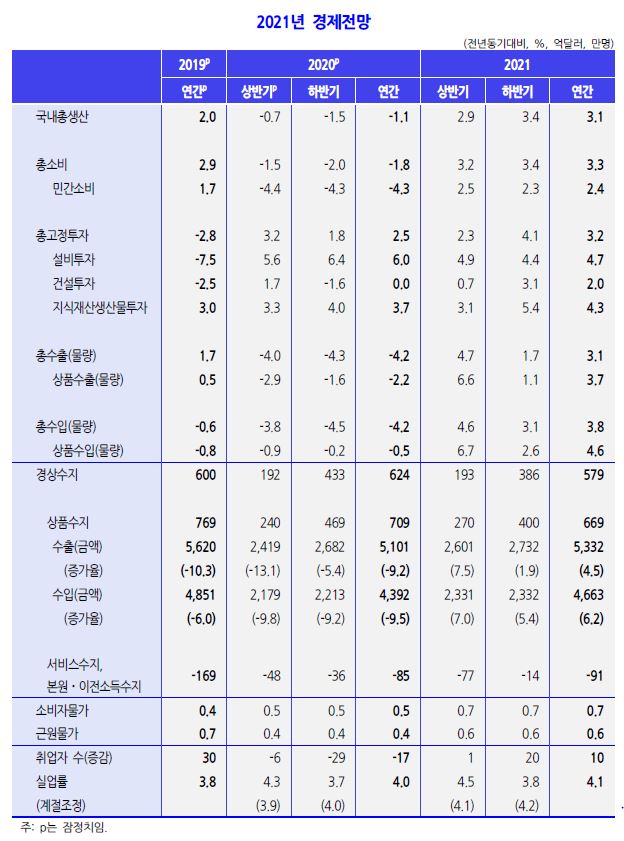
The Korean economy is projected to grow -1.1% in 2020 and 3.1% in 2021 as goods exports improve but the recovery in domestic demand remains limited. |
- Considering that the annual average growth rate for 2020-2021 is a mere 1.0%, Korea’s economic growth in 2021 will likely remain below the normal trajectory.
- Influenced by the continued contraction in consumer activities due to concerns over the spread of the coronavirus, private consumption is expected to record a 2.4% growth in 2021 despite the base effect from the steep downturn (-4.3%) in 2020.
- Equipment investment will likely maintain the favorable trend seen in 2020 (6.0%), posting 4.7% in 2021 and reflecting the recovery in the manufacturing industry owed to improving goods exports.
- Construction investment is expected to grow 2.0% in 2021, up from 2020 (0.0%), as the civil engineering sector maintains favorable conditions and the sluggishness in housing construction eases.
- Exports are expected to improve by 3.1% led by goods exports as the global economy recovers and the slowdown gradually moderates.
| □ |
Amid deteriorating terms of trade, the current account is projected to run a $57.9 billion surplus in 2021, down from 2020 ($62.4 billion), as imports grow on the increases in durable goods consumption and the demand for equipment investment. |
| □ |
Headline inflation is projected to be 0.7% in 2021, continuing to stay low from 2020 (0.5%) as oil prices rise but expected inflation and demand pressure stay low. |
| □ |
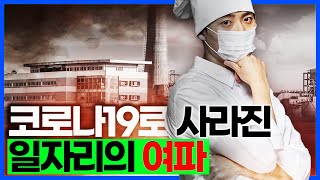
The total number of employed persons is projected to increase by only 100,000 in 2021 following the loss of 170,000 in 2020 as the service industry continues to stagnate on the spread of Covid-19. |
3. Risks
| □ |
If not properly controlled, the recent global resurgence of Covid-19 could drag on much longer than most expect, which could weigh heavily on Korea’s economic growth prospects. |
| □ |
On the other hand, if a cure and/or vaccine for COVID-19 is developed early and supplied widely, it is highly likely that 2021 will see a faster-than-expected recovery in economic activity as the contraction in the service industry eases. |
| □ |
Additionally, a further escalation of the US-China conflict may disrupt global economic sentiment and thus hinder the growth of the Korean economy. |

Ⅲ. Policy Recommendations
1. Fiscal Policy
| □ |
The budget bill for 2021 appears to be expansionary to deal with the economic sluggishness caused by Covid-19, and to secure new growth engines for the future. |
- Budgets on pending agenda need to be seamlessly executed as planned in tandem with thorough monitoring of the progress in key projects and followed by strict ex-post performance evaluations.
| □ |
Meanwhile, given the long-term demographic changes and the decline in potential growth, efforts are needed to control the growth pace of government debt and to secure fiscal sustainability in the mid- to long-term. |
- Government debt is increasing rapidly due to the recent surge in fiscal expenditure spent on tackling the Covid-19 crisis and the slowdown in tax revenue growth.
- An accumulative increase in government debt could have a negative impact on fiscal soundness and the national credit rating. In this regard, detailed preemptive measures are needed to vigorously control the growth of government debt in the future when recovery is back on track.
- Consistent efforts should be made for expenditure restructuring to control the pace of expenditure growth as much as possible, while gradually initiating discussions on long-term measures to secure fiscal revenue so that expenditure is spent where necessary and without delay.
2. Monetary Policy
| □ |
Monetary policies need to remain accommodative to deal with the economic slowdown and low inflation. Additionally, it may be necessary to consider additional measures in case of any sudden unexpected fallout. |
- Economic activity continues to stagnate on the Covid-19 spread while inflation hovers far below the target (2%).
- The current accommodative stance should be sustained until the economy enters a recovery phase, and it is also necessary to act fast to cut the base rate and mobilize non-traditional monetary measures if economic activity contracts sharply due to the accelerating global spread of Covid-19.
3. Financial Policy
| □ |
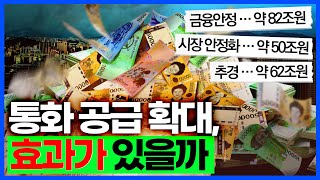
Considering the possibility that the recent rapid expansion in liquidity―excessively large compared to the size of the real economy―could be a potential financial risk, the pace of liquidity expansion should be decelerated in the mid-term while its condition is closely monitored in the short-term. |
- Due to the stimulus policy measures to overcome the Covid-19 crisis, liquidity provision has rapidly increased resulting in a sharp rise in the private credit to GDP ratio, and stock prices have rebounded significantly despite deteriorating corporate profitability.
- If liquidity expands excessively compared to the real economy, this could lead to financial instability. As such, it is necessary to pay close attention to the monitoring and management of how the situation develops.
| □ |
Given that the Covid-19 fallout could weaken financial soundness in the future, financial supervision should be strengthened and additional capacity should be secured to absorb losses. |
- Despite concerns over financial soundness since Covid-19, loans have expanded and banks’ liquidity and capital ratios have slipped.
- Moreover, bank soundness may deteriorate in the future due to certain eased financial regulations including a loan maturity extension, interest payment deferral, and relaxation of lending standards.
- Therefore, it is necessary to induce banks to secure sufficient capital and allowance for bad debt while strengthening financial supervision of their overall soundness.

 통화 공급 증가의 파급효과와 코로나19 경제위기
 프로필
프로필
 코로나19로 인한 고용충격의 양상과 정책적 시사점
