
KDI 경제동향 KDI 경제동향 2010. 10 2010.10.06

2010.10.06
- 영문요약
-
* All growth figures are on a year-on-year basis unless otherwise noted.
The Korean economy which showed a rapid recovery since the global financial crisis now shows a gradually moderating growth pace.
□ The mining, manufacturing and service industries in August showed a moderate slowdown in production due to some seasonal factors.
- The mining & manufacturing production growth rate registered -1.0% on a month-on-month basis, recording a negative growth for the first time in ten months. [Table 2-1]
- The downturn appears to be affected by some seasonal factors, while the recovery pace of real economy seems to be maintained.
- By sector, automobile recorded a -13.3% growth rate, a sharp drop from the previous month.
- Meanwhile, the monthly year-on-year growth rate registered 17.1%, continuing the upward trend.
- The service industry production index fell slightly, but appears to maintain the overall upward trend. [Table 2-4]
- The wholesale & retail trade and education services recorded a high growth rate of 6.3% and 11.5%, respectively, whereas real estate and renting and leasing services decreased sharply.
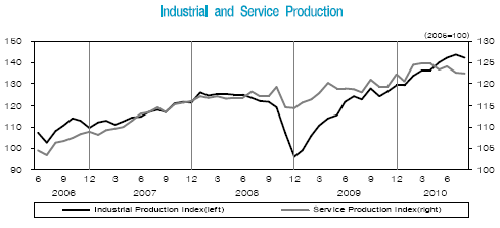
- The average capacity utilization rate in manufacturing recorded 81.8%, down by 3%p from the previous month.
- The production-inventory cycle signaled a moderate slowdown in economic expansion with the decrease in production growth. [Table 2-3]
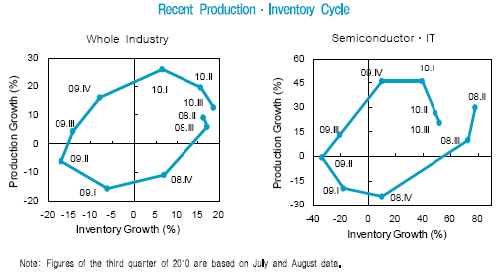
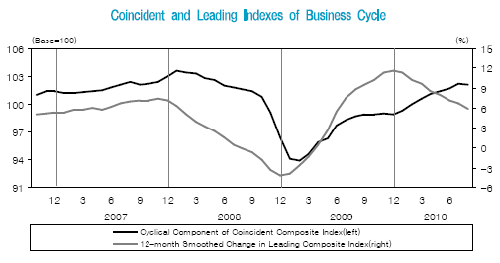
- The coincident index remained at the level similar to the previous month, while the year-on-year growth rate of the leading index continued to fall.
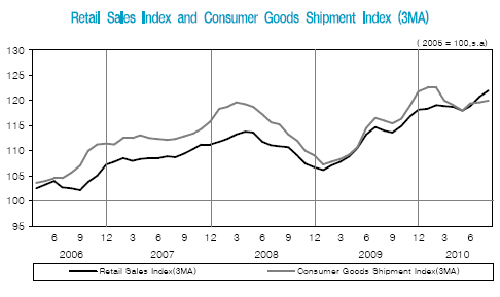
□ During August, consumption-related economic indicators suggest a continuous rise in private consumption.
- The retail sales index recorded a growth rate of 9.3%, up from the previous month (8.7%), while the month-on-month growth rate recorded a growth rate of -0.7% [Table 3-2]
- By sector, the consumption of durable goods registered a high growth rate of 25.8% due to the base effect, while the consumption of quasi-durable and non-durable goods recorded 5.3% and 3.1%, respectively, slightly down from the previous month.
- On a seasonally adjusted month-on-month growth basis, the consumption of durable goods recorded an increase (3.1%), whereas that of quasi-durable (-2.2%) and non-durable goods (-2.3%) consumption recorded a decrease.
- The consumer goods shipment index for domestic demand rose significantly to 7.2% due to the base effect, compared to the previous month (2.4%), and the seasonally adjusted month-on-month growth rate recorded -0.8%. [Table 3-3]
- The consumer sentiment index in September registered 109, similar to the previous month (110), remaining above the benchmark level of 100. [Table 3-4]
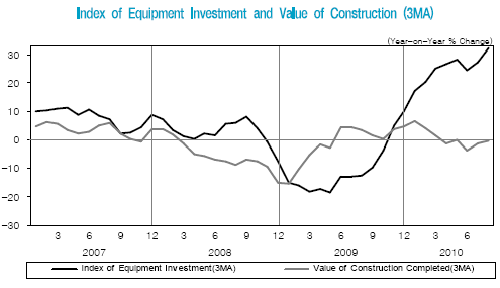
□ In August, equipment investment-related indicators maintained the upward trend, while construction-related indicators showed moderate improvement led by the coincident index.
- The equipment investment index recorded a 39.8% growth rate (33.7% in the previous month), due to the continuing increase in investment in machinery. [Table 4-1]
- Imports of capital goods for domestic demand recorded a growth of 50.5%, carrying on the high upward trend of the previous month (35.0%).
- The domestic machinery orders received recorded a growth rate of 33.6% due to the turnaround in the public sector (-90.2 → 42.5%) and the continuing upward trend in the private sector (-19.1% in the previous month).
- Construction-related indicators show that the value of construction completed continues to rise whereas the construction orders received as a leading indicator turned to fall. [Table 5-2]
- The value of construction completed increased by 3.0%, due to the increased performance of civil works, up from the previous month (2.2%).
- The construction orders received fell by 22.2%, compared with the previous month (22.2%%), influenced by the decreased order in both the public and private sectors.
□ The trade account in September recorded a surplus of $5.01 billion, up from $1.72 billion in the previous month, due to the sharp rise in exports led by the increase in ship exports.
- Exports recorded $39.75 billion, a high rise from the previous month ($36.97 billion). [Table 6-1]
- Ship and automobile exports registered $4.74 billion and $2.79 billion, respectively, up from $2.83 billion and $2.44 billion, respectively, in the previous month, leading the upward trend of overall exports.
- Exports of semiconductor recorded $4.84 billion, a slight increase from the previous month, continuing their upward trend despite the recent downward pace of unit price.
-
Imports recorded $34.74 billion, slightly down from the previous month ($35.25billion). [Table 6-3]
Balance of Payments in August 2010- Current account recorded a surplus of $2.07 billion, a large drop from the previous month ($5.82 billion), influenced by the decreased surplus of goods account caused by the fall in exports. [Table 6-6]
- Goods account registered a surplus of $3.69 billion, a sharp drop from the previous month ($7.16 billion), due to the decreased exports of major items influenced by the summer vacation season.
- Service account recorded -$1.78 billion, higher deficit than the previous month (-$1.5 billion), due to aggravating performance of travel and business services accounts.
- Capital account recorded a net outflow of $200 million, a turnaround from the net inflow of the previous month ($200 million) due to the reduced inflow of portfolio investment account though the outflow of miscellaneous investment account decreased. [Table 6-7]
- Direct investment account recorded a net outflow of $1.25 billion, down from the previous year ($1.9 billion) due to the reduced foreign direct investment.
- The portfolio investment account recorded a net inflow of $1.41 billion, down from the previous month's $8.68 billion, as the investment made by foreign investors in domestic bonds decreased and foreign equity investment turned into a net outflow.
- Miscellaneous investment account recorded a net outflow of $520 million, down from $6.5 billion in the previous month, due to the decrease in the repayment of short-term borrowings and trade credit.
□ The labor market-related indicators in August showed continuing recovery with the rise in employment rate and the fall in unemployment rate.
- The number of employed recorded a rise of 473,000 (2.0%), while the labor force participation rate and the employment rate recorded 62.1% and 59.8%, respectively. [Table 7-1]
- However, the employment rate still remains lower than the pre-crisis level of 59.8% on average in 2007.
- The employment rate of all age groups, excluding the youth aged between 15 and 29 and the elderly aged 60 or older, showed rise with a notably improved rate of those in the 30s age group (+1.2%p).
- The labor force participation rate maintained the level of the previous year (61.1%) while the unemployment rate fell by 0.4%p to 3.3%.
- The number of employed in the manufacturing sector rose by 297,000, continuing the upward trend for 8 consecutive months, helped by the strong performance of exports. [Table 7-2]
- The upward trend has been continued in the construction sector (109,000), while in the service industry, healthcare & social welfare services and facility management & business support services recorded a sharp rise of 189,000 and 110,000, respectively.
- Since the Hope Work project, a public job program launched on June 1st 2009, was terminated at the end of June, the number of employed in the public administration sector has decreased sharply for three consecutive months (-214,000).
□ CPI in August recorded a 2.6% growth rate, the same as the previous month
- The number of employed recorded a rise of 386,000 (1.6%) and the employment rate rose by 0.3 %p to 59.1%. [Table 7-1]
- However, the employment rate still remains lower than the pre-crisis level of 59.8% on average in 2007.
- The employment rate of all age groups, excluding the youth aged between 15 and 29 and the elderly aged 60 or older, showed rise with a notably improved rate of those in the 30s age group (+1.2%p).
- The labor force participation rate maintained the level of the previous year (61.1%) while the unemployment rate fell by 0.4%p to 3.3%.
- The number of employed in the manufacturing sector rose by 297,000, continuing the upward trend for 8 consecutive months, helped by the strong performance of exports. [Table 7-2]
- The upward trend has been continued in the construction sector (109,000), while in the service industry, healthcare & social welfare services and facility management & business support services recorded a sharp rise of 189,000 and 110,000, respectively.
- Since the Hope Work project, a public job program launched on June 1st 2009, was terminated at the end of June, the number of employed in the public administration sector has decreased sharply for three consecutive months (-214,000).
□ CPI in September recorded a 3.6% growth rate, a steep rise from the previous month, due to the price hike of agricultural, livestock and marine products.
- The growth rate of agricultural, livestock and marine product prices recorded 21.1%, a sharp rise from the previous month, while that of industrial product prices fell slightly and that of service prices rose slightly.
- Core inflation registered 1.9%, similar to the previous month (1.8%), and its month-on-month growth rate recorded 0.3%.
- The purchase price of apartments nationwide registered a 0.2% growth rate on a month-on-month basis, marginally up from the previous month (0.0%), while Cheonsei prices recorded a rise of 0.7%, up from the previous month (0.4%). [Table 8-3]
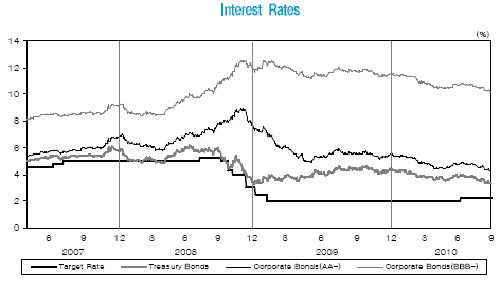
□ During September, stock prices rose while interest rates and foreign exchange rates decreased.
- Interest rates dropped influenced by the frozen base interest rate and the continued net purchase by foreign investors.
- Government bond yields recorded 3.32% as of late September, down by 23bp from the previous month.
- AA- corporate bond yields recorded 4.26% (27bp down from the previous month), while BBB- corporate bond yields recorded 10.19% (28bp down from the previous month).
- Accordingly, the term spread recorded 103bp as of late September, down by 24bp from the previous month (127bp), while the credit spread between AA- and BBB- corporate bonds recorded 593bp, similar to the previous month.
- The KRW/USD exchange rate dropped sharply to 1,142 won as of end-September, influenced by the weak performance of the dollar and the continuing surplus of current account.
- The KOSPI index rose by 130.1p to close at 1872.8p as of end-September, due to the improved investment sentiment and the continuing net purchase by foreign investors.
□ The global economy appears to maintain an overall recovery pace, led by developing countries, while the downward risks of the real economy appears to decrease.
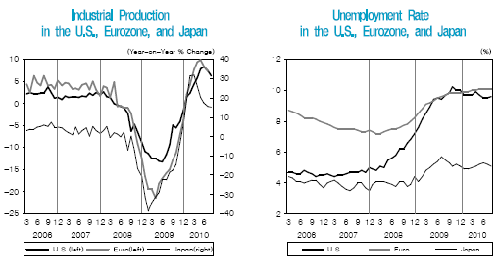
- Advanced economies continued their moderate recovery pace with the improvement in real economic indicators and sentiment index of mainly the US and Eurozone, although some countries face continuing slump in the employment market or show slight economic slowdown
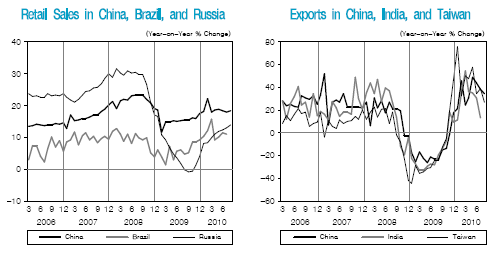
- Developing countries recorded a relatively rapid recovery in real economic indicators led by Asian emerging economies with continuing growth in exports and domestic demand.
-
The US economy maintained a gradual recovery pace with a moderate rise in major economic indicators such as production and consumption.
- The unemployment rate in August recorded 9.6%, a slight increase from the previous month, but uncertainty over the future economic conditions is still high as the housing market indicators show both positive and negative signs.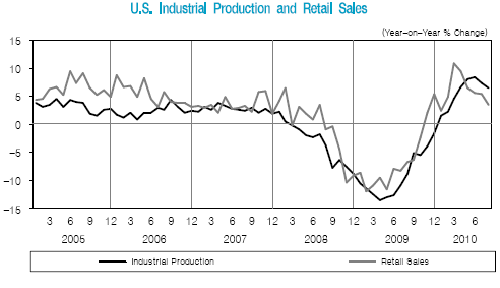
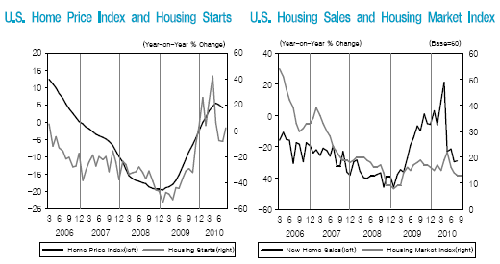
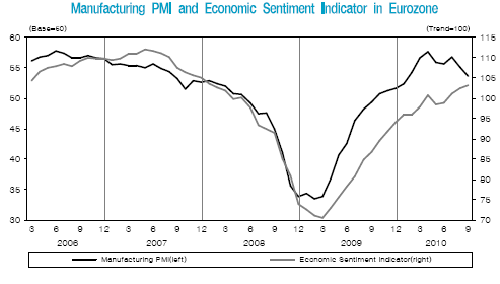
- Eurozone continues to uphold the moderate recovery pace with the rise in sentiment indexes of major economic agents, although the unemployment rate remains still high and the recovery pace of a few countries appears to be lagging.
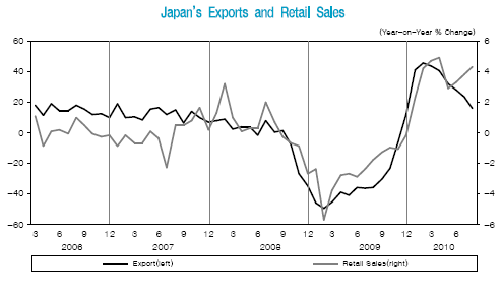
- Despite the continued rise in exports and production and the moderate recovery of some domestic demand indicators, the Japanese economy seems to recover at a relatively slower pace compared to other advanced economies.
-
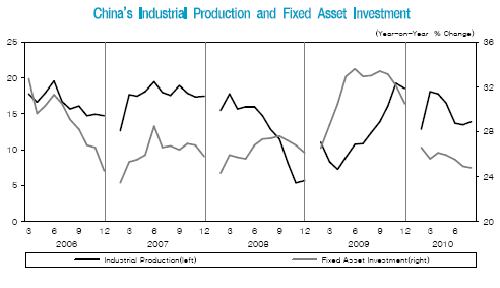
The Chinese economy continued a steady upward trend with high growth rates in production and consumption, whereas rapidly rising CPI growth rate triggers a growing concern over the possibility of increased inflation.
- The upward trend of asset prices including real estate appears to slow down, but the CPI growth rate in August rose to 3.5%.
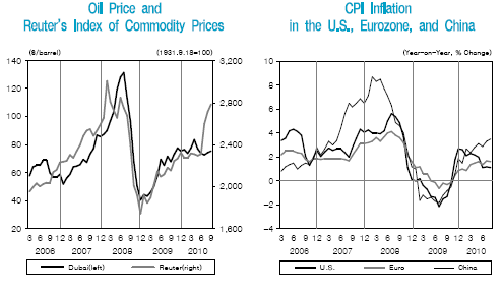
- The inflationary pressure appears to rise centering on developing countries while the international oil prices rose slightly from the previous month and the prices of some raw materials maintain the upward trend.
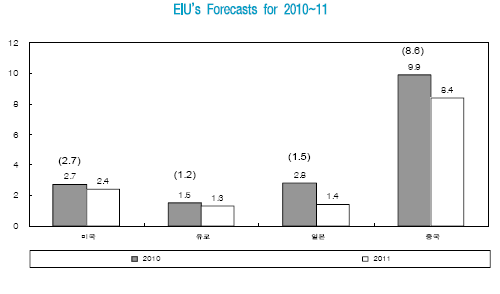
□ Although a fast global economic recovery may not be expected due to the delay in employment markets of advanced countries, some forecasting institutions have recently shown high expectations on the continuing recovery of the global economy led by the rapid recovery of Asian developing countries.
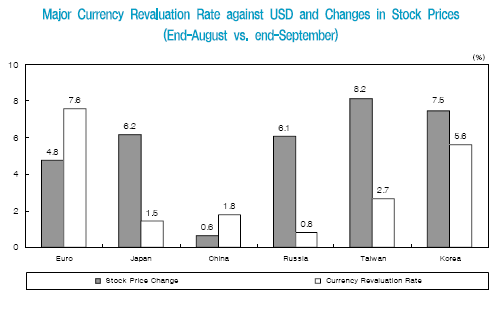
□ With the continuing moderate recovery pace of the global economy, overall conditions of global financial markets have stabilized, while uncertainty over the foreign exchange market appears to increase due to major countries' government intervention in the market in response to the weakening dollar.
- Stock prices in major economies soared significantly influenced by the growing attention on the improvement in real economy indicators of some advanced economies and also by the weakening concerns over the global financial markets. The yield rate on government bonds turned downward.
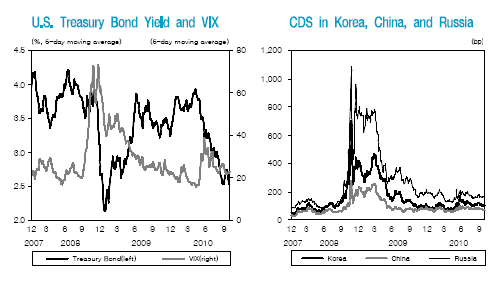
- Meanwhile, the dollar value turned weak against major currencies.
- The mining & manufacturing production growth rate registered -1.0% on a month-on-month basis, recording a negative growth for the first time in ten months. [Table 2-1]
- 목차
-
주요 경제지표 Major Economic Indicators
요약 및 평가 Summary and Assessment
1. 국내총생산Contents
1-1.경제활동별 국내총생산 (2005년 불변가격)
GDP by Economic Activity (at 2005 Constant Prices)
1-2.국내총생산에 대한 지출 (2005년 불변가격)
Expenditure on GDP (at 2005 Constant Prices)
1-3.국내총소득 및 국민총소득 (2005년 불변가격)
Gross Domestic Income and Gross National Income (at 2005 Constant Prices)
1-4.경제활동별 국내총생산 (경상가격)
GDP by Economic Activity (at Current Prices)
1-5.국내총생산에 대한 지출 (경상가격)
Expenditure on GDP (at Current Prices)
2. 경기
2-1.광공업·서비스업 생산지수 및 경기종합지수
Industrial Production, Service Production, and Composite Indices of Business Indicators
2-2.산업별, 공업구조별 광공업 생산
Industrial Production by Industry and Industrial Structure
2-3.생산자제품 출하 및 재고 지수
Shipment and Inventory Indices
2-4.업종별 서비스 生産
Service Production Index by Type
2-5.기업경기실사지수
Business Survey Index
3. 소비
3-1.민간소비
Private Consumption
3-2.소비재판매액지수
Sales Index by Consumer Goods
3-3.소비재 출하 및 소비재 수입
Consumer Goods Shipment Index and Consumer Goods Import
3-4.소비자동향조사와 소비자전망조사
Consumer Survey Index (CSI) and Consumer Sentiment Survey (CSS)
4. 설비투자
4-1.설비투자와 설비투자지수
Equipment Investment and Index of Equipment Investment
4-2.내수용자본재수입액과 기계류수입액
Import of Capital Goods for Domestic Demand and Machinery Import
4-3.국내기계수주
Machinery Orders Received
5. 건설투자
5-1.용도별 건설투자
Construction Investment
5-2.건설기성액
Value of Construction Completed
5-3.국내건설수주
Construction Orders Received
5-4.건축허가면적 및 건축착공면적
Building Construction Permits and Building Construction Initiated
5-5.주택건설 및 토지거래
Housing Construction and Real Estate Transaction
6. 대외거래
6-1.상품별 수출
Exports by Commodity
6-2.주요 지역별 수출
Exports by Region
6-3.용도별 수입
Imports by Usage
6-4.지역별 수입
Imports by Region
6-5.수출입 단가
Unit Value Indices of Exports and Imports
6-6.경상수지
Current Account
6-7.자본수지
Capital and Financial Account
7. 노동시장
7-1.고용
Employment
7-2.산업별 취업자
Employment by Industry
7-3.종사상지위별 및 취업시간별 취업자
Employment by Status of Worker / by Working Hours
7-4.임금 상승률 (Ⅰ)
Wage Growth Rate (Ⅰ)
7-5.임금 상승률 (Ⅱ)
Wage Growth Rate (Ⅱ)
8. 물가
8-1.소비자 물가
Consumer Price Indices
8-2.생산자 및 수출입 물가
Producer Price and Export & Import Prices
8-3.부동산 가격
Real Estate Price Indices
9. 금융시장
9-1.금리
Market Interest Rates
9-2.주가
Stock Price
9-3.통화량
Monetary Aggregates
9-4.금융기관 수신
Deposits in Financial Institutions
9-5.금융기관 여신 및 자산운용
Loans and Asset Management of Financial Institutions
9-6.가계신용
Credit to Households
10. 재정
10-1.통합재정
Consolidated Public Sector Finance
10-2.수입 및 지출/순융자
Revenue and Expenditure / Net Lending
10-3.국가채무
Government Debt
11. 세계경제 동향
11-1.미국의 경제동향
Economic Indicators of U.S.A
11-2.EURO의 경제동향
Economic Indicators of EURO
11-3.일본의 경제동향
Economic Indicators of Japan
11-4.중국의 경제동향
Economic Indicators of China
11-5.주요국의 환율
Exchange Rates of Major Currencies
11-6.주요국의 금리
Major International Interest Rates
11-7.원유 및 원자재 가격
Crude Oil and Commodity Prices
12. 세계경제 전망
12-1.주요 선진국의 경제전망
Economic Outlook for Major Advanced Economies
12-2.NIEs와 BRICs의 경제전망
Economic Outlook for NIEs and BRICs
12-3.세계교역량 및 교역조건, 원유 및 원자재 가격 전망
World Trade Volume & Terms of Trade, Crude Oil & Commodity Price Forecast
12-4.국제 환율 및 금리 전망
International Interest and Exchange Rate Forecast
더 자세히 알고 싶으면?

한국개발연구원의 본 저작물은 “공공누리 제3유형 : 출처표시 + 변경금지” 조건에 따라 이용할 수 있습니다. 저작권정책 참조
무단등록 및 수집 방지를 위해 아래 보안문자를 입력해 주세요.
담당자 정보를 확인해 주세요. 044-550-5454
소중한 의견 감사드립니다.
잠시 후 다시 시도해주세요.