

Ⅰ. 현 경제상황에 대한 인식
| □ | 최근 우리 경제는 제조업 성장이 둔화되고 서비스업 개선 추세도 완만해진 가운데, 건설업의 부진이 지속되면서 성장세가 점차 약화되고 있는 것으로 판단됨. |
- 경상성장률의 경우도 최근 추세에 비해 낮아진 상태이며, 교역조건 악화 등에 따라 국내총소득의 증가세도 빠르게 둔화되고 있음.
| □ | 수요 측면에서 보면, 투자 부진이 심화되는 가운데 소비 증가세도 완만해지면서 내수 성장세는 둔화되는 모습 |
- 설비투자는 작년의 반도체 관련 투자 급증에 따른 기저효과로 급격한 조정이 진행되고 있으며, 건설투자도 감소세로 전환됨.
- 민간소비는 재화소비가 비교적 양호하나 서비스소비는 상대적으로 저조한 모습이며, 소비자심리지수가 급락하는 등 전반적인 개선 추세가 완만해지고 있음.
- 수출은 반도체를 중심으로 양호한 흐름을 유지하고 있으나, 여타 품목들의 수출이 부진한 모습을 나타내면서 산업별 격차가 점차 확대되고 있음.
- 수출 증가율이 세계교역량 증가율을 하회하는 등 제조업의 경쟁력 저하 우려도 점증
| □ | 이와 같이 수요 측면에서 나타나고 있는 부문 간 불균형은 산업별 경기의 차별화가 심화되는 요인으로 작용함. |
- 반도체 의존도가 심화되고 있는 제조업 및 서비스업의 성장세 약화는 우리 경제에서 고용 부진을 초래한 주된 요인으로도 작용하고 있음.
| □ | 세계경제는 완만한 성장세를 유지하고 있으나, 미국의 금리인상에 따른 신흥국 경제 불안, 미중 무역분쟁 등의 위험이 가시화되면서 글로벌 경기 둔화 우려가 커지고 있음. |
- 최근 미국 이외 주요국들의 성장세가 둔화되는 모습을 보이면서, IMF 등 국제기구들은 글로벌 회복세에 대한 기존의 낙관적 전망을 하향 조정하는 추세
| □ | 이와 같은 최근의 대내외 경제환경 변화를 감안할 때, 단기 거시경제정책은 당분간 현재 수준의 완화적인 기조를 유지하여 경기불안 가능성에 대응할 필요 |
- 재정정책은 향후 경기 변화에 탄력적으로 대응하되, 중장기적 재정수요를 검토하여 재정지출의 증가 속도를 적절히 유지할 필요
- 통화정책은 내수 증가세가 둔화되는 가운데 수요 측면의 물가상승압력도 여전히 낮은 수준임을 감안하여 당분간 완화적인 기조를 유지하는 것이 바람직함.
| □ | 한편, 대내외 경제상황과 더불어 글로벌 교역 여건의 변화로 인해 장기적으로도 경제 활력 제고를 통한 견실한 성장세 유지가 점차 어려워지는 환경이 전개되고 있음. |
- 우리 경제의 수출 의존도가 높게 유지되는 가운데, 세계교역 증가세가 약화될 조짐도 나타나면서, 수출 제조업 경쟁력 저하에 따른 저성장 우려를 심화시키고 있음.
- 따라서 제조업 경쟁력을 강화함과 동시에 서비스산업에서 새로운 성장동력을 모색하는 등 성장의 지속가능성을 높이기 위한 정책적 노력이 절실한 상황임.
| □ | 우리 경제의 활력을 제고하고 성장잠재력을 확충하기 위해서는 구조개혁 정책을 보다 적극적으로 추진함과 동시에, 구조개혁 과정에서 발생할 수 있는 부작용을 완화할 수 있는 정책대안들을 장기적 관점에서 준비하고 실행해 나가야 함. |
- 근로조건의 경직성 등 경제의 비효율적 요소들을 제거함으로써, 인적자원의 원활한 재배치를 통해 생산성을 높일 수 있는 환경을 조성해야 함.
- 주요 산업들의 경쟁력 강화를 위한 구조조정과 규제개혁을 질서 있게 추진함으로써 대부분 산업에서 수출의 역동성이 저하되고 있는 문제에 적극적으로 대응할 필요
- 구조개혁 과정에서 발생할 수 있는 이해관계 간 대립 및 사회안전망 미흡 등의 문제를 보다 적극적으로 해소해 나가는 정책적 리더십을 발휘함으로써 구조개혁의 추진력을 강화하는 노력이 요구됨.
- 재정규율의 강화를 통해 확보된 재정 여력은 단기적인 경기부양보다 사회안전망 확충과 인적자원의 재교육 등 구조개혁의 원활한 추진을 위해 필요한 정책적 리더십을 확보하고 보완조치들을 실행하는 데에 활용하는 것이 바람직함.
Ⅱ. 2019년 국내경제 전망
1. 대외여건에 대한 주요 전제
| □ | 세계경제는 2019년에도 금년과 유사한 수준의 완만한 성장세를 지속할 것으로 전제 |
- IMF는 주요 선진국의 성장세가 소폭 둔화되나, 신흥국이 양호한 성장세를 보이며 2019년에 세계경제가 금년과 동일한 3.7%의 성장률을 기록할 것으로 전망
- 그러나 선진국 간 성장세 격차가 확대되고 일부 신흥국에서 금융시장이 불안한 조짐을 보이는 등 세계경제의 성장세에 대한 불확실성이 점차 확대되고 있는 상황
| □ | 원유 도입단가는 2019년에 배럴당 77달러 내외를 기록하여 2018년 대비 7% 내외 상승할 것으로 전제 |
| □ | 실질실효환율로 평가한 원화가치는 2019년에 1% 내외 절하되는 것으로 전제 |
2. 2019년 국내경제 전망
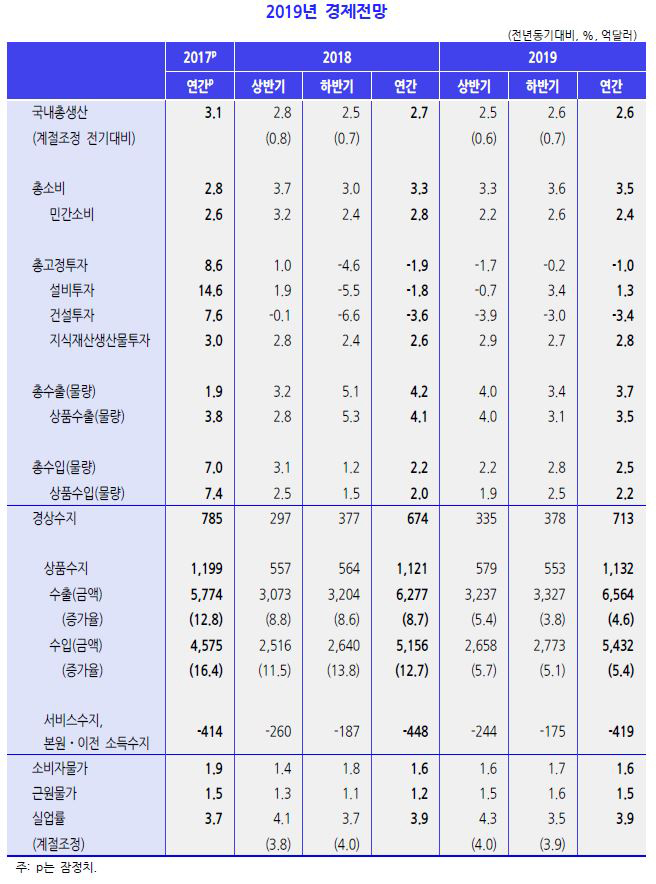
| □ | 우리 경제는 2019년에 내수 경기가 둔화되는 가운데 수출 증가세도 점차 완만해지면서, 금년(2.7%)보다 소폭 낮은 2.6%의 성장률을 기록할 전망 |
- 민간소비는 가계소득 증대 및 일자리 관련 정책효과에도 불구하고 자산가격의 하락, 가계부채 상환 부담 등의 영향으로 2018년에 비해 증가율이 소폭 둔화될 전망
- 설비투자는 이례적 수준의 반도체 관련 투자가 일단락되고 여타 산업의 투자 수요도 크지 않을 것으로 예상됨에 따라 2019년에도 낮은 증가세를 보일 전망
- 건설투자는 토목부문의 부진이 다소 완화되겠으나, 건축부문이 주택건설을 중심으로 감소폭이 확대됨에 따라 부진한 흐름을 지속할 것으로 판단
- 수출은 세계교역량 증가세가 둔화되고 반도체 등 특정 품목의 높은 수출 증가세도 점차 약화될 것으로 판단되나, 전반적으로는 경제성장률을 상회하는 증가율이 유지될 수 있을 것으로 전망
| □ | 경상수지는 2019년에 서비스수지 적자폭이 감소하면서 금년보다 흑자폭이 소폭 확대될 전망 |
| □ | 소비자물가는 유가상승의 영향에 주로 기인하여 1%대 중반의 상승률을 지속하고, 근원물가도 이와 유사한 수준의 상승률을 나타낼 것으로 예상 |
| □ | 실업률은 내수 경기가 둔화되는 가운데 대외 수요의 증가세도 점차 완만해짐에 따라 금년과 유사한 수준을 유지하고, 취업자 수 증가폭은 금년보다 소폭 개선될 전망 |
3. 전망의 위험요인
| □ | 대외적으로는 세계경제 성장세 및 교역량 증가세 약화, 주요 수출품목의 단가 하락, 대외 경쟁력 약화 등이 성장률 전망에 하방위험으로 작용할 수 있음. |
- 미국을 제외한 선진국의 경기가 예상보다 빠르게 둔화되거나, 미국의 금리인상 과정에서 기초여건이 견실하지 못한 일부 신흥국에서 금융시장 불안이 확산되는 경우 세계경제 성장세와 교역량 증가세가 예상을 하회할 수 있음.
- 반도체가격이 급락하거나 중국경제의 추격으로 주력 수출품목의 경쟁력이 약화되는 추세가 가속화되는 경우, 교역조건이 악화되고 수출시장 점유율이 축소되면서 우리 경제는 예상을 하회하는 성장률을 기록할 가능성
- 한편, 미중 무역분쟁이 장기화되면서, 세계교역량 증가세가 예상보다 빠르게 둔화될 경우 우리 경제의 성장률에도 부정적으로 작용할 가능성
| □ | 대내적으로는 시장금리 급등, 자산가격 하락 등이 하방위험으로, 정부 정책에 따른 소비 개선의 가속화 등이 상방위험으로 작용 |
- 시장금리가 빠르게 상승하는 가운데 자산가격이 급락하는 상황이 발생하는 경우, 금융시장의 변동성이 확대되고 한계가구의 부채상환능력도 급격히 저하되면서 내수를 중심으로 우리 경제의 성장세가 예상보다 빠르게 둔화될 가능성
- 반면, 가계소득 확대를 위한 정부 정책이 가시적인 성과를 거둔다면, 소비심리가 꾸준히 상승하고 민간소비가 빠르게 확대되면서 예상을 상회하는 성장률을 나타낼 가능성
Ⅲ. 정책방향
1. 재정정책
| □ | 내년도 재정정책은 정부의 주요 정책과제 수행을 위한 예산을 차질 없이 집행하는 한편, 중장기 재정지출 증가에 대비한 지출 효율화 노력 또한 지속할 필요 |
- 2019년도 예산안은 국가채무 및 관리재정수지 적자폭의 소폭 증가를 감수하는 한편, 당면한 경제·사회 문제 해소를 위해 확장적으로 편성된 것으로 평가됨.
- 일자리 창출, 혁신성장, 삶의 질 개선 등 주요 현안 및 정책과제를 중심으로 편성된 예산은 차질 없이 지출하면서, 중점사업의 진행 상황을 면밀히 주시하고 사후적으로 엄밀한 성과평가를 수행할 필요
| □ | 향후 재정소요가 증가할 것으로 예견되는 상황에서 중장기 재정운용 원칙을 확립하여 재정의 지속가능성을 확보할 필요 |
- 지출수요 및 세입 규모 예측을 바탕으로 한 합리적인 재정총량 관리 원칙을 확립하고, 이에 입각하여 중장기적 관점에서 재정을 안정적으로 운용할 필요
2. 통화정책
| □ | 통화정책은 내수 경기 둔화 및 고용 부진으로 인해 물가가 빠르게 상승하기는 어려운 상황임을 감안하여 현재 수준의 완화적인 기조를 유지할 필요 |
- 최근 공급 측면의 물가상승압력이 강화되면서 소비자물가 상승률이 물가안정목표인 2%에 근접하였으나, 근원물가는 1%대 초반의 상승률을 지속하는 등 수요 측면의 물가압력은 낮은 상황
| □ | 수도권 주택가격 급등이나 일부 금융시장의 신용리스크 증대 등 미시적 불안요인에 대해서는 기준금리 인상 등 통화정책 기조의 긴축적 전환보다 해당 시장의 불균형에 직접 대응할 수 있는 미시적 정책수단을 우선 동원하는 것이 바람직함. |
| □ | 한편, 글로벌 경제의 불확실성 확대가 국내 금융시장의 불안으로 이어질 가능성에 대한 우려를 완화하기 위해서는 시장과의 적극적인 소통노력을 지속할 필요 |
Ⅰ. Current Economic Conditions
| □ | The Korean economy is gradually slowing with decreased growth in manufacturing, moderated improvements in services and continued sluggishness in construction. |
- The nominal growth rate remains below the recent trend and the GDI growth rate is fast receding on deteriorating terms of trade.
| □ | On the demand side, domestic demand is stagnating with weaker investment and slower consumption growth. |
- Facilities investment is undergoing a rapid adjustment due to the base effect from the sharp increase in semiconductor-related investments last year while construction investment turned to a decrease.
- Private consumption is improving at a slower pace as commodities consumption remains relatively favorable but services consumption is comparatively weak and CCSI plunges.
- Led by semiconductors, exports maintained favorable growth but those of other items have been sluggish, widening the industrial gap.
- Export growth has been below that of global trade volume, raising concerns over the weakening competitiveness of the manufacturing industry.
| □ | As such, the imbalance between consumption, investment and exports has deepened the differing conditions across industrial sectors. |
- Accordingly, manufacturing is increasingly rely on semiconductors and services are slowing gradually, serving as the main reason for the stagnant employment.
| □ | The global economy is sustaining moderate growth but concerns over a slowdown are mounting on unstable economic conditions in emerging markets influenced by the US rate hike and looming risks from the US-China trade disputes. |
- International forecasting institutes such as the IMF amended their previous optimistic projections for a global recovery after seeing other major economies beside the US lose their growth steam.
| □ | Considering the recent changes in internal and external economic conditions, the short-term macroeconomic policy should maintain its current accommodative stance to counter possible economic instability. |
- Fiscal policies must be flexibly managed in response to changing economic conditions in the future and the pace of fiscal expenditure should be properly adjusted based on reviews of the mid- to long-term fiscal demand.
- Monetary policies should remain accommodative, considering that demand-side inflationary pressure is still low while domestic demand growth is slowing.
| □ | Meanwhile, it is becoming increasingly difficult to sustain steady growth even in the long-term due to the internal and external economic landscape and changing global trade conditions. |
- Global trade volume is exhibiting signs of weakening growth and Korea’s dependence on exports remains high, fueling concerns over slow growth resulting from the diminished competitiveness of the export manufacturing industry.
- Accordingly, policy efforts are strongly needed to enhance the sustainability of growth, such as by finding new growth engines in the services industry while, at the same time, heightening the competitiveness of the manufacturing industry.
| □ | To bolster economic activities and increase growth potential, structural reform policies must be more actively executed. At the same time, long-term policy alternatives should be prepared and implemented to mitigate the possible side effects from the reform. |
- A productivity-friendly environment must be created through the smooth transition of human resources which can be achieved when ineffective factors such as rigidity of labor conditions are removed from the economy.
- Active countermeasures are required to enhance competitiveness of the export manufacturing industry by implementing restructuring and regulatory reforms aimed at heightening the competitiveness of key industries.
- Attention must be paid to reinforcing the driving force of structural reform by exercising policy leadership to actively resolve problems such as conflicts of interest and the lack of social safety nets that can arise during the structural reform process.
- Instead of being put to use for short-term economic stimulus, fiscal space obtained through strengthened fiscal discipline should be used to consolidate policy leadership necessary in securing social safety nets and promoting seamless structural reforms such as retraining human resources and to implement supplementary measures.
Ⅱ. Domestic Economic Outlook for 2019
1. Assumed External Conditions
| □ | The global economy will continue to grow in 2019 at a similar rate to 2018. |
- The IMF foresees the global economy growing 3.7% in 2019, the same as 2018, as major advanced economies recede slightly but emerging market grow at a favorable pace.
- However, the gap between the growth rates of advanced economies is widening and the financial markets in a few emerging countries are showing signs of instability, escalating uncertainties over global growth.
| □ | Crude oil prices will climb by 7% from 2018 to around $77 per barrel in 2019. |
| □ | The value of the Korean won, in terms of the real effective exchange rate, will descend by 1% in 2019. |
2. Outlook for Domestic Economy
| □ | Korea is projected to grow 2.6% in 2019, an inch down from 2018 (2.7%), as export growth moderates and domestic demand slows. |
- Despite rises in household income and effects from job creation projects, private consumption growth will slightly decrease from 2018, influenced by falling asset prices and households’ debt repayment burden.
- Facilities investment will continue to see slow growth in 2019, as the unprecedently huge investment in semiconductors is expected to subside and investment demand in other sectors will be marginal.
- Construction investment will remain stagnant as the downward trend in the civil engineering sector eases and the building construction sector sees an increased decline led by residential building construction.
- Exports will continue to grow at a rate exceeding GDP growth overall in spite of the slowing global trade volume and gradual decline in the high export of specific items such as semiconductors.
| □ | The current account is projected to run a slightly increased surplus from 2018 as the services account deficit decreases. |
| □ | Headline inflation is expected to stay at a mid-1% influenced mostly by oil price hikes while core inflation is likely to remain similar. |
| □ | Employment growth is projected to improve slightly from 2018 while the unemployment rate remains similar to 2018 as domestic demand slows and overseas demand moderates gradually. |
3. Risks
| □ | Externally, the lackluster growth of the global economy and trade volume, falling unit prices of major export items and weakening global competitiveness could become downside risks to growth projections. |
- The growth of the global economy and trade volume will fall below projected figures if advanced economies (excl. the US) slow faster than anticipated or the US rate hikes incur and spread anxiety in emerging countries without strong fundamentals.
- If semiconductor prices plunge or the global competitiveness of major export items weakens at an accelerating pace due to China’s catch-up, Korea’s terms of trade will deteriorate and export market shares will shrink, leading to slower-than-expected growth.
- Meanwhile, if the US-China trade disputes protract and hence the growth in global trade volume slows faster than expected, this will likely have a negative effect on Korea’s economic growth.
| □ | Internally, soaring market interest rates and falling asset prices could pose downside risks and accelerating improvements in consumption driven by government policies will serve as an upside risk. |
- If asset prices plunge amid soaring market rates, the financial market will become highly volatile and marginal households’ repayment ability will be significantly diminished. As a result of the shrinking domestic demand, Korea‘s economic growth will likely contract faster than projected.
- Meanwhile, if policies to enhance household income generate tangible benefits, consumer sentiment will continue to rise and private consumption will expand rapidly, meaning that Korea will grow faster than expected.

Ⅲ. Policy Recommendations
1. Fiscal Policy
| □ | Fiscal policies need to continuously enhance the efficiency of expenditure to prepare for an increase in the mid- to long-term fiscal expenditure while ensuring that budgets for key policy agendas are implemented seamlessly. |
- Budget bills for 2019 are expansionary in order to resolve the pending economic and social issues while enduring slight increases in national debt and operational balance deficit.
- Budgets for key issues and policy agendas such as job creation, innovative growth and quality of life should be used as planned without any setbacks. And, the progress of major projects must be closely monitored followed by a thorough ex-post evaluation of their accomplishments.
| □ | Considering the projected increase in fiscal demands, efforts are required to achieve fiscal sustainability by formulating the rules for mid- to long-term fiscal management. |
- Reasonable fiscal management rules should be established based on the forecasting of tax revenue and expenditure demand, and fiscal aggregates need to be managed in the mid- to long-term perspective according to these rules.
2. Monetary Policy
| □ | Monetary policies should maintain the current accommodative stance in consideration of the recent inflation trend which is showing no signs of a sharp upward turn on slowing domestic demand and stagnant employment. |
- Influenced by growing inflationary pressure on the supply side, headline CPI growth neared the inflationary target (2%) while core CPI continued the low 1% growth, pointing to low inflationary pressure on the demand side.
| □ | When it comes to micro worries such as soaring house prices in the capital region and rising credit risks in certain financial markets, micro-policy tools are more recommendable than a shift towards a tightening stance including a base rate hike as such tools can directly respond to the imbalances in the market. |
| □ | Meanwhile, to reduce concerns over the possible mounting uncertainties in the global economy leading to instability of the domestic financial market, the Bank of Korea should make concerted and consistent efforts to communicate with the market. |
제 1 부 경제전망 및 정책방향
Ⅰ. 현 경제상황에 대한 인식
Ⅱ. 2019년 국내경제 전망
Ⅲ. 정책방향
제 2 부 경제현안 분석
Ⅰ. 2014년 이후 실업률 상승에 대한 요인 분석
Ⅱ. 외국인 국내소비의 변동과 시사점
제 3 부 국내외 경제동향
Ⅰ. 국내경제 동향
Ⅱ. 세계경제 동향

요약
현 경제상황에 대한 인식
2019년 국내경제 전망
정책방향
2014년 이후 실업률 상승에 대한 요인 분석
자세히보기외국인 국내소비의 변동과 시사점
자세히보기국내경제 동향
세계경제 동향
경제 현안 분석
-
 외국인 국내소비의 변동과 시사점
■ 2017년 외국인 국내소비가 큰 폭으로 감소하면서 국내소비의 변동성을 확대하였으며, 서비스업 등 국내 소비 관련 산업에 일정 부분 부정적인 요인으로 작용함. ■ 중국인 관광객이 국내소비 부진에 기여하고 있는바, 전통적 수출산업뿐 아니라 국내 소비 관련 산업의 경기에도 중국의 영향이 작지 않음을 시사 ■ 단기적으로는 환율 신축성을 확보하여 국내소비의 변동을 완화하는 한편, 장기적으로는 서비스업 경쟁력 강화가 요구되는 상황임.
-
KDI박종호
-
정규철 선임연구위원
 프로필
-
-
 2014년 이후 실업률 상승에 대한 요인 분석
■ 2014~17년 사이의 실업률 상승(0.23%)은 대부분 산업 미스매치 및 노동수요 부족으로 설명되며, 최근에는 노동수요 부족의 영향이 더욱 확대된 것으로 나타남. ■ 실업문제의 완화를 위해서는 노동수요 진작 및 일자리 창출이 필요하며, 산업 미스매치 실업 완화를 위한 노동시장 여건 개선이 필요함. ■ 실업의 대부분은 연령구조 등 기타 미스매치로 인한 실업이므로, 이를 낮추기 위한 정책적 노력도 고려해야 함.

한국개발연구원의 본 저작물은 “공공누리 제1유형 : 출처표시” 조건에 따라 이용할 수 있습니다. 저작권정책 참조
무단등록 및 수집 방지를 위해 아래 보안문자를 입력해 주세요.
담당자 정보를 확인해 주세요. 044-550-5454
소중한 의견 감사드립니다.
잠시 후 다시 시도해주세요.