
News “The 14th Korea-OECD International Forum on Budgeting” Held
“The 14th Korea-OECD International Forum on Budgeting” Held
OECD-Ministry of Planning and Budget-KDI
“The 14th Korea-OECD International Forum on Budgeting” Held
-
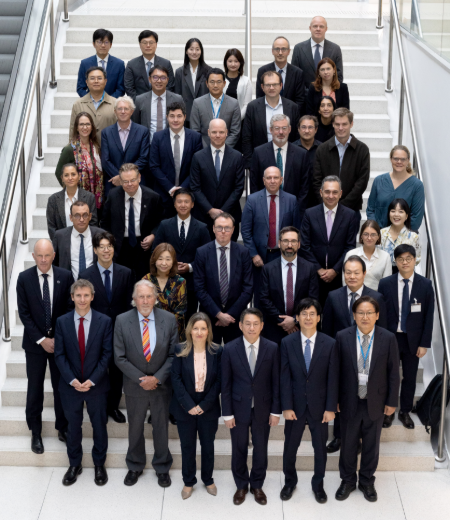
The 14th Korea-OECD International Forum on Budgeting was held on September 30 (Wednesday) and October 1 (Thursday), 2026, at the OECD Conference Centre in Paris, France. Co-organized by the OECD, the Ministry of Planning and Budget, and the Korea Development Institute (KDI), the forum brought together senior budget officials and experts from OECD member countries under the theme of “Fiscal Policy Beyond Crisis: Preparing for the Future.” Over two days, participants discussed how budgeting can support growth and structural transformation, respond to crises, and secure fiscal sustainability amid long-term pressures.
[Day 1]
[Opening Ceremony]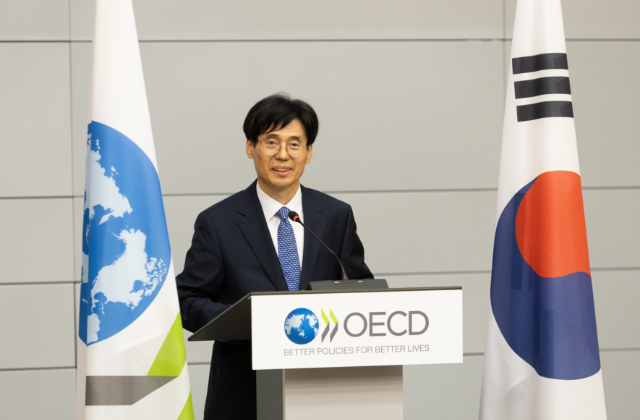
The opening ceremony, chaired by Barry Anderson, Chairman Emeritus of the Committee of Senior Budget Officials, was attended by Yong-Beom Cho, Vice Minister of the Ministry of Planning and Budget; Yasushi Masaki, Deputy Secretary-General of the OECD; Se-Jik Kim, President of KDI; and Tae-Ung Baik, Ambassador of Korea to the OECD.
[Session 1: Budgeting for Growth and Transformation]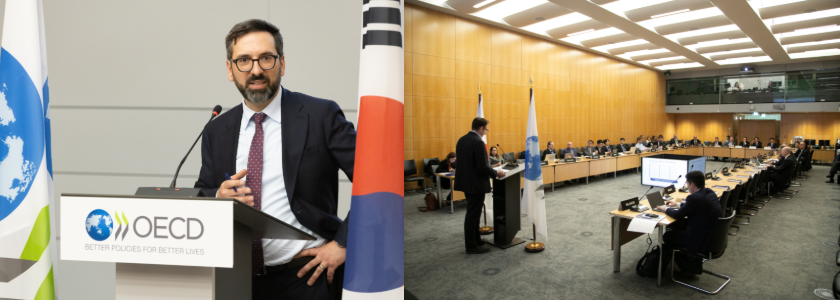
Session 1 explored how budgets and public spending can support growth and structural transformation while maintaining fiscal soundness. Thomas Larouche of Canada’s Department of Finance introduced Canada’s capital budgeting framework adopted in 2025, while Damian Mullaly of the Australian Treasury presented fiscal soundness and structural transformation as mutually reinforcing, citing AI, aging, and the energy transition as key shifts. Ben Gaukrodger of the New Zealand Treasury stressed principle-based fiscal management and buffers against shocks, and Erik Höglin of Sweden’s Ministry of Finance emphasized the lasting value of fiscal rules and political consensus. Douglas Sutherland of the OECD Economics Department said public spending should prioritize investment that crowds in private investment and raises productivity, and noted that Korea, despite favorable near-term conditions, needs a stronger medium-term fiscal framework to prepare for aging. In the discussion, Korea introduced its plan for a “Future Fund” to invest excess revenue in future industries and generations.
[Session 2: Budgeting in Times of Crisis]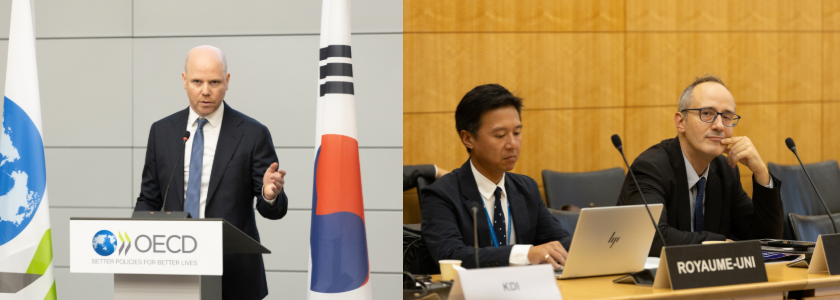
Session 2 examined how budget systems respond to crises and return to normal afterward. Pavlina Karasiotou of Greece’s Ministry of Economy and Finance, Sami Ylaoutinen, Auditor-General of Finland, and Mário Monteiro, former Director-General of Budget of Portugal, shared how their countries reformed fiscal management frameworks through successive crises, while Tae Suk Lee of KDI analyzed Korea’s recent 26.2 trillion won supplementary budget responding to rising energy prices. Participants agreed that crisis response requires swift support and flexibility, but that the scope, targets, and exit conditions of support must be clearly designed in advance, with mechanisms for returning to prior fiscal targets.
[Session 3: Overcoming Fiscal Challenges]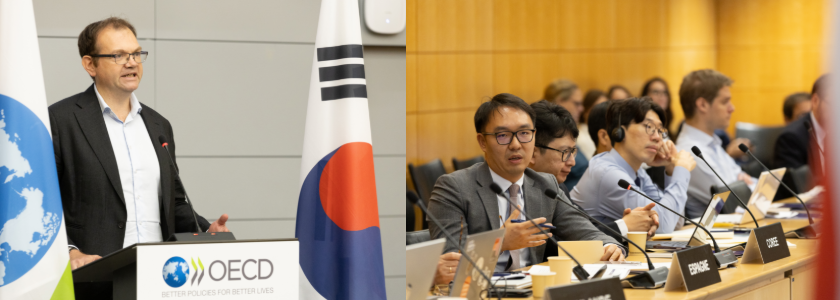
Session 3 addressed how to secure both growth and fiscal sustainability as aging, low growth, and geopolitical uncertainty constrain fiscal space. Hyun Kyung Oh of Korea’s Ministry of Planning and Budget presented a strategy that pairs strategic investment in AI, semiconductors, and youth with fiscal discipline and the Future Fund. OECD experts Stephane Jacobzone and Camila Vammalle called for structural reform of pension and health spending and greater labor market participation, while Daniel Gerson and Claire Salama stressed citizen engagement, data-driven anticipatory government, and reducing administrative burdens. Juan Manuel Santa Cruz Campaña, Ambassador of Chile to the OECD, added that reform requires political legitimacy and public trust beyond technical analysis.
[Day 2]
[Comprehensive Discussion and Closing Ceremony]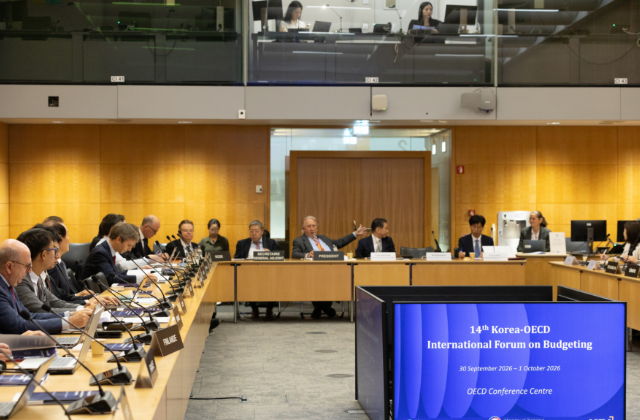
On the second day, building on the issues raised on Day 1, participants held a comprehensive discussion on fiscal policy directions for sustainable growth and preparedness for the future. The forum then concluded with closing remarks by Se-Jik Kim, President of KDI, and Jon Blondal, Head of Budgeting and Public Management at the OECD. Over the two days, discussions covered directing public spending toward investment that raises productivity, clearly designing the scope and exit conditions of crisis-response measures, and preparing for long-term spending pressures from aging. It was also discussed that fiscal and government reform cannot be achieved through technical institutional design alone, and requires building public understanding and trust, as well as cooperation between parliament and ministries.
We reject unauthorized collection of email addresses posted on our website by using email address collecting programs or other technical devices. To access the email address, please type in the characters exactly as they appear in the box below.
Please enter the security code to prevent unauthorized information collection.