Economic Outlook KDI Economic Outlook 2025-2nd Half November 11, 2025
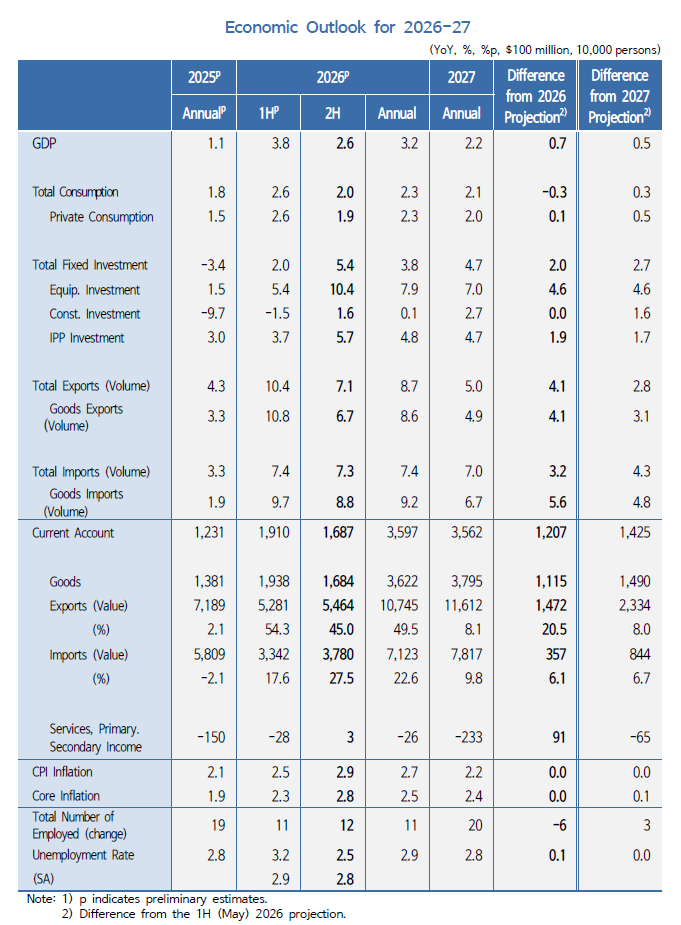
The Korean economy is expected to grow by around 1.8% in 2026, as export growth slows but domestic demand recovers.
- Consumer price are expected to rise by around 2.0%, a rate similar to this year’s 2.1%, as domestic demand recovers while international oil prices decline.
- Private consumption is projected to increase by 1.6%, up from this year’s 1.3%, supported by lower market interest rates and expansionary fiscal policy.
- Equipment investment is expected to rise by around 2.0%, extending the moderate gains (2.5%) seen this year, as semiconductor-related investment demand remains strong despite sluggishness in other sectors.
- Construction investment is projected to shift from this year’s sharp decline (-9.1%) to an increase of 2.2%, indicating a partial easing of weakness.
- Exports are expected to grow by around 1.3%, below this year’s 4.1%, as the front-loading effects diminish and the adverse impact of U.S. tariff hikes becomes more pronounced.
- Despite slower export growth, the current account surplus is expected to remain large, supported by improving terms of trade.
- Employment conditions are expected to improve moderately in line with the recovery in domestic demand, although the number of employed persons is projected to increase by about 150,000, lower than this year’s 170,000, reflecting demographic shifts.
Ⅰ. Current Economic Conditions
- □ The Korean economy has shown signs of moderate improvement, supported by a pickup in growth momentum.
- · GDP grew by 1.2% quarter-on-quarter in the third quarter, driven by improvements in private consumption and exports. Year-on-year growth also rose to 1.7%, up from 0.6% in the previous quarter.
- · By sector, construction remains weak, whereas manufacturing and services have shown signs of improvement.
- □ The sluggishness in domestic demand has eased, as construction investment remains weak but private consumption has improved.
- · Equipment investment remains weak in most sectors except semiconductors. Despite the rise in construction orders received, the lag in translating these orders into actual construction activity has kept construction investment on a continued downward path.
- · By contrast, private consumption gained momentum, supported by lower market interest rates and government support measures, while government consumption also recorded rapid growth, contributing to the improvement in overall economic conditions.
- · Inflation remains relatively stable, while the number of employed persons increased modestly, mainly in service sectors heavily influenced by government job programs.
- □ Despite deteriorating trade conditions following U.S. tariff hikes, exports continued to show modest growth, supported by strong semiconductor performance.
- · Exports to the U.S. fell sharply due to tariff increases, and exports to China also contracted amid weak domestic demand there, while semiconductor exports to Taiwan and other Asian economies surged, sustaining the overall upward trend in exports.
- · With export growth and improving terms of trade, the current account continued to post a large surplus.
- □ Externally, although the global semiconductor market remains strong, the global economy is expected to stay on a gradual slowdown path amid ongoing trade tensions.
- · Global semiconductor trade (value) expanded further in the third quarter.
- · In the U.S., the effects of tariff increases are spreading, pushing up inflation and weighing on employment, while heightened concerns over an economic slowdown are driving down long-term interest rates.
- · China’s growth is slowing, driven mainly by weaker investment as the downturn in the real estate market persists.
- □ Considering both domestic and external conditions, the Korean economy is expected to experience a modest improvement led by private consumption.
- · Export growth may moderate as the effects of U.S. tariff hikes continue to spread.
- · However, as consumption improves supported by declining market interest rates and expansionary fiscal policy, the accumulated construction orders received may partially translate into construction investment with a time lag.
- · Accordingly, despite moderating export growth, the Korean economy is expected to improve modestly, centered on domestic demand.
- □ Given the expected improvement in economic activity, macroeconomic policy should gradually move toward normalization.
- · Fiscal policy should adjust its expansionary stance gradually in line with the pace of economic recovery.
- · Given the stable paths of economic recovery and inflation, monetary policy should maintain its current stance, while responding flexibly to both upside and downside risks to inflation.
- □ Policy efforts should also continue to pursue structural reforms aimed at enhancing productivity alongside maintaining economic stability.
- · Korea’s potential growth rate has been on a steady decline, driven mainly by slowing productivity.
- · Policy efforts should include fostering an environment that encourages the entry of promising innovative firms and the exit of non-viable ones, along with building a more flexible labor market to raise economy-wide productivity.
- · While part of the current low growth reflects cyclical factors, a more longer-term factor is the sharp decline in potential growth, underscoring the need to avoid excessive reliance on short-term stimulus measures.
Ⅱ. Domestic Economic Outlook for 2026
1. Major Assumptions on External Conditions
- □ The global economy is assumed to slow modestly in 2026.
- · The IMF projects global GDP growth at 3.1% in 2026, slightly below the 3.2% expected for 2025, reflecting elevated trade uncertainty and weakening global trade amid rising trade protectionism.
- □ The import price of crude oil (Dubai) for 2026 is assumed to decline to around $63 per barrel, about 10% below the 2025 level ($70 per barrel), as supply increases sharply while demand softens.
- □ The Korean won, in terms of the real effective exchange rate, is assumed to remain broadly stable at recent levels.
2. Domestic Outlook
- □ The Korean economy is expected to grow by around 1.8% in 2026, as export growth slows but domestic demand recovers.
- · Private consumption is projected to increase by 1.6%, up from this year’s 1.3%, supported by lower market interest rates and expansionary fiscal policy.
- · Equipment investment is expected to rise by around 2.0%, extending the moderate gains (2.5%) seen this year, as semiconductor-related investment demand remains strong despite sluggishness in other sectors.
- · Construction investment is projected to shift from this year’s sharp decline (-9.1%) to an increase of 2.2%, indicating a partial easing of weakness.
- · Exports are expected to grow by around 1.3%, below this year’s 4.1%, as the front-loading effects diminish and the adverse impact of U.S. tariff hikes becomes more pronounced.
- · Despite slower export growth, the current account surplus is expected to remain large, supported by improving terms of trade.
- □ Consumer prices are expected to rise by around 2.0%, a rate similar to this year’s 2.1%, as domestic demand recovers while international oil prices decline.
- · Core inflation (excluding food and energy) is expected to reach around 2.2%, above this year’s 1.9%, reflecting the recovery of domestic demand.
- □ Employment conditions are expected to improve moderately in line with the recovery in domestic demand, although the number of employed persons is projected to increase by about 150,000, lower than this year’s 170,000, reflecting demographic shifts.
- · The unemployment rate is expected to remain low at around 2.8%, driven mainly by structural factors.
3. Risks to the Outlook
- □ Trade-related uncertainty remains high, and the specific provisions of trade agreements, together with legal issues in the U.S. may have a significant impact on Korea’s exports.
- ·Despite progress in Korea-U.S. trade negotiations and some easing of U.S.-China trade tensions, uncertainties persist regarding the tariff rates applied to major export items and the timing of their implementation.
- ·There is also a possibility that trade uncertainty could rise sharply depending on the U.S. Supreme Court’s decision on the legality of broad-based tariff measures.
- □ A sustained rise in the exchange rate may heighten upward pressure on inflation.
- · Amid demand-side downward pressure easing as the economy improves, if the continued rise in the exchange rate since late September adds further upward pressure, it is not possible to rule out the possibility that inflation may exceed the 2% target.

Ⅲ. Policy Recommendations
1. Fiscal Policy
- □ Fiscal policy should move toward a gradual normalization of its expansionary stance in line with the pace of economic recovery.
- · According to the National Fiscal Management Plan for 2025-29, the consolidated fiscal balance excluding social security funds is projected to remain in deficit by more than 4% of GDP each year, while the national debt ratio is expected to rise rapidly, with an annual average increase of 2.2%p.
- · Normalizing the expansionary fiscal stance in line with the expected pace of recovery is necessary to prevent large fiscal deficits from becoming entrenched.
- □ Over the medium to long term, tax and fiscal frameworks should be made capable of adapting flexibly to demographic changes such as low birth rates and population aging, so as to minimize structural increases in fiscal burdens.
- · A rigid tax and fiscal system may further weaken fiscal soundness, given the expected erosion of the tax base and rising social spending associated with low fertility and population aging.
- · Given the persistently low birth rate, the scale of local education subsidies should be revised to be linked to the school-age population rather than national tax revenue.
- · Basic pension benefits should be revised to better target vulnerable elderly groups and to raise the statutory elderly age, thereby improving spending efficiency and strengthening the revenue base.
2. Monetary Policy
- □ Monetary policy should remain broadly aligned with its current stance for the time being, given the easing of economic weakness and the stable inflation trend.
- · With the economic slowdown easing mainly in consumption and fiscal policy set on an expansionary path, the need for monetary policy to support activity appears limited.
- · Inflation has remained relatively stable near the 2% target. As the economy improves going forward, demand-side downward pressure on prices may ease, while exchange rate movements may add further upward pressure on inflation.
- · Accordingly, the base rate should be kept around its current level, with the authorities monitoring both upside and downside risks to inflation and responding flexibly as needed.
3. Financial Policy
- □ The financial system remains broadly stable despite heightened trade-related uncertainty.
- · Capital adequacy indicators across major financial sectors have improved, and external soundness is assessed to be generally robust, as reflected in low CDS premiums.
- · Although household debt increased somewhat in the first half of 2025, the household debt-to-GDP ratio remains similar to the level at the end of 2024.
- □ However, exchange rate and equity market volatility may increase due to global trade tensions and funding uncertainty surrounding the investment agreement with the U.S. In this context, risks in major financial institutions should be monitored closely, and stabilization measures should be implemented promptly when needed.
- · If liquidity conditions in financial institutions deteriorate sharply due to domestic or external shocks, emergency liquidity provision should be deployed to prevent temporary funding strains from spreading into broader financial system risks.
- □ Macroprudential policy should focus on strengthening autonomous credit risk management within financial institutions rather than managing loan demand in the short term.
- · Given the time lag between policy implementation and actual housing transactions and lending, the household debt management measures announced on June 27 and the housing market stabilization package announced on October 15 are highly likely to slow the pace of household debt growth.
- · As loan demand eases, related measures should be adjusted gradually so that market mechanisms can function normally.
- · To ensure that lending is based on borrowers’ actual repayment capacity, exemptions from DSR rules for jeonse loans and policy funds should be reduced, thereby enhancing the effectiveness of prudential measures related to household debt.
Analysis of current economic issues
-
Recent Low Unemployment Rate: Drivers and Implications■ Despite recent economic weakness, the persistence of low unemployment reflects two opposing forces: rising worker discouragement and improvements in matching efficiency. - These two forces were already placing downward pressure on unemployment before the COVID-19 crisis. As labor demand strengthened after the crisis, unemployment fell sharply and has remained low despite recent softening in employment conditions. - Advances in matching technology and demographic shifts have substantially improved matching efficiency, continuing to push down the unemployment rate. - At the same time, the increasing number of discouraged workers, especially among the young, has mechanically lowered the headline unemployment rate. ■ This implies that low unemployment does not necessarily signal improved employment conditions. - A substantial share of the unemployment decline reflects young workers exiting the labor market. This suggests that, as the job creation capacity of firms has weakened and the labor market duality has deepened, a growing share of young people have become pessimistic about securing high-quality, regular employment and have stopped searching for work altogether. - If these structural barriers that discourage job search among the young become entrenched, participation in an already shrinking workforce could decline further, posing risks to social cohesion. ■ Accordingly, efforts to improve matching efficiency should continue alongside measures to reduce labor market duality and strengthen incentives for workforce participation. - It would be advisable to improve business productivity to create quality jobs, ease the labor market duality, and gradually align the education system with industry needs. - Additionally, in-depth analysis of the growing “taking a break“ population should continue to inform the detailed design of mechanisms to help those who have been out of the workforce for extended periods return to work.
-
Recent Low Unemployment Rate: Drivers and Implications■ Despite recent economic weakness, the persistence of low unemployment reflects two opposing forces: rising worker discouragement and improvements in matching efficiency. - These two forces were already placing downward pressure on unemployment before the COVID-19 crisis. As labor demand strengthened after the crisis, unemployment fell sharply and has remained low despite recent softening in employment conditions. - Advances in matching technology and demographic shifts have substantially improved matching efficiency, continuing to push down the unemployment rate. - At the same time, the increasing number of discouraged workers, especially among the young, has mechanically lowered the headline unemployment rate. ■ This implies that low unemployment does not necessarily signal improved employment conditions. - A substantial share of the unemployment decline reflects young workers exiting the labor market. This suggests that, as the job creation capacity of firms has weakened and the labor market duality has deepened, a growing share of young people have become pessimistic about securing high-quality, regular employment and have stopped searching for work altogether. - If these structural barriers that discourage job search among the young become entrenched, participation in an already shrinking workforce could decline further, posing risks to social cohesion. ■ Accordingly, efforts to improve matching efficiency should continue alongside measures to reduce labor market duality and strengthen incentives for workforce participation. - It would be advisable to improve business productivity to create quality jobs, ease the labor market duality, and gradually align the education system with industry needs. - Additionally, in-depth analysis of the growing “taking a break“ population should continue to inform the detailed design of mechanisms to help those who have been out of the workforce for extended periods return to work.
-
Increasing overseas investment: Macroeconomic Context and Implications■ As in Japan’s case, the slowdown in productivity growth has been a major driver of declining capital returns in Korea, leading to a shift from domestic to overseas investment. - Looking ahead, a shrinking working-age population will weaken labor input and domestic capital returns, further accelerating the shift toward overseas investment. - A productivity slowdown directly reduces GDP and also shrinks the domestic capital stock, amplifying the total impact on GDP to about 1.5 times the direct effect. - In Japan, where productivity and demographic shifts occurred about twenty years earlier than in Korea, slower productivity growth led to a marked loss of economic dynamism and greater reliance on investment income from abroad. ■ Therefore, restoring growth momentum will require sustained structural reforms that boost productivity. - If the productivity slowdown persists, adverse effects may broaden, particularly for those who depend heavily on labor income. - This will require building an environment that enables innovative firms to enter and unproductive firms to exit, alongside a more flexible labor market that supports economy-wide productivity growth. ※ The shift to overseas investment arises from declining domestic productivity and helps offset the resulting loss in national income. It would therefore not be advisable to restrict it by policy. ※ Since the current account surplus is equivalent to net overseas investment, an increase in the surplus should be interpreted with caution.
-
Increasing overseas investment: Macroeconomic Context and Implications■ As in Japan’s case, the slowdown in productivity growth has been a major driver of declining capital returns in Korea, leading to a shift from domestic to overseas investment. - Looking ahead, a shrinking working-age population will weaken labor input and domestic capital returns, further accelerating the shift toward overseas investment. - A productivity slowdown directly reduces GDP and also shrinks the domestic capital stock, amplifying the total impact on GDP to about 1.5 times the direct effect. - In Japan, where productivity and demographic shifts occurred about twenty years earlier than in Korea, slower productivity growth led to a marked loss of economic dynamism and greater reliance on investment income from abroad. ■ Therefore, restoring growth momentum will require sustained structural reforms that boost productivity. - If the productivity slowdown persists, adverse effects may broaden, particularly for those who depend heavily on labor income. - This will require building an environment that enables innovative firms to enter and unproductive firms to exit, alongside a more flexible labor market that supports economy-wide productivity growth. ※ The shift to overseas investment arises from declining domestic productivity and helps offset the resulting loss in national income. It would therefore not be advisable to restrict it by policy. ※ Since the current account surplus is equivalent to net overseas investment, an increase in the surplus should be interpreted with caution.
We reject unauthorized collection of email addresses posted on our website by using email address collecting programs or other technical devices. To access the email address, please type in the characters exactly as they appear in the box below.
Please enter the security code to prevent unauthorized information collection.