
News KDI Hosts Conference Featuring Nobel Laureate Peter Howitt
KDI Hosts Conference Featuring Nobel Laureate Peter Howitt
KDI Hosts Conference on「Shifting the Economic Paradigm to Reignite Growth」
Featuring Nobel Laureate in Economic Sciences Peter Howitt
-
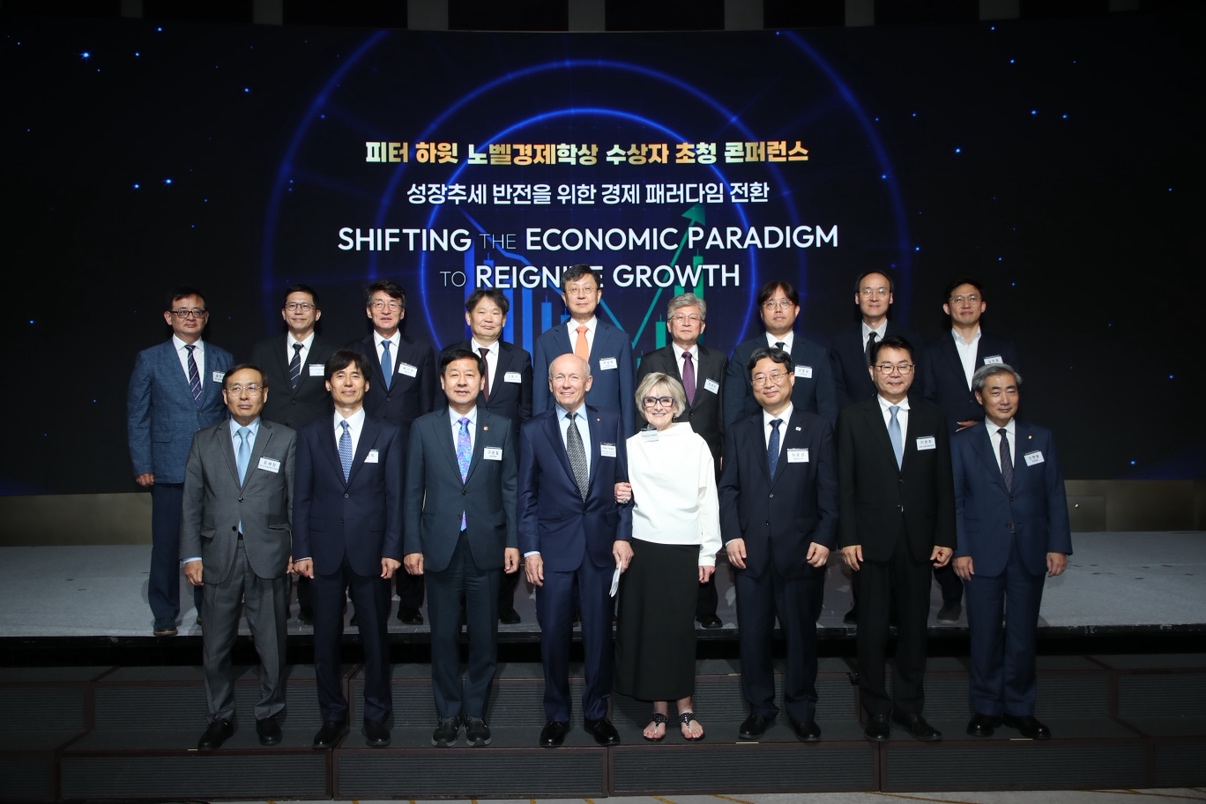
On May 15, 2026, KDI jointly hosted a conference with the National Research Council for Economics, Humanities and Social Sciences at the Westin Josun Seoul Hotel under the theme "Shifting the Economic Paradigm to Reignite Growth." The event was organized to diagnose the structural challenges facing the Korean economy amid rapidly changing conditions — including the spread of AI, rising protectionism, and demographic shifts — and to explore directions for enhancing productivity and building an innovation ecosystem grounded in "creative destruction."
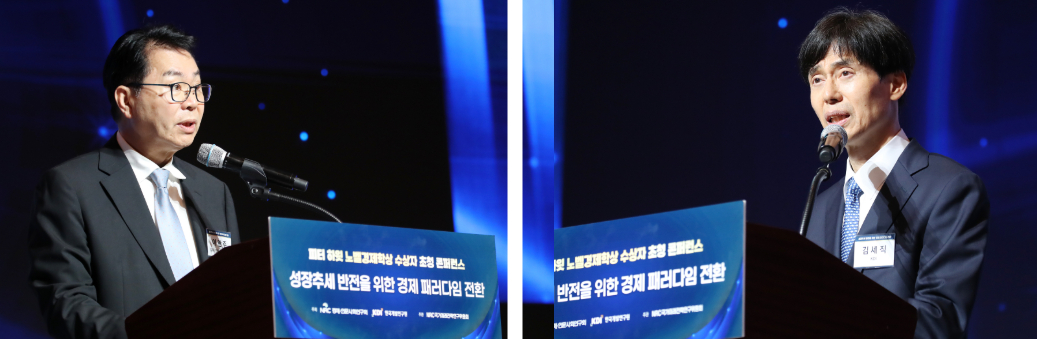
In his opening remarks, Han-joo Lee, Chairperson of the National Research Council for Economics, Humanities and Social Sciences, emphasized that "as the Korean economy faces the limits of its catch-up growth model, the time has come to chart a new growth path based on creativity and innovation," and expressed hope that the conference would serve as a starting point for academia, government, and industry to jointly discuss innovation-driven growth strategies.
In his welcoming remarks, Se-Jik Kim, President of KDI, diagnosed the Korean economy as confronting the structural challenges of a declining long-term growth rate and the risk of zero growth, stressing that "what is needed now is not short-term demand management, but a new growth strategy for 'real growth.'"
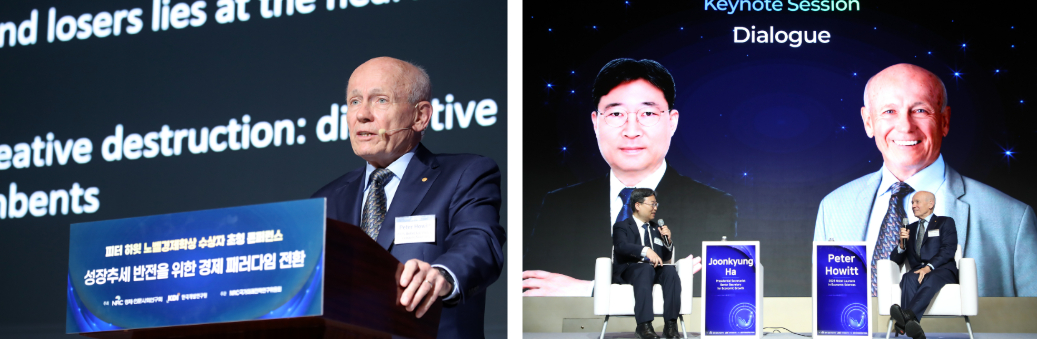
The keynote session featured Peter Howitt, 2025 Nobel Laureate in Economic Sciences, who presented on the path forward for the Korean economy amid four structural challenges: the spread of artificial intelligence, rising protectionism, demographic change, and the transition to innovation-led growth — framed through Schumpeter's theory of creative destruction. He noted that AI is a general-purpose technology requiring a fundamental redesign of education systems, social safety nets, and financial systems, and recommended maintaining an open trade regime, attracting global innovation talent, nurturing SMEs, and strengthening antitrust policy as foundations for innovation-led growth.
A subsequent dialogue between Joonkyung Ha, Senior Secretary for Economic Growth at the Presidential Secretariat, and Professor Howitt explored the effects of the spread of AI and robotics on Korea's productivity and industrial structure, and exchanged views on building an innovation ecosystem grounded in creative destruction.
Session 1: The Present and Future of Innovation-Led Growth in the Korean Economy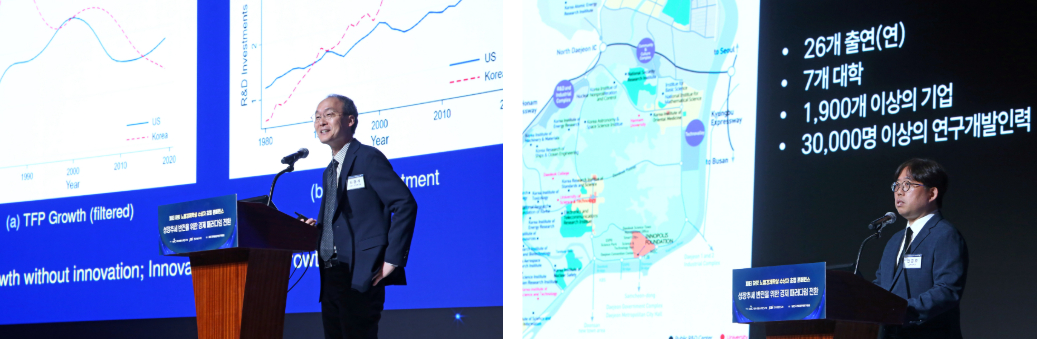
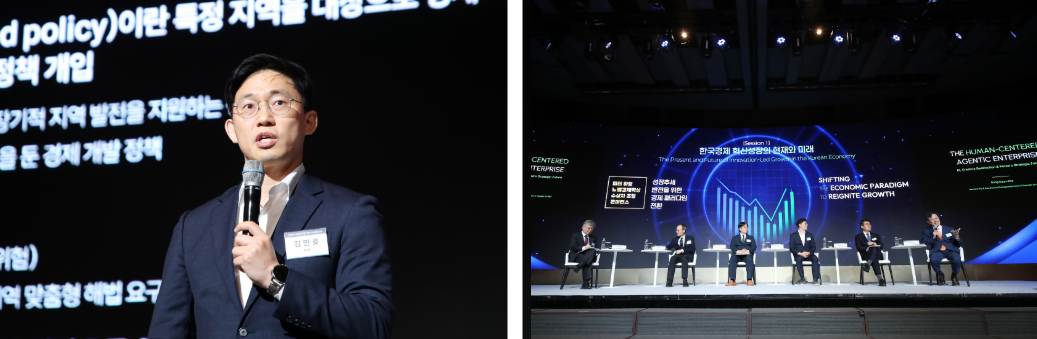
Yongseok Shin, Executive Vice President of Hyundai Motor Group, noted that despite a significant expansion in Korea's R&D investment as a share of GDP, total factor productivity (TFP) growth has recently fallen to near zero. He diagnosed a weakening in the reallocation of resources toward high-productivity firms due to resource misallocation within manufacturing and declining labor market dynamism. He also raised concerns about the qualitative efficiency of R&D investment, citing a declining share of high-level researchers and an expansion of R&D subsidies concentrated among SMEs, and emphasized the need for regulatory reform and labor market restructuring to respond to global competition.
Joonmo Ahn, Professor at Korea University, stressed that as the Korean economy faces the limits of fast-follower innovation and the paradigm shift to AI-driven transformation (AIX), a redesign of the national innovation system is needed centered on "systematized flexibility." He recommended moving away from a rigid existing growth framework and enhancing national competitiveness through measures such as DARPA-style R&D autonomy, utilization of global talent, promotion of foreign-founded deep-tech startups, performance-based budgeting, regulatory innovation, and decentralization.
Minho Kim, Senior Fellow at KDI, assessed that existing regional industrial policies centered on sector designation and subsidy support have failed to translate into substantive corporate growth, and argued for a paradigm shift from "sector support" to "enterprise growth support." He recommended building "innovation cluster hubs" involving local governments, universities, research institutes, and firms, and creating an ecosystem that supports corporate investment and growth through mechanisms such as regulatory clinics and standing growth strategy task forces.
The discussion was moderated by Sung Jin Kang, President of the Korean Economic Association, with participation from Keunkwan Ryu, Professor Emeritus at Seoul National University, and Sang Kyun Cha, Founding Dean (Emeritus) of the Seoul National University Graduate School of Data Science.
Session 2: Directions for Structural Reform to Foster Innovation-Led Growth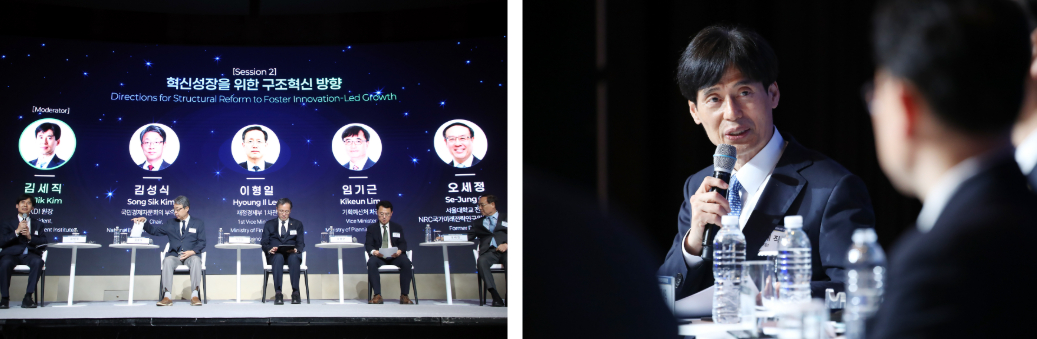
Moderated by Se-Jik Kim, President of KDI, Session 2 featured panelists Song Sik Kim, Vice-Chairperson of the National Economic Advisory Council; Hyoung Il Lee, 1st Vice Minister of the Ministry of Finance and Economy; Kikeun Lim, Vice Minister of the Ministry of Planning and Budget; and Se-Jung Oh, Former President of Seoul National University. Participants discussed the key priorities and new growth paradigm needed to reverse a growth decline that has persisted for 30 years and is now entering zero-growth territory, sharing views on the roles of government and the private sector for "real growth," innovation in R&D budget allocation, reform of the education system to cultivate future talent, and measures to address educational inequality.
▶ Watch the live stream of the conference [click here]
We reject unauthorized collection of email addresses posted on our website by using email address collecting programs or other technical devices. To access the email address, please type in the characters exactly as they appear in the box below.
Please enter the security code to prevent unauthorized information collection.