
KDI Journal of Economic Policy KDI Journal of Economic Policy, May 2026 May 31, 2026
- Summary
-
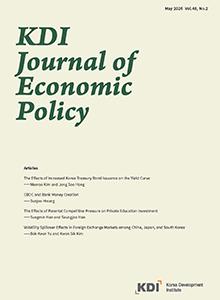
The Effects of Increased Korea Treasury Bond Issuance on the Yield Curve / MEEROO KIM AND JONG SOO HONG
This study examines the impact of the sharp increase in Korea Treasury Bond (KTB) issuance following the COVID-19 crisis and analyzes the effects of bond buybacks as a policy countermeasure. Using a dynamic Nelson-Siegel model with macroeconomic factors, we estimate the effects of changes in the bond supply on the yield curve. Empirical results show that a KRW 1 trillion increase in KTB issuance raises yields by approximately 2.5 to 2.9 basis points, with stronger effects observed in the post-COVID period and in medium- to long-term maturities with weaker demand. Conversely, emergency buybacks reduce yields by about 1.9 to 2.1 basis points, with similar maturity dependent dynamics. These findings highlight the importance of demand conditions in amplifying the interest rate effects of government bond supply shocks.
CBDC and Bank Money Creation / SUNJOO HWANG
This paper examines the impact of a retail type of Central Bank Digital Currency (CBDC) on bank lending. While concerns exist that CBDC could reduce bank lending by diverting deposits from commercial banks to the central bank, this paper argues that the relationship between CBDC and bank lending is more complex because real-life banks do not lend out of deposits but instead create deposits by making loans. By examining a model of “fountain pen money” creation, the paper shows that a bank's lending capacity is influenced by both cash deposits and an augmentation factor. While CBDC reduces the capacity for lending as some deposits shift to the central bank, the magnitude of this reduction depends on the size of the augmentation factor and may not lead to a significant decrease in bank lending. In economies where banks lend close to their deposit base, such as in South Korea, the reduction in lending due to CBDC is likely to be marginal. Furthermore, this paper explores the social welfare implications of the contractionary effect of CBDC, showing that if the money creation constraint is weakly binding, CBDC can improve social welfare by mitigating excessive lending. Conversely, if the money creation constraint is strongly binding, CBDC may reduce social welfare by exacerbating credit shortages.
The Effects of Parental Competitive Pressure on Private Education Investment / SUNGMIN HAN AND SEUNGJOO HAN
In South Korea, education serves as a critical engine for social mobility, where academic credentials from prestigious universities function as a decisive factor in shaping career trajectories and earning potential. This dynamic has fostered intense educational fervor and led to the proliferation of a massive private education market. This study empirically examines the relationship between parental competitive pressure defined as a synthesis of achievement expectations and anxiety and investment in private education within a highly competitive educational environment. The analysis shows that private education expenditures are positively associated with parental competitive pressure. Notably, this increase occurs primarily through greater spending rather than an increase in total tutoring hours. This pattern suggests that, given children’s time constraints, highly pressured parents strategically prioritize quality over quantity. Furthermore, the effect varies across family backgrounds, indicating that reliance on private education reflects the interplay between socio-structural factors and household resources, thereby reproducing inter generational educational inequality. Overall, it was found that dependence on private education is a structural phenomenon amplified by status competition within a success-oriented society. Consequently, policy interventions should shift away from superficial regulations and focus on addressing the fundamental socioeconomic drivers of parental competitive pressure.
Volatility Spillover Effects in Foreign Exchange Markets among China, Japan, and South Korea / BOK-KEUN YU AND KWON SIK KIM
This paper analyzes the dynamic spillover effects of exchange rate volatility among the foreign exchange markets of China, Japan, and South Korea from January of 2010 to March of 2024 based on exchange rate determinataion theories, the GJR-GARCH model, and the TVP-VAR model. The key empirical results are as follows. First, while the factors determining the CNY/USD, JPY/USD, and KRW/USD exchange rates are somewhat different, it was found that CNY/USD is influenced by the short-term interest rate differential with the U.S., JPY/USD is affected by the VIX and by a COVID-19 dummy, and KRW/USD is impacted by the difference in the money supply change rate with the U.S. and the VIX. Second, the exchange rate volatility of the three currencies was found to exhibit the well-known persistence and leverage effects. Third, regarding the time-varying spillover effects of exchange rate volatility between the three countries’ foreign exchange markets, the transmission effects of exchange rate volatility between the three countries varied with the timing, frequency, and persistence.
- Contents
-
The Effects of Increased Korea Treasury Bond Issuance on the Yield Curve / Meeroo Kim and Jong Soo Hong
I. Introduction
II. Literature Review
III. Overview of the Government Bond Market
IV. Empirical Model and Estimation Method
V. Data and Summary Statistics
VI. Empirical Results
VII. Conclusion
APPENDIX
REFERENCES
CBDC and Bank Money Creation / Sunjoo Hwang
I. Introduction
II. Theoretic Analysis
III. Discussion
IV. Wholesale Funding
V. Pass-Through Lending
VI. Concluding Remarks
REFERENCES
The Effects of Parental Competitive Pressure on Private Education Investment / Sungmin Han and Seungjoo Han
I. Introduction
II. Existing Literature
III. Competitive Environment in South Korea
IV. Empirical Analysis
V. Empirical Results
VI. Conclusion and Policy Implications
APPENDIX
REFERENCES
Volatility Spillover Effects in Foreign Exchange Markets among China, Japan, and South Korea / Bok-Keun Yu and Kwon Sik Kim
I. Introduction
II. Literature Review
III. Data and Methodology
IV. Empirical Results
V. Conclusion
REFERENCES
-
Journal of Economic Policy The Effects of Increased Korea Treasury Bond Issuance on the Yield Curve
Meeroo Kim 35p
-
Journal of Economic Policy CBDC and Bank Money Creation
Sunjoo Hwang 26p
-
Journal of Economic Policy The Effects of Parental Competitive Pressure on Private Education Investment
Sungmin Han 25p
-
Journal of Economic Policy Volatility Spillover Effects in Foreign Exchange Markets among China, Japan, and South Korea
Bok-Keun Yu 21p
We reject unauthorized collection of email addresses posted on our website by using email address collecting programs or other technical devices. To access the email address, please type in the characters exactly as they appear in the box below.
Please enter the security code to prevent unauthorized information collection.