|
|
What's Up Monthly
October 20, 2026 | vol. 38
|
|
|
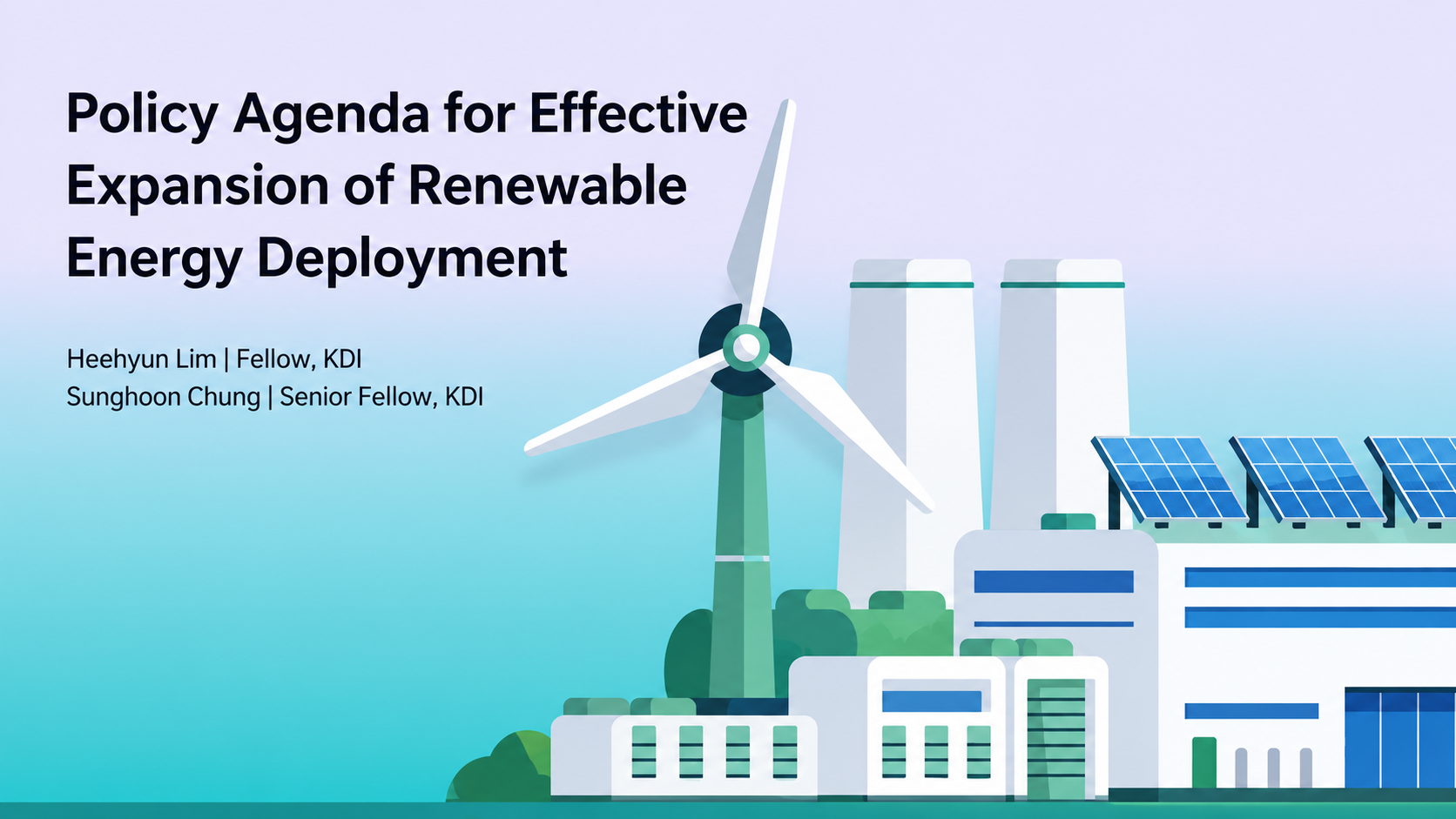
Speed or Efficiency? Korea’s Renewable Push Needs Grid, Finance, and Subsidy Reform Together
Korea needs to add renewable capacity four times faster than before, yet grid congestion is already forcing generators to cut output. Reaching 100 GW by 2030 means adding at least 6.8 GW every half-year, against a 1.7 GW average over the past 5.5 years. Meanwhile, spending under the main subsidy scheme, collected through electricity bills, reached 4.5 trillion won in 2025 alone. The authors combine a cost-benefit analysis with cross-country panel data to test whether speed and efficiency can go together.
The Subsidy Clears the Cost-Benefit Test Only Narrowly
Under conservative 2020 estimates, each won of subsidy generates 1.33 won in social benefit for solar PV and 1.18 won for onshore wind. Learning-by-doing, the know-how that lowers the cost of later installations, supplies roughly one-third of estimated benefits; without it, the figures fall to 0.89 won and 0.80 won. These values are not fixed: long-term revenue certainty and investment that responds to price signals can set off a virtuous cycle that lifts them.
High Costs Do Not Fully Explain the Slow Rollout
Korea’s generation costs are relatively high among major economies, yet its renewable generation share remains below the level of countries with comparable costs. Cross-country panel analysis links better financing conditions (and, for solar PV, better grid conditions) to higher shares even among countries with similar costs, pointing to structural barriers beyond generation costs.
|
|
|
Two Bottlenecks Undermine Subsidy Efficiency
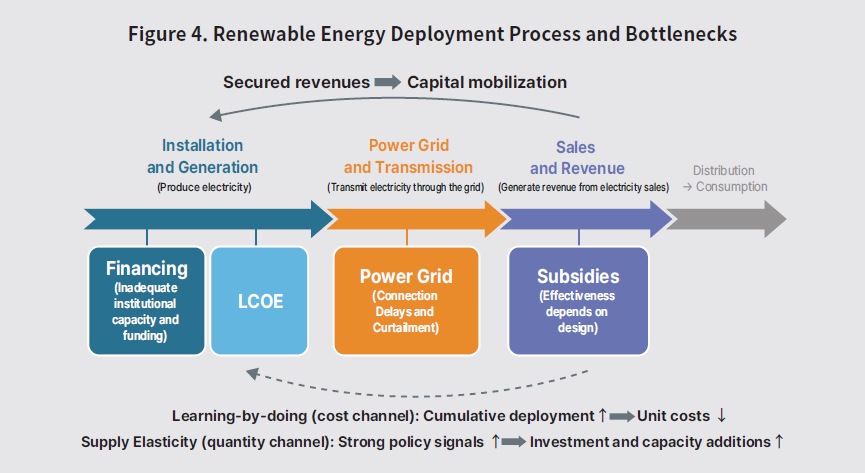
Between 2003 and 2023, generation capacity grew by 154% while the transmission network expanded by only 26%. On financing, producer revenues swing with volatile wholesale electricity and certificate prices. Stable long-term channels are thin: solar PV and onshore wind auctions have been undersubscribed, and direct corporate power purchase agreements have yet to take off. Without secure long-term revenue, producers face a higher cost of capital.
Curtailment and connection delays then cut sales and make revenues harder to forecast, which lenders price into a higher risk premium. This weakens new investment and producers’ responsiveness to price signals, and with it the virtuous cycle behind the subsidy’s payoff.
Three Pillars Must Advance in Unison
The authors identify grid infrastructure as the most urgent pillar, since a bottleneck there leaves financing and deployment support ineffective. That means clearing obstacles to transmission expansion and building a market that compensates energy storage and demand response. With legal frameworks now taking shape, the test is effective implementation.
On financing, they call for effective long-term auction contracts and policy finance that crowds in private capital. On subsidies, contracts for difference, now under consideration to stabilize producer revenues, should be designed using the cost-benefit findings, with multi-year auction volumes announced in advance. Isolated reform on any single axis will not be enough.
|
|
|
|
KDI Monthly Economic Trends (October 2026)
Strong AI-Related Exports Support Recovery as Oil-Driven Price Pressures Persist
Korea’s economy continued to improve, supported by strong AI-related exports and equipment investment. Consumption improved only gradually as subdued underlying wage growth and elevated supply-side inflationary pressures, including high oil prices, constrained household purchasing power. Production remained relatively solid in August despite a temporary manufacturing contraction, while construction weakness eased slightly.
Exports grew 83.5% year-on-year in September, led by ICT products, with semiconductor and computer gains mainly reflecting sharp price increases. Consumer price inflation eased to 2.9%, but underlying inflation picked up as supply-side pressures, notably higher oil prices, intensified. Globally, manufacturing recovery continues, but uncertainty remains high, with Middle East tensions and inflation concerns posing downside risks.
|
|
|
|
Pension Reform, Currency Invoicing, and Bond Yields: Evidence from KDI JEP
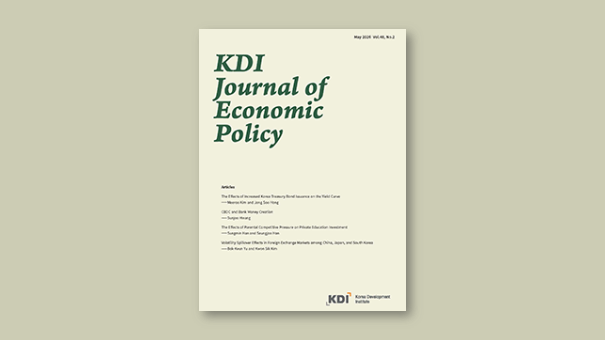
KDI Journal of Economic Policy (August 2026)
The August issue of the KDI Journal of Economic Policy covers pensions, trade, and finance. Minsoo Cho and Hyelim Son find that the Basic Pension reform modestly raised household consumption without significantly changing overall employment, though full-time work and hours fell among the elderly. Junhyong Kim shows that exchange rate passthrough in Korean exports differs markedly by invoicing currency.
On financial policy, Jong Chil Son and Joonyoung Hur find that Korea’s effective reserve requirement ratio, at 4.2%, remains close to its equilibrium path. Jong Soo Hong and Meeroo Kim show that restricting securities firms’ call borrowing cumulatively lowered Korea Treasury bond yields by about 10.8 to 12.5 basis points.
|
|
|
|
KDI Co-organizes the 14th Korea-OECD International Forum on Budgeting in Paris
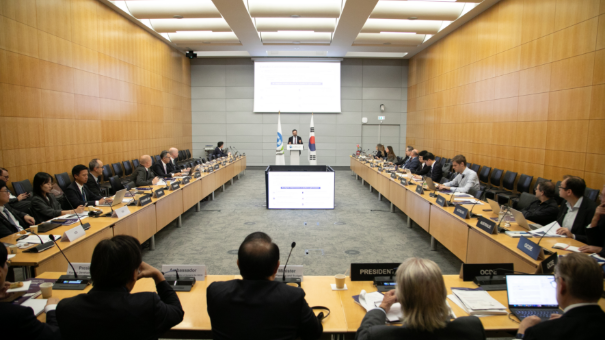
KDI co-organized the 14th Korea-OECD International Forum on Budgeting with the OECD and the Ministry of Planning and Budget on September 30 and October 1 at the OECD Conference Centre in Paris. Under the theme “Fiscal Policy Beyond Crisis: Preparing for the Future,” senior budget officials and experts from OECD member countries discussed how budgeting can support growth and structural transformation, respond to crises, and secure fiscal sustainability. KDI President Se-Jik Kim emphasized sustainable public finances through human capital innovation in his welcoming remarks, while Director Taesuk Lee of KDI analyzed Korea’s recent 26.2 trillion won supplementary budget in the crisis session.
Participants discussed directing public spending toward productivity-enhancing investment, clearly designing the scope and exit conditions of crisis-response measures, and preparing for long-term spending pressures from aging. The forum also noted that fiscal and government reform requires public understanding and trust, as well as cooperation between parliament and ministries.
|
|
|
Copyright © Korea Development Institute.
All Rights Reserved.
263, Namsejong-ro, Sejong-si 30149 |
|
|
|
|