
News KDI-IDOS Joint Seminar on Middle Powers in the Future Global Development Agenda
KDI-IDOS Joint Seminar on Middle Powers in the Future Global Development Agenda
KDI-IDOS Joint Seminar
Exploring the Role and Responsibility of Middle Powers
in the Future Global Development Agenda
-
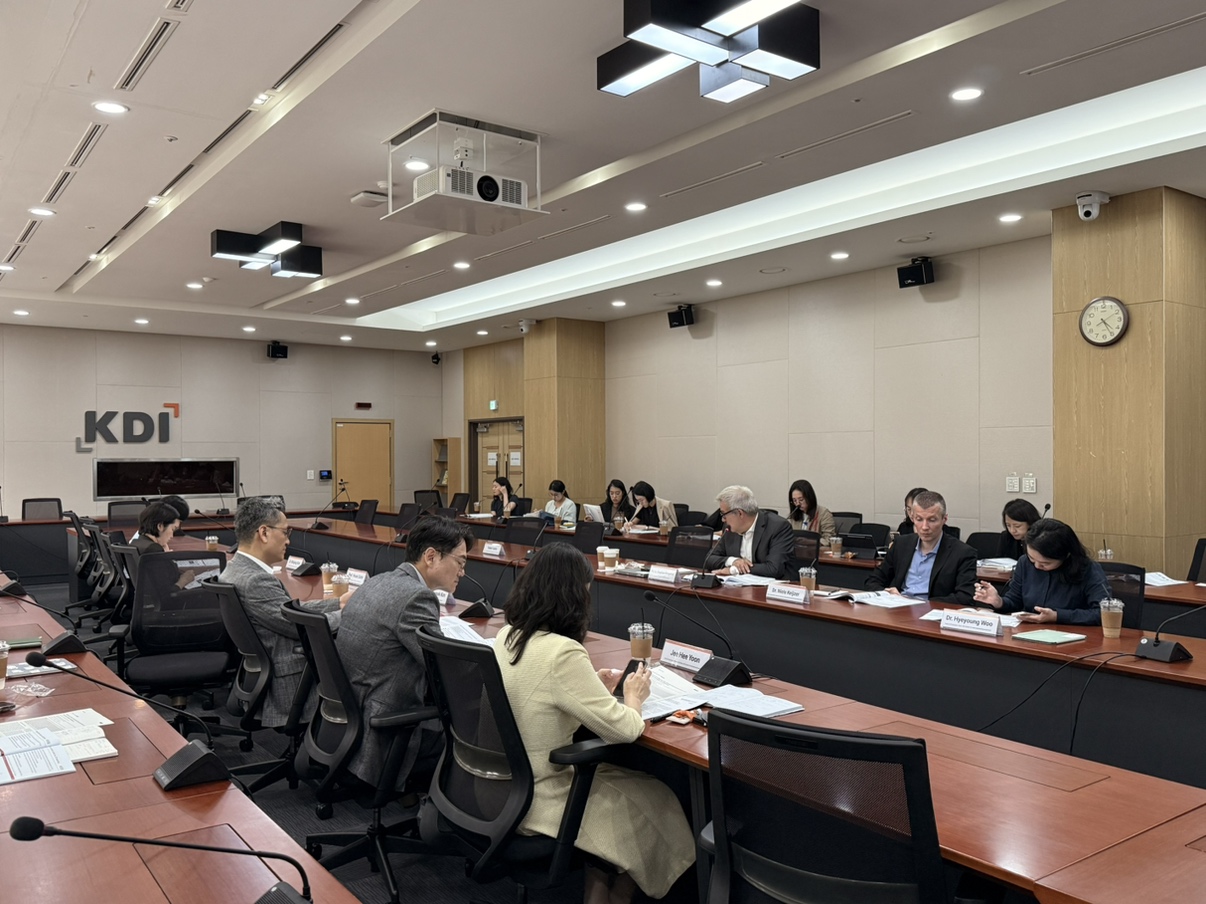
On June 25, 2026, the Center for International Development (CID) of KDI hosted the KDI–IDOS Joint Seminar with the German Institute of Development and Sustainability(IDOS) at KDI in Sejong. The seminar, held under the theme of "Exploring the Role and Responsibility of Middle Powers in the Future Global Development Agenda," brought together leading experts and researchers to share the latest policy discussions and research findings on the roles and responsibilities of middle powers in an evolving international development landscape, and to explore avenues for cooperation among middle powers in advancing the global development agenda.
In his opening remarks, Dr. Jungwook Kim, the Executive Director of KDI CID, emphasized that middle powers should deepen mutual understanding and reduce barriers to cooperation through trust and knowledge-based collaboration, thereby contributing not only to bilateral interests but also to the broader global common good.
Dr. Stephan Klingebiel, Head of Inter- and Transnational Cooperation at IDOS, noted that Korea and Germany are "like-minded countries" that share common values and norms in development cooperation. He stressed the importance of strengthening practical collaboration through joint research and policy dialogue at a time when the multilateral system is facing increasing challenges.
Session 1: The Role of Middle Power Donors
Professor Izumi Ohno, Professor Emeritus at the National Graduate Institute for Policy Studies (GRIPS), presented on Japan's development cooperation strategy. Professor Ohno argued that Japan, as a bridge-builder between traditional and emerging development partners, should lead the shift from knowledge sharing to genuine "Knowledge Co-creation" while also building the institutional capacity of partner countries. Professor Ohno further emphasized the need to strengthen private sector engagement and expand collaboration with development finance institutions (DFIs).
Dr. Hyeyoung Woo, Head of the Evaluation Team at KDI CID, presented on the case of Central Asia, highlighted that middle powers should pursue "Niche Diplomacy" in Central Asia, where the strategic importance of the region is growing. Dr. Woo underscored that Korea's comparative advantage lies not in the scale of its development finance, but in its capacity to provide policy consultations in areas such as digital governance and innovation ecosystem development.
Professor Wook Sohn of KDI School of Public Policy and Management proposed a joint coordination framework between agencies, along with localization and mutual learning to address the fragmentation and lack of integrated strategy in Korea’s policy consultation programmes.
Dr. Niels Keijzer, Senior Researcher at IDOS, discussed the role of middle-power donors within the European Union. While the EU has long been regarded as a coalition of middle powers committed to democracy and multilateralism, he noted that recent ODA budget cuts among member states and the weakening of a shared vision for global development cooperation have reduced its influence. He therefore emphasized the need for the EU to exercise stronger policy leadership in shaping the global development agenda.Session 2: Opportunities for Further Cooperation Between Middle Powers
Dr. Minjung Kim, Specialist at KDI CID, presented findings from Aid for Trade (AfT) research, emphasizing that middle-power donors can expand their role through specialization based on their comparative advantage, despite ODA reductions. Dr. Kim highlighted that Korea's rapidly growing share of AfT in the digital economy suggests strong potential for Korea to serve as a policy and technology bridge between advanced and developing economies.
Professor Anna-Katharina Hornidge, Director of IDOS, highlighted the growing challenges facing middle powers amid the spread of disinformation, social polarization, and authoritarian tendencies. She emphasized the importance of building solidarity based on scientific capacity rather than military or economic power and called for strengthening the science-policy interface as a key foundation for resilient governance.
Dr. Stephan Klingebiel, Head of Inter- and Transnational Cooperation at IDOS, proposed "Like-minded Internationalism" as a viable alternative in an era of growing multipolarity, calling for the creation of "pockets of effectiveness" through cooperation. He outlined concrete avenues for Korea-Germany collaboration, including government-to-government consultations, Track 1.5/2.0 dialogues, and joint international initiatives.
The KDI–IDOS Joint Seminar reaffirmed that, amid rising uncertainty in international development driven by ODA budget cuts and geopolitical fragmentation, middle powers such as Korea, Germany, and Japan have an important role to play in shaping the global development agenda through trust-, knowledge-, and partnership-based cooperation.
Written by: Jieun Park, Research Associate,
Division of Development Research, Center for International Development (CID),
044-550-4421, jieunp@kdi.re.kr
We reject unauthorized collection of email addresses posted on our website by using email address collecting programs or other technical devices. To access the email address, please type in the characters exactly as they appear in the box below.
Please enter the security code to prevent unauthorized information collection.