
KDI FOCUS Eldercare Workforce: Projections and Policy Implications April 16, 2026
Eldercare Workforce: Projections and Policy Implications
April 16, 2026-
Junghyun Kwon
 프로필
프로필


Operating beyond the super-aged threshold, Korea faces deepening shortages in its eldercare workforce as the sector struggles to attract workers. While better job quality is imperative to expand this workforce and maintain the quality of life for older adults, incentives for domestic workers alone will not close the gap. Visa policy needs to change to bring in foreign care workers, and care robot technologies should be actively deployed to raise labor productivity in the sector.
Ⅰ. Introduction
As Korea moves beyond the super-aged threshold, the number of older adults requiring care is expected to rise sharply. Changes in household structure and women’s roles within the family are reducing the availability of informal care at home. Together, these trends point to significantly stronger demand for formal eldercare services. Policy shifts will further reshape that demand. The nationwide rollout of Integrated Community Care, scheduled for March 2026, is likely to drive demand for home- and community-based services, requiring both broader service coverage and greater workforce professionalization.
Demand for formal eldercare services is expected to rise sharply, with workforce shortages deepening in step.
Eldercare work is labor-intensive and emotionally demanding, yet wages are low with relatively easy entry for less-skilled workers. These conditions make the profession unattractive, and advanced economies where aging emerged earlier have long struggled with care worker shortages. In the long-term care (LTC) sector, workforce shortages are now widely cited as the most serious risk to service quality (OECD, 2020; Kotschy and Bloom, 2022). In Korea, too, these shortages have been a persistent concern, and they are projected to intensify as the cohort of women aged 60 and over, who today make up the bulk of the care workforce, begins to age out of the labor market.
Care workers are the core resource underpinning eldercare, and the quality of life for the elderly is at risk where workforce shortfalls compromise service delivery. Mitigating this risk requires proactive policy interventions grounded in a clear assessment of the supply-demand imbalance. This paper projects future labor shortfall by estimating the supply and demand for certified care workers at the frontline of LTC delivery. It then examines two policy options actively debated as solutions—the integration of foreign care workers and the deployment of care robots—and offers policy recommendations.
Ⅱ. Supply and Demand Outlook for Long-Term Care Services
1. Demand for Long-Term Care (LTC) Services
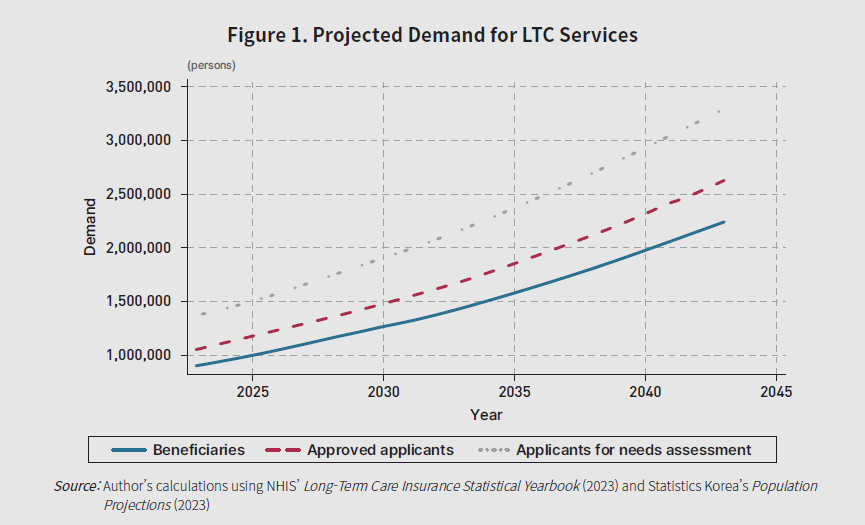
Figure 1 presents demand projections for LTC services under the assumption that the age- and sex-specific demand profile observed in 2023 carries forward unchanged. As the older population expands, demand in 2043 is projected to rise more than 2.4 times its 2023 level. Demand will more than double between 2030 and 2038—a surge driven by the first baby-boom cohort (born 1955–1963) crossing the 75-year age threshold.
Demand for LTC services is projected to increase by more than 2.4 times between 2023 and 2043.
These projections are deliberately conservative, resting on the strong assumption that age- and sex-specific rates for applications for LTC needs assessment, approval, and service utilization remain at their 2023 levels. Policy changes, including coverage expansion, could quickly push demand higher. Applicants for needs assessment constitute a pool of latent demand, individuals who have expressed a need for care but are currently ineligible. Expanding LTC insurance coverage would move part of this group into the beneficiary group, translating directly into higher realized demand.
Health improvements offset demand only modestly. The growing 85+ population will drive faster growth in high-intensity care (Grades 1–3).
Even accounting for health improvements among older adults, the resulting reduction in demand is only about 4–7%. Because no measurable health gains are observed for those aged 85 and over, this moderating effect is expected to weaken over time. Moreover, as the oldest-old cohort with high care demand expands, demand will grow faster in the more resource-intensive end of the care spectrum (Grades 1-3). By 2043, demand for Grades 1, 2, and 3 is projected to increase 2.48, 2.57, and 2.53 times their 2023 levels, respectively.
2. Supply of LTC Services: Care Worker Projections
Demand for LTC services is expected to rise sharply, but the supply of care workers will not keep pace. Figure 2 presents the LTC workforce projections, with 2023 employment patterns by sex, age, and region held constant. The number of active care workers, roughly 710,000 in 2023, is projected to peak at 806,000 in 2034 before turning down. The baseline also holds the current employment rate of care workers constant over the next two decades. As women achieve higher education, participate more in the labor market, and experience rising reservation wages, a further decline in care work participation among women in their 50s and 60s would cause the workforce contraction to begin earlier than the baseline projection.
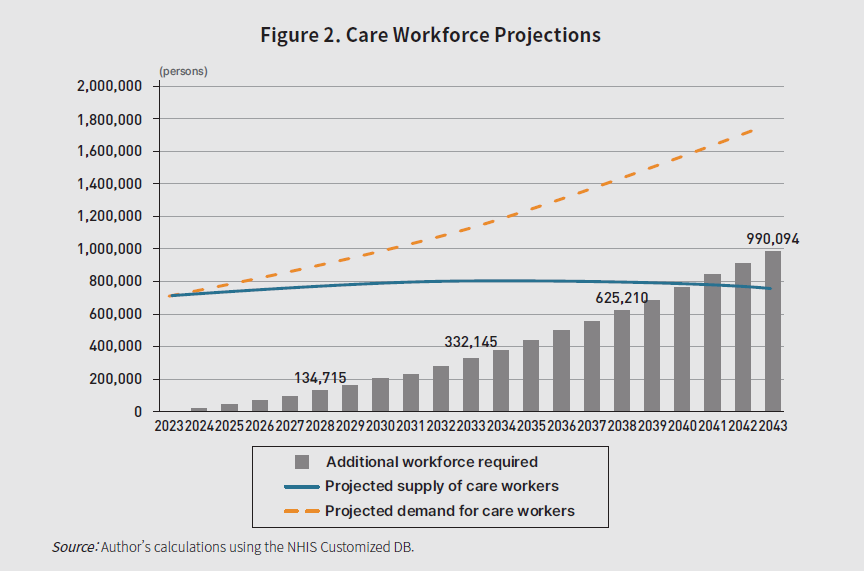
The supply of LTC workers is projected to peak at 806,000 in 2034 before declining.
Recent growth in the care workforce has been driven primarily by older workers. In 2023, the care worker employment rate was 1.55% for those aged 40–59, rising to 2.89% for those aged 60–79. As a result, the share of care workers aged 60 and over is projected to rise from 63.1% in 2023 to a peak of 72.6% in 2043 before gradually falling back.
The share of care workers aged 60 and over is expected to rise from 63.1% in 2023 to 72.6% in 2043, reflecting an increasingly aged workforce.
As the workforce ages, labor productivity will decline, particularly in physically demanding work, further shrinking effective labor supply in the LTC sector. Applying a 20% productivity discount to workers aged 65 and over relative to those under 653) puts the effective size of the 2043 workforce at roughly 90% of the projected headcount.
Holding the 2023 caseload per care worker constant would require an additional 990,000 workers by 2043.
If current trends of demand and supply continue, caseloads for care workers will increase quickly. In 2023, each active care worker served between 1.5 and 1.9 beneficiaries. Under the baseline projection, this ratio rises to 1.9–2.4 by 2030 and to 3.0–3.7 by 2040. Holding caseloads at the 2023 level—the number of beneficiaries per care worker—would require an additional 332,000 workers by 2033, 625,000 by 2038, and 990,000 by 2043.
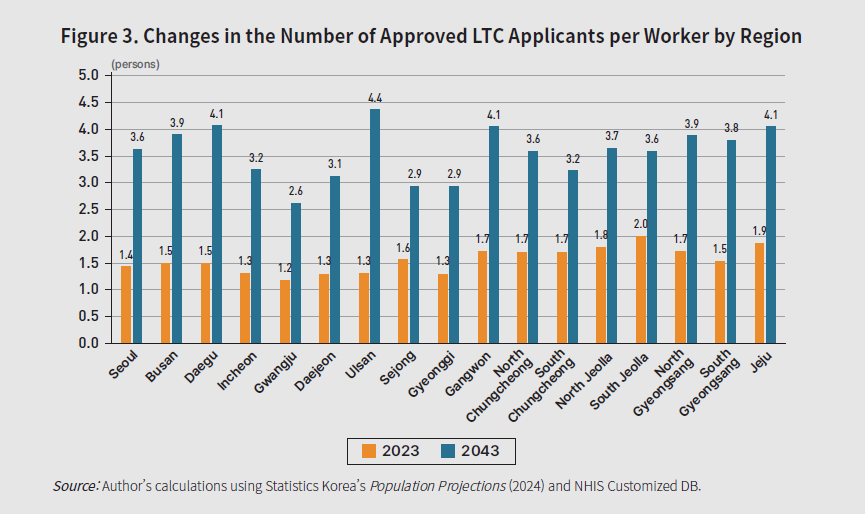
Differences in the pace of aging across regions will widen disparities in the number of beneficiaries per care worker.
The pace of population aging varies significantly across regions, and so do the resulting pressures on demand and workforce shortages. A higher concentration of older adults in a region implies a smaller pool of potential care workers, likely constraining access to care services. Regional assessments of LTC demand and local workforce availability at metropolitan-city and provincial levels are therefore necessary to map the evolving supply-demand imbalances and to calibrate regionspecific responses.
Differences in the pace of aging across regions will widen disparities in the number of beneficiaries per care worker.
Figure 3 compares the number of individuals approved for LTC benefits per care worker across regions in 2023 with the projected figures for 2043. In 2023, the ratio ranged from 1.2 to 2.0. By 2043, it is projected to rise sharply to between 2.6 and 4.4, with regional disparities widening. These pressures will disproportionately affect regions already well advanced in aging. Across Daegu, Busan, Gangwon, North Gyeongsang, and South Gyeongsang, the ratio is expected to exceed 3.8, and worker shortages will intensify.
III. Foreign Care Workers: Current Status and Directions for Visa Policy
Improving job quality is a necessary first step to attract workers in the eldercare sector. However, with rapid growth in Korea’s oldest age groups projected to leave the sector acutely short of care workers, improving working conditions alone cannot close the labor gap. The recruitment of foreign care workers has also been actively debated as an alternative policy option for expanding the eldercare workforce.
Under the current foreign care worker policy, eligibility to work as a care worker in Korea is limited to visa holders with no restriction on domestic employment. Access to the certification course and examination is confined to holders of Resident (F-2), Overseas Korean (F-4), Permanent Resident (F-5), Marriage Migrant (F-6), and Visiting Employment (H-2) visas. A pilot program launched in July 2024 created a care worker category under the Specific Activities (E-7) visa. Under this pilot, international graduates of Korean universities who obtain the certification and take up employment at a care facility may change status to E-7. Accordingly, certification eligibility has been extended to holders of Student (D-2) and Job Seeker (D-10) visas.
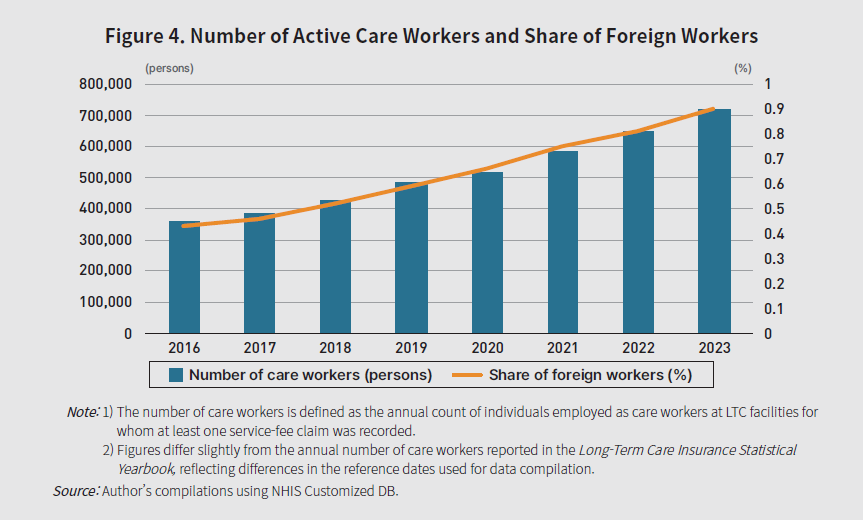
Foreign care workers comprised just 0.9% of the total workforce in 2023, a marginal presence in the sector.
The number of foreign care workers has risen steadily, yet they made up only 0.9% of the active workforce in 2023. This contrasts sharply with comparable roles such as hospital caregivers (ganbyeong-in ), in which ethnic Koreans from China are estimated to account for about 90% of workers. Two factors appear to explain the gap. First, certification acts as a barrier to entry. Second, the foreign nationals currently eligible for certification already hold visas that allow unrestricted employment choices. They tend to gravitate toward betterpaying jobs, with few opting for the LTC sector as its poorer working conditions diminish job appeal.
The current policy, which targets foreign residents whose visas impose no employment restriction, has limited effectiveness in addressing qualitative workforce challenges—namely, rapid aging and regional supply-demand imbalances. While the foreign workforce generally skews younger than its domestic counterpart in comparable roles, this does not hold in the LTC sector: in 2023, 56.6% of foreign care workers were aged 60 or over, close to the 63.2% share among domestic care workers. This age profile is largely driven by low wages in the sector, which filter out younger workers. Many older foreign nationals who had previously worked in hospital caregiving, food service, or manufacturing move into LTC later in life, willing to accept modest pay in exchange for lighter physical demands, greater job stability, and full coverage under the Labor Standards Act. (Kim et al. , 2021).
With 56.6% of foreign care workers aged 60 or over and 77% concentrated in the SMA, their capacity to mitigate workforce aging and regional supply disparities remains highly constrained.
Foreign care workers are also concentrated in the Seoul Metropolitan Area (SMA). In 2023, more than 77% of them worked in the SMA—compared with 44.1% among domestic workers—and this concentration has deepened over time from 72.94% in 2016 to 77.39% in 2023. The pilot program extending certification eligibility to international students is unlikely to significantly alter this spatial imbalance. In 2023, 59% of international students at four-year and two-year colleges were enrolled in the capital region, and given the path dependence of location choice, measures targeted solely at this group will not meaningfully strengthen non-SMA labor supply. As currently designed, the foreign worker approach offers little relief for regional supply-demand imbalances.
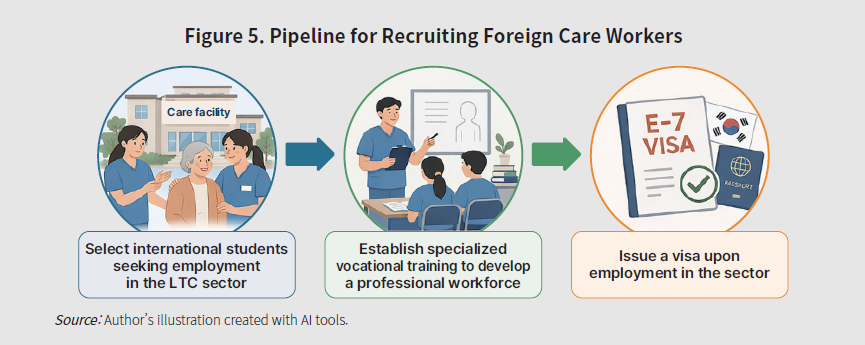
Given the aging care workforce and regional divides in labor supply, managing recruitment and deployment through an occupation-specific visa policy offers a more efficient means to secure an adequate supply of qualified care workers. Because a large inflow of low-skilled migrant workers risks displacing domestic workers, restricting issuance to designated LTC roles and managing aggregate inflows would also help build broader public acceptance of the policy.
Visa policy for foreign care workers should shift to occupation-specific visas with managed aggregate inflows, guided by the extent to which better job quality can expand the domestic workforce.
Foreign worker recruitment should begin with an assessment of the extent of workforce shortages and how much of the gap can be closed by raising job quality for domestic workers. The remaining shortfall would then determine an ex ante quota for foreign care workers, followed by recruitment of trainees and visa issuance upon training and certification. While the required scale for foreign recruitment warrants careful study, applying current service-sector quotas under the Employment Permit System to care facilities would permit up to 63,000 foreign workers, roughly 10% of today’s active care workforce.
Applying current EPS service-sector quotas to care facilities would permit up to 63,000 foreign workers.
One avenue for scaling foreign recruitment is to expand the ongoing E-7 pilot for international students to include care workers. The existing pilot, however, treats students educated in Korea as a stopgap for low-skilled labor shortages—an approach poorly aligned with the mission of higher education to cultivate high-productivity talent and with broader international student policy. To secure a stable labor supply, it would be more effective to recruit international students who intend to work in the LTC sector from the outset and to admit them in line with workforce needs. This model requires dedicated specialized vocational training pipelines—enrolling targeted students, cultivating a professional workforce, and issuing occupation-specific visas upon employment. Korea has already moved in this direction, launching a pilot program to train foreign care workers at selected universities from the spring semester of 2026. This track could be scaled to a level commensurate with the projected shortfall.
The E-7 care worker visa pilot should be expanded in scale, alongside efforts to secure sufficient enrollment for the associated training program.
However, completing the care worker certification requires substantial time and expense, while pay remains near the minimum wage, blunting the incentive to enter the profession. This may constrain the supply of international students willing to enter the LTC sector, calling for concerted efforts to secure sufficient enrollees. Partnerships with major labor-sending countries can help: pre-screening candidates in origin countries and offering Korean-language courses would lower the cost of migration and build a more stable pipeline into the workforce.
Attracting domestic workers and retaining recruited foreign careworkers both require better job quality.
Job quality improvements must accompany the expansion of foreign recruitment. Without them, domestic workers will not be drawn to the LTC sector, and foreign workers will not stay. In Japan, poor working conditions and long hours have driven more than one-third of foreign workers who obtained the Certified Care Worker (Kaigo Fukushishi) qualification to return home, raising questions about the program’s effectiveness (Hirano and Komazawa, 2022). Once permanent residency or a more stable status is secured, there is little policy room to prevent movement into better-paid or less physically demanding occupations. Over time, foreign workers leaving care jobs for better options would reproduce the same workforce patterns seen today and hamper the build-up of skilled labor. Higher wages and stronger rewards for experience and skills should therefore accompany visa reform. To relieve regional imbalances, E-7 holders could, for example, earn additional points toward permanent residency after five years of continuous employment in underserved regions. An incentive framework of this kind would channel foreign workers into regions where the care workforce is in short supply.
Targeted incentives are needed to encourage employment in underserved regions and ease supply-demand imbalances.
Ⅳ. Care Robot Adoption: Current Status and Policy Responses
The second response—deploying care robots to raise labor productivity—has emerged as a key solution to workforce shortages in eldercare. Given the advanced aging of the care workforce, robots that ease the physical demands of the most burdensome tasks can increase worker productivity, reduce workplace injuries, and improve job quality. Above all, their greatest value is that they can deliver better care to recipients. Recent studies find that these technologies ease workload pressures and enhance worker retention, relieving chronic staffing shortages in care facilities. By substituting for or complementing human labor, robots free staff to spend more time with care recipients, which in turn has been linked to fewer falls, fewer pressure ulcers, and less use of physical restraints (Lee et al. , 2024).
Care robot uptake in Korea remains low, with just 6.4% of surveyed facilities deploying them.
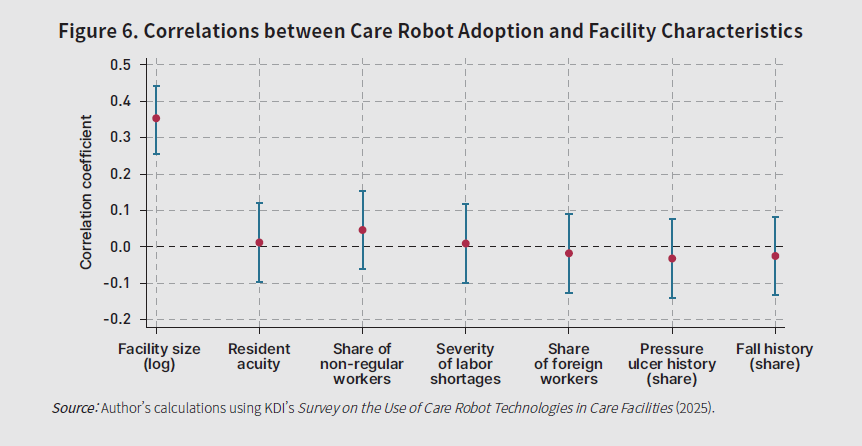
Nevertheless, uptake in Korea remains modest. A survey of care facilities with a licensed capacity of 80 residents or more shows that while 89.1% recognize the need for such technologies, just 6.4% have deployed them. Correlation analysis indicates that larger facilities are more likely to adopt care robots. Resident acuity, the share of non-regular care workers, and prior experience of workforce shortages are all positively associated with adoption, though none of these relationships is statistically significant.
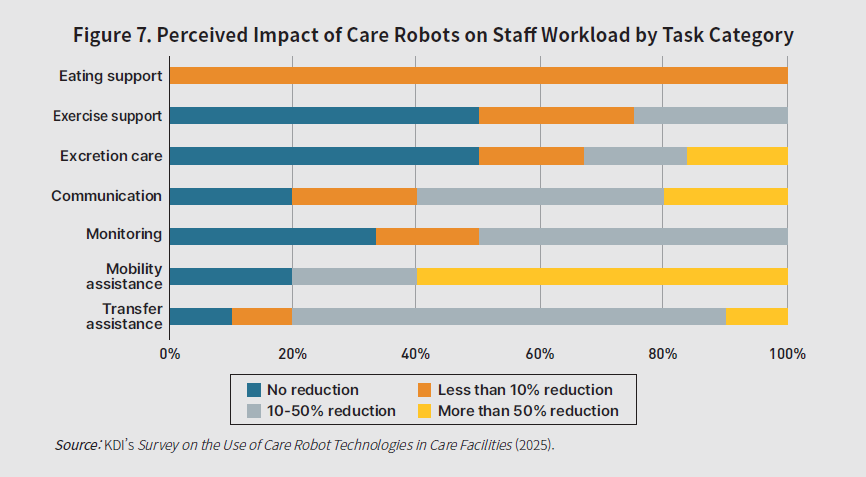
The main reason for deploying care robots is to ease the physical burden on care workers; adopters report workload reductions of more than half in some cases.
Adopter facilities cite two main reasons: (i) easing the physical burden on care workers, and (ii) cutting the time required to perform care tasks. Care robots serve as a productivity tool to mitigate staff shortages. Effects vary by robot type, but adopters generally reported reductions in staff workload. Transfer- and mobility-assistance robots appear particularly effective. For mobility-assistance robots, 60% of adopters reported that their workload eased by more than half.
Care robot adoption remains limited, and these technologies cannot fully substitute for human care workers. They can, however, ease the pressure on labor demand by raising productivity. Japan’s Ministry of Economy, Trade and Industry has estimated that introducing IT technologies and care equipment in LTC could increase productivity sufficiently to reduce labor demand by up to 17% (??産業省, 2018). If a comparable effect can be achieved in Korea, the projected shortfall would shrink accordingly.
Cost is a key barrier to adoption: 51.8% of care facilities would deploy care robots if cost subsidies were provided.
The low adoption rate, despite widespread recognition of need, reflects a combination of perceptions, costs, and concerns about effectiveness. The most frequently cited reason is that care should still be delivered directly by human workers (27.5%), followed by cost considerations (26.9%) and skepticism about effectiveness (21.7%). On costs, 72% of respondents point to subsidies for purchase or rental as the key enabler, and 51.8% say they would adopt care robots if support were provided by the central government, local governments, or the LTC Insurance system.
Care robot policy should expand beyond its developer-centered focus to include support for care facilities, promoting wider adoption in frontline care settings.
Faced with an aging care workforce and a strained labor supply, boosting labor productivity through robot adoption is essential to moderating the growing demand for care workers. To expand the use of care robots in frontline care delivery, policy must move beyond its developer-centered focus to include comprehensive support for user facilities. Although a range of R&D programs is in place, field validation and commercialization remain limited. A platform connecting developers and care facilities would help build an evidence base on effectiveness and accelerate commercialization. The effects of care robots on the health of both residents and workers should be systematically evaluated, and case technologies with proven cost-effectiveness should be supported through financial assistance and integration into the LTC Insurance fee schedule.
Even as care robotics matures, demand for in-person care workers will continue growing. Care robots can moderate the pace of growth in labor demand but cannot fully replace human workers. As routine physical tasks shift to robots, the demand for higher-quality, face-to-face services will likely increase. Therefore, efforts to improve job quality must be maintained alongside technology adoption.
- CONTENTS
-
- I. Introduction
- II. Supply and Demand Outlook for Long-Term Care Services
- III. Foreign Care Workers: Current Status and Directions for Visa Policy
- IV. Care Robot Adoption: Current Status and Policy Responses
- Key related materials
We reject unauthorized collection of email addresses posted on our website by using email address collecting programs or other technical devices. To access the email address, please type in the characters exactly as they appear in the box below.
Please enter the security code to prevent unauthorized information collection.