
Policy Study The Role of Invoicing Currency in International Trade: Determinants and Implications December 31, 2023
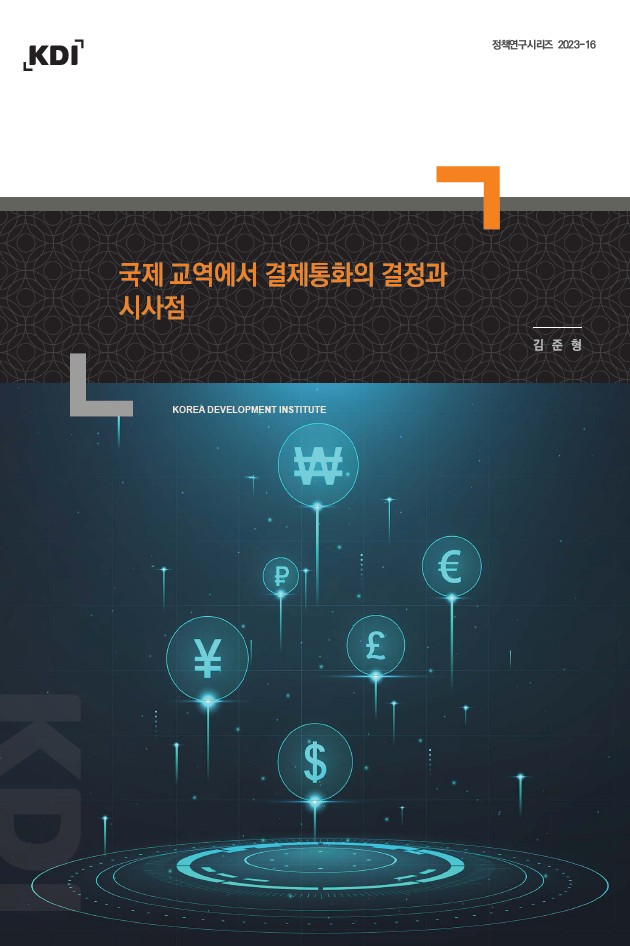
Series No. 2023-16
Policy Study
KOR
The Role of Invoicing Currency in International Trade: Determinants and Implications
#Consumption, Investment, Export-Import, and Balance of Payments
#Trade
#International Finance
#International Macroeconomics
#General(Other)
December 31, 2023
-
Junhyong Kim
 프로필
프로필
- Summary
-
This study examines the determinants of invoicing currency choice in South Korea’s international trade and analyzes how exchange rates affect trade outcomes across invoicing currencies. Using Korean product-level customs data, it documents distinctive patterns in Korea’s invoicing currency composition and identifies key factors shaping firm-level currency choices for exports.
These factors include the invoicing currency composition of imported intermediate goods, firm-level foreign-currency debt ratios, past invoicing practices, export market share, foreign exchange market size, invoicing currencies of competitors, and exchange rate volatility.
The results show that the degree of exchange rate pass-through varies significantly by invoicing currency, leading to meaningful differences in export volumes. Building on these findings, the study investigates the impact of recent exchange rate movements on Korea’s exports and demonstrates that the dominance of the U.S. dollar as invoicing currency imposes significant constraints on Korean export performance.
This study provides an updated and comprehensive overview of Korea’s invoicing currency patterns in trade, offering rich implications regarding the determinants and consequences of invoicing currency choice. The findings are expected to inform ongoing policy discussions on the revision of the Foreign Exchange Transactions Act, the internationalization of the Korean won, and broader initiatives aimed at advancing Korea’s foreign exchange market.
- Contents
-
Abstract (ENG)
Preface
Summary (KOR)
Chapter 1 Introduction
Section 1 Overview
Section 2 Literature Review
Chapter 2 The Current Status of Invoicing Currencies in Korea’s Exports and Imports
Section 1 Overall Trends in Invoicing Currencies of Korea’s Exports and Imports
Section 2 Micro-Level Patterns of Invoicing Currencies in Korea’s Exports and Imports
Chapter 3 Determinants of Export Invoicing Currency Choice
Section 1 Theoretical Models and Empirical Findings on Invoicing Currency Choice
Section 2 Empirical Analysis of Determinants of Invoicing Currency Choice in Korean Exports
Chapter 4 Differential Effects of Exchange Rates by Invoicing Currency
Section 1 Exchange Rate Pass-Through by Invoicing Currency
Section 2 Effects of Exchange Rates on Export Volumes
Section 3 Implications of Invoicing Currency Choice amid Recent Exchange Rate Fluctuations
Chapter 5 Conclusion and Policy Implications
References
Appendix
If you want to know more in detail?
related materials ( 9 )
- Key related materials
Security code
![captcha]()
We reject unauthorized collection of email addresses posted on our website by using email address collecting programs or other technical devices. To access the email address, please type in the characters exactly as they appear in the box below.
KDI Staff Information
Please enter the security code to prevent unauthorized information collection.
KDI Staff Information
KDI Staff Information