
KDI FOCUS Online Retail Growth and Reforming Korea’s Retail Policy June 30, 2026
Online Retail Growth and Reforming Korea’s Retail Policy
June 30, 2026-
Gong Lee
 프로필
프로필

- | Related information |
-
What really happens after you hit 'Buy'?
Online shopping has become a daily routine... or perhaps, everything.
Does that mean brick-and-mortar stores around us are taking a hit?
Part 2 of KDI's Online Retail Series!
This time, we analyzed how significantly the rise in online shopping impacts sales at offline stores.
* This video contains AI-generated video and audio.

Amid the robust expansion of online retail, the retail sector has shown a conspicuous divergence: hypermarket sales have decreased due to competition from online channels, whereas smaller formats like SSMs and convenience stores have expanded by capturing distinct, proximity-based demand. This asymmetrical outcome underscores the need to reform the Distribution Industry Development Act, shifting away from current hypermarket restrictions toward a framework that bolsters the competitiveness of brick-and-mortar retailers and addresses the regulatory imbalances between online and offline channels.
Ⅰ. Background
Over the last decade, Korea’s retail market has undergone an unprecedented structural transformation, driven by the rapid proliferation and advancement of online retail channels. Online retailers have achieved explosive growth by leveraging competitive prices, diverse product portfolios, low search costs, and efficient logistics and delivery systems. Amid the rapid growth, the center of gravity is rapidly shifting from brick-and-mortar stores to online platforms. This shift represents more than a mere expansion of distribution channels—it marks a fundamental restructuring of the retail industry as a whole.
The rapid growth of online retail has widened the gap between the market the Distribution Industry Development Act was designed for and today’s retail reality.
However, the legal and institutional foundation governing the retail sector has not kept pace. The Distribution Industry Development Act, enacted in 1997, was designed primarily to protect traditional markets and regulate hypermarkets. The 2012 amendment maintained the regulatory framework built around large-format offline stores, including restrictions on operating hours, mandatory closing days, and controls on new store openings. Platform-based transactions, such as online and mobile orders and early-morning delivery, have surged, widening the gap between the market the law presupposed and the market as it currently operates.
That gap has created concrete distortions. Offline retailers are subject to regulatory restrictions on operating hours and closing days, while online platforms competing for the same consumer demand face no comparable regulatory requirements. The outcome is a regulatory asymmetry targeted at particular retail formats, undermining both fairness and efficiency across the sector. Critics have also long argued that this structure has weakened the competitiveness of hypermarkets and delayed the adoption of modern retail models such as earlymorning delivery.
The current regulatory framework, still designed around offline retail, is undermining both fairness and efficiency across the retail sector.
How, then, should policy be designed for a market in which online channels have become increasingly dominant? To answer that question with evidence, this paper first examines how the growth of online retail has affected the structure and performance of the existing offline market and then draws out the implications for revising the Distribution Industry Development Act and for the broader direction of retail policy.
Ⅱ. The Growth of Online Retail
Traditional offline channels carry inefficiencies from the inherent limitations of brick-and-mortar stores, including high search costs, difficulty comparing prices, and limited product exposure, whereas online channels connect supply and demand far more efficiently. Through online shopping, consumers save on transaction costs by not having to visit a store, and on search costs by locating a wide range of products with ease. Broader access to a variety of goods is one of the key benefits consumers gain from online channels. On the strength of these efficiencies, the online market has grown rapidly in recent years.
Online retail has expanded rapidly, driven by competitive pricing, a wider range of products, and logistics advancement.
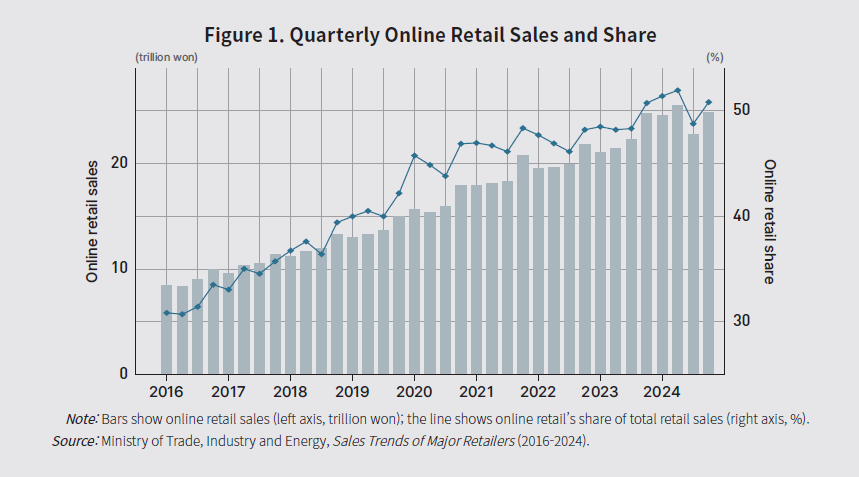
The scale of that growth is clearly visible in the data. As of 2024, Korea’s online retail market stood at roughly 97.74 trillion won, more than double its 2018 level of 48.05 trillion won.
Online retail, once a supplementary channel, has become a core pillar of the retail industry.
The growth is even more striking against offline performance. Total retail sales rose by 8.2% in 2024. Offline sales grew by only 2.0%, while online sales increased by 15.0%. On that momentum, online retail’s share of total sales passed 50% in 2023 (Figure 1) and reached 60% by March 2026. Online retail has become a dominance force of the sector.
The rise of online retail is creating competitive pressure from multiple fronts on traditional offline retailers. In some retail formats, declining sales and store closures are increasingly visible, and the shrinking market share of hypermarkets is the primary example. In early 2025, Homeplus, one of Korea’s three major hypermarket chains, filed for bankruptcy protection under court supervision. Its downfall cannot be explained by management failure at one company alone: convenience stores and SSMs (corporate supermarkets) have steadily improved the quality of their food offerings and operating capabilities, encroaching on hypermarkets’ core competitive territory, and online channels have absorbed customers quickly enough to weaken the very rationale for large offline stores. Given its heavy losses over the past three years, the Homeplus crisis appears to be structural in nature -rooted in broader shifts in the retail landscape rather than firm-specific mismanagement. Even if the immediate danger passes, the broader hypermarket sector is likely to face prolonged operational strain.
The expansion of online retail is exerting competitive pressure on traditional offline retailers, particularly hypermarkets.
Another defining feature of Korea’s online retail market is the dominant growth and expanding market share of Coupang, which built its name on Rocket Delivery. As of January 2024, Coupang accounted for 67.76% of total payment value across sixteen major online platforms, including Gmarket, 11st, Interpark, SSG, AK Mall, Auction, Lotte ON, Lotte Mart, Homeplus, TMON, and WeMakePrice. While other platforms stagnated or grew only modestly, Coupang stayed on a distinctly stronger growth trajectory, with the expedited delivery infrastructure of Rocket Delivery as its competitive edge.
The explosive growth of Coupang, which built its name on Rocket Delivery, brings efficiency gains and consumer benefits, but also risks reducing competition.
Market consolidation around a single dominant platform entails both benefits and risks. Economies of scale and logistics optimization can raise market efficiency and consumer welfare, but these same dynamics can weaken competition among platforms, deepen the bargaining-power imbalance faced by platform vendors, and erode the diversity of the retail ecosystem. This duality suggests that retail policy should look beyond the arithmetic of market growth to weigh market soundness and the long-term sustainability of the retail sector.
III. How Online Expansion Affects the Offline Retail Market
As the preceding section shows, the rapid growth of online retail is reshaping the landscape of Korea’s retail sector. This section analyzes how online expansion affects local offline markets, examining the competitive dynamic between online and offline channels and the resulting shift in market structure. Rather than confining its scope to a single region or policy change, this analysis captures the nationwide effects of online retail growth.
The analysis uses monthly Shinhan Credit Card transaction data from January 2020 through December 2024, aggregated at the eup/myeon/dong (sub-municipal administrative) level. The online retail market is defined as consumer spending in each eup/myeon/dong through online channels, while the offline retail market refers to the total sales of offline retailers in the same administrative unit. Linking these records nationwide allows for an analysis of how changes in per capita online spending affect local offline retail performance at this granular level.
Online expansion is commonly thought to draw demand away from offline retailers—a business-stealing externality. This expectation is grounded in straightforward reasoning: as online spending rises, consumers visit offline stores less often, and offline sales may fall. However, Column (1) of Table 1 shows that a 1% rise in a locality’s per capita online spending (log) is associated with a 0.186% increase in that locality’s total offline sales. This is at odds with the conventional view of online and offline channels as competing substitutes and warrants a closer examination of the underlying mechanism. The analysis therefore decomposes the effect of online retail growth on offline retail by component and format.
Although online retail expansion was expected to reduce offline sales through a businessstealing externality, the analysis shows that higher online spending is associated with higher offline sales.
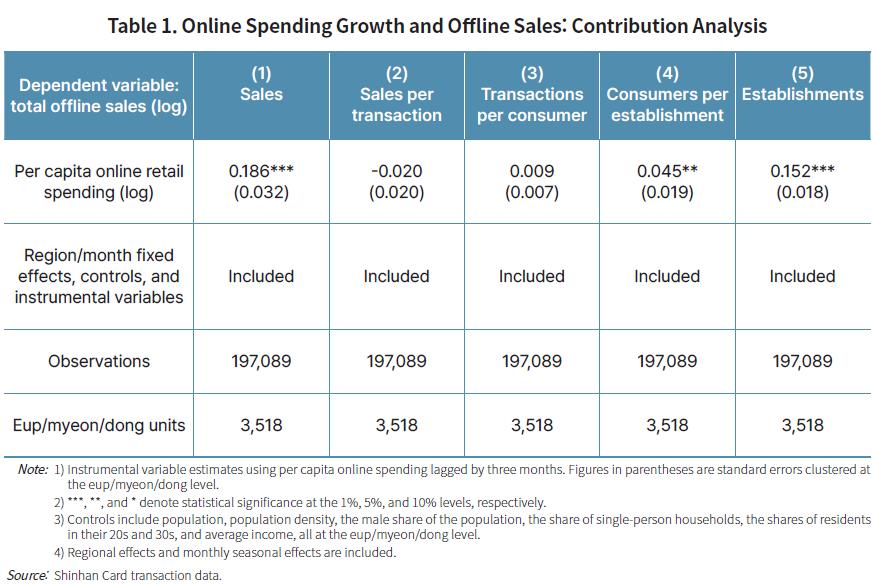
The analysis first decomposes offline sales by component to assess each factor’s contribution to overall market performance. Columns (2) through (5) of Table 1 break total offline sales into sales per transaction, transactions per consumer, consumers per establishment, and the number of establishments. There is no significant change in the intensive margin—(2) sales per transaction and (3) transactions per consumer—despite higher online spending. Along extensive margin, (4) consumers per establishment and (5) the number of establishments both rise clearly by 0.045% and 0.152%, respectively, indicating that higher online spending is associated with an extensive margin expansion.
Offline retail expansion driven by online growth occurs primarily through quantitative expansion, such as increases in the number of establishments and consumers.
Table 2 assesses how the effect differs by format. The analysis distinguishes five major formats: (1) hypermarkets, (2) SSMs, (3) discount stores and supermarkets, (4) convenience stores, and (5)other specialized retailers. The unit of observation is again the eup/myeon/dong level, except for hypermarkets, which are analyzed at the si/gun/gu (municipal administrative) level, since their market reaches beyond a single neighborhood into adjacent areas.
Table 2 shows, for hypermarkets, a 1% rise in per capita online spending (log) is associated with a 0.264% decline in sales. This suggests that rising online spending in a given si/gun/gu may weaken hypermarket sales through a business-stealing externality, putting online channels and hypermarkets in direct competition.
While online expansion erodes hypermarket sales, it drives market growth for proximitybased retailers, such as SSMs, convenience stores, and other specialized retailers.
By contrast, for SSMs, convenience stores, and other specialized retailers, the same 1% rise in sub-municipal per capita online spending expands sales by 0.221%, 0.324%, and 0.356%, respectively. These retail formats are all anchored in neighborhood commercial districts. Their physical proximity to consumers allows them to compete in a demand segment that is distinct from the one online channels serve.
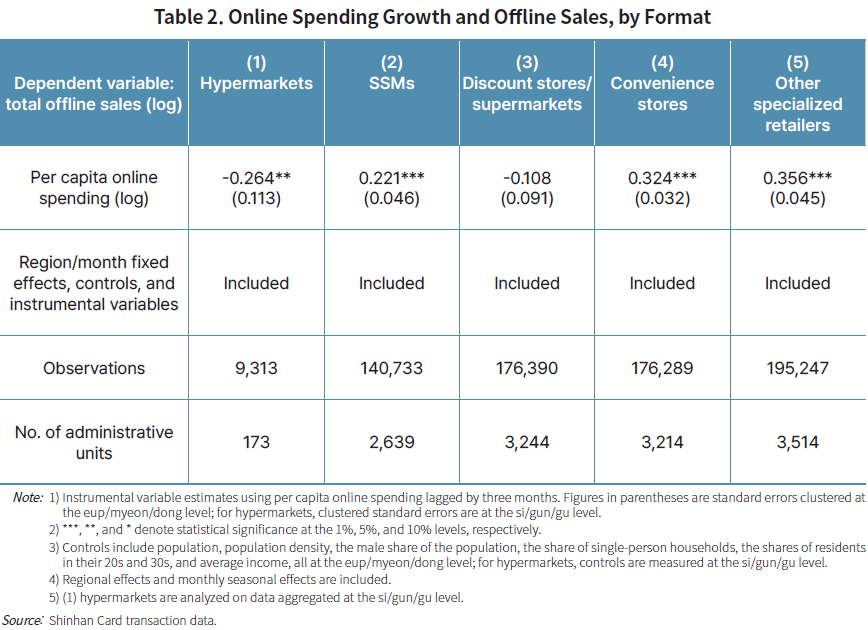
Tables 1 and 2 indicate that online expansion affects offline retail formats asymmetrically. Although total offline sales increase modestly with higher online spending, the gain comes mainly from SSMs, convenience stores, and other specialized retailers. Within these retail formats, the expansion mostly comes from expanding store counts and growing customer bases per store. Hypermarkets, on the other hand, are directly impacted by online channels, resulting in lower sales. A detailed account of the mechanisms behind this divergence lies beyond the scope of this study, but several possibilities merit consideration.
Higher online spending may stimulate latent consumer demand and broaden the overall retail market.
First, online shopping lowers the travel, time, and search costs of visiting brick-and-mortar stores, easing the barriers to buying. Consumers may then make additional purchases that they would otherwise have postponed or forgone. This can expand total consumer spending across both online and offline channels as online retail continues to spread.
Second, demand for physical stores may persist in product categories or situations that online channels cannot fully serve. Offline retailers that recognize these consumption patterns have an incentive to adjust their location and business strategies to improve consumer access. The rise in the number of offline retail stores despite higher online spending suggests that SSMs, convenience stores, and other specialized retailers may be responding endogenously by opening stores closer to consumers and adopting strategies to attract new ones.
Higher online spending may encourage new business entry and customer inflows among neighborhood-serving offline retailers.
Ultimately, the proliferation of online retail may allow consumers to satisfy some of the demand that had previously remained latent. While consumers tend to buy a wide range of goods online, they continue to rely on neighborhood stores. This pattern may lead some formats such as SSMs and convenience stores to expand their store networks and improve consumer access. In this way, rising consumer spending across online channels and neighborhood offline stores comes at the direct expense of hypermarkets, which consumers have long frequented.
This finding is significant in that higher online spending does not simply reshuffle existing demand within the retail market. Instead, the convenience of online shopping can unlock latent demand and reshape consumption patterns. Offline formats that employ flexible strategies such as new market entry can maintain their competitiveness despite online expansion, contributing to the broadening of the retail market as a whole. In short, online growth, shifts in offline strategy, and changes in consumption occur together. Retail policy should move beyond the zero-sum assumption that equates the rise of online retail with the decline of offline retail and instead recognize the possibility that the retail ecosystem as a whole may expand.
Policy discussions should move beyond the zero-sum assumption that equates online retail expansion with offline retail contraction.
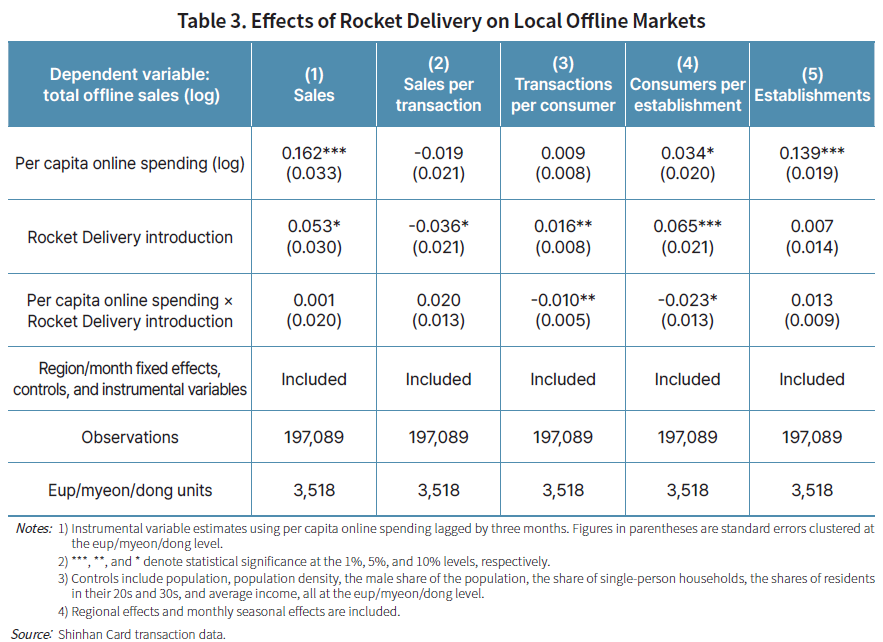
Same-day delivery, led by Coupang’s Rocket Delivery, adds another dimension to the relationship between online and offline retail. Table 3 examines the effect of higher online spending on the offline retail market in areas where it has been introduced.Rocket Delivery produced no additional change in total offline sales, but it did alter some of the underlying components. Specifically, a 1% increase in online spending in these areas is associated with an additional 0.010% fall in offline transactions per consumer and an additional 0.023% fall in consumers per offline retailer. The advent of fast delivery systems, such as Rocket Delivery, further reduces the frequency with which consumers visit offline stores.
Rocket Delivery has reduced visit frequency at offline retailers, though its aggregate impact remains limited.
To sum up, while the introduction of Rocket Delivery is changing spending patterns, including visit frequency, there is little evidence that it has significantly impacted the broader retail market. However, should delivery systems become increasingly sophisticated, their effects on offline sales and market structure could expand considerably, warranting continued monitoring.
Ⅳ. Policy Implications
Unlike in 2012, when the Distribution Industry Development Act was last amended, online retail today wields far greater influence on the entire retail sector. Retail policy must be redesigned to reflect this evolving competitive dynamics between online and offline channels. Only then can both channels, particularly offline retailers, remain competitive. Drawing on the findings above, this section outlines implications the Distribution Industry Development Act and for retail policy more broadly.
1. Ensuring Regulatory Balance between Online and Offline Channels
The current Act is designed to protect traditional markets by restricting hypermarkets through operating hour limits and mandatory closing days. However, as online retail continues to expand, it is increasingly doubtful whether regulating hypermarkets remains an effective way to protect traditional markets. In particular, the finding that hypermarket sales decline as the online market grows suggests a need to reevaluate the rationale for these regulations.
The offline-oriented Distribution Industry Development Act should be revised to remedy the regulatory asymmetry between online and offline channels.
This distortion stems from the fundamental limitation that the current regulatory framework was designed with only the offline retail environment in mind. The Act targets offline hypermarkets, while online platforms absorbing the same consumer demand face no comparable regulatory obligations. This asymmetry results in a disproportionate regulatory burden falling on a specific offline retail format. Future amendments should urgently establish regulatory parity between online and offline channels, ensuring a balanced framework in which the regulatory burden is not concentrated on any single channel.
2. Building a Foundation for Proximity-based Small Offline Retailers
Even as the online market expands, certain neighborhood-based offline formats continue to grow by opening new stores and differentiating their product offerings. This outcome demonstrates that adapting business strategies to changing market dynamics can turn market challenges into opportunity and build a sustainable competitive edge.
Policy support should help traditional markets and offline retailers strengthen their local consumer base and expand product offerings that online channels cannot easily replicate.
Despite the growing dominance of online channels, a subset of consumer demand remains difficult to satisfy online, such as making immediate purchases, inspecting fresh groceries in person, and making quick nearby purchases. This mismatch is creating a dual structure: online channels absorb the general-purpose demand hypermarkets once served, while creating distinct niches for neighborhood retailers. Accordingly, policy support should focus on helping proximity-based offline retailers, including traditional markets, expand their local consumer accessibility and broaden the goods and services online platforms cannot easily replace, such as local specialties, ready-to-eat food, and community-based services.
Furthermore, offline retailers must be able to fully leverage advancing online channels—a shift that calls for dedicated policy support. The trajectory of Korea’s retail market points to a synthesis of the strengths of online and offline channels,20) where online platforms handle search, comparison, and purchase, and offline stores specialize in hands-on experience and staff advice. By pairing brick-and-mortar retail (mortar) with online channels (click), this click-and-mortar strategy can generate synergies. Bringing this strategy within reach of offline retailers through digital transformation, specifically online-tooffline (O2O) platform integration and data-driven marketing, will be critical to securing new sources of competitiveness.
3. Adjusting Retail Policy for Advances in Online Logistics
While Rocket Delivery has had a minor impact on offline sales, it has altered the qualitative nature of offline consumer behavior. This shift underscores that fast delivery systems like Rocket Delivery are structurally reshaping consumer spending patterns. Over the long run, further advances in logistics infrastructure—particularly if Chinabased C-commerce platforms such as Temu and AliExpress establish early-morning and same-day delivery networks in Korea—could trigger business-stealing externalities that erode offline retailers’ sales. Low pricing coupled with delivery convenience will likely sharply intensify competitive pressure on proximity-based offline retailers.
Advances in logistics infrastructure should be continuously monitored, with the findings promptly reflected in retail policy.
A systematic mechanism is required to monitor the impact of logistics advances on offline retail and integrate these findings into the legislative cycle to enable flexible policymaking. Because logistics innovation is a powerful driver for qualitative shifts in consumer behavior, priority must be given to tracking the speed and direction of these market changes in real time to facilitate proactive regulatory responses.
4. Fostering Fair Competition for Online Retail Platforms
Promoting fair competition in the retail market extends beyond achieving regulatory parity between online and offline channels, and ensuring it within the online market is essential for the long-term sustainability of the retail ecosystem. Market concentration on a single platform generates the consumer benefit of economies of scale, but it also carries the risk of deepening bargaining-power imbalances between platforms and third-party sellers. Where a dominant platform imposes unreasonable commission increases, unilaterally revises contract terms, or favors its own offerings algorithmically, such conduct may constitute abuse of superior bargaining position under the Monopoly Regulation and Fair Trade Act (MRFTA), ultimately undermining the diversity and innovative capacity of the retail ecosystem.
Abuse of superior bargaining position by online platforms should be actively curbed to promote fair competition.
Accordingly, the Korea Fair Trade Commission should strengthen its monitoring of anti-competitive practices by online platforms. Core priorities include ensuring the transparency of contractual terms between platforms and third-party sellers and reviewing the fairness of platform fee structures. The regulatory aim is not to penalize dominant firms, but to preserve the retail sector’s innovative capacity by guaranteeing fair competition among platforms and reasonable operating conditions for third-party sellers.
The sustained vitality of the retail industry can be secured only when fair competition is guaranteed both across online and offline channels and among online platforms. When regulatory parity and competitive fairness are in place together, the retail ecosystem can maximize consumer welfare while sustaining its own long-term development.
- CONTENTS
-
- I. Background
- II. The Growth of Online Retail
- III. How Online Expansion Affects the Offline Retail Market
- IV. Policy Implications
- Key related materials
We reject unauthorized collection of email addresses posted on our website by using email address collecting programs or other technical devices. To access the email address, please type in the characters exactly as they appear in the box below.
Please enter the security code to prevent unauthorized information collection.