
KDI FOCUS Shifting Mandatory Closures to Weekdays: Implications for Retail Policy May 21, 2026
Shifting Mandatory Closures to Weekdays: Implications for Retail Policy
May 21, 2026-
Jinkook Lee
 프로필
프로필


This study finds that shifting mandatory closing days to weekdays increased hypermarket sales across the regions examined, without a corresponding decline in other offline retail formats such as traditional markets. The gains appear to reflect a shift of consumer spending from online to offline channels rather than reallocation within the offline sector. The mandatory closure policy has long rested on the assumption that offline retailers compete primarily with one another, hence its traditional focus on weekends. Given the growing fluidity of spending between the two channels and the wide variation in local market conditions across regions, the weekday shift should be actively explored.
Ⅰ. Background
Since 2012, Korea has required hypermarkets (large discount stores) and corporate supermarkets (super supermarkets or SSMs) to close on two designated weekend days each month in order to protect traditional markets and neighborhood commercial districts and to promote a healthy and fair retail ecosystem. The policy was premised on the substantial overlap of consumer demand between hypermarkets and traditional markets. By restricting operating days, it sought to redirect consumer spending toward traditional markets.
It is time to reassess whether the mandatory closure policy still fits the changed retail environment.
More than a decade on, these structural assumptions have been overtaken by the spread of e-commerce and the reorganization of retail around platform-based channels, fundamentally reshaping competition among retail formats and altering how consumers shop. These shifts raise genuine questions about whether the original premise that consumers primarily substitute between offline retail formats still holds.
Several local governments have recently adjusted this mandate while retaining its basic framework, moving mandatory closing days from weekends to weekdays. These changes, introduced in major cities including Daegu, Seoul, and Busan, can be seen as a natural policy experiment. By easing restrictions on weekend shopping, they may have meaningfully affected both consumer convenience and the distribution of sales across retail formats. As similar changes spread to other regions, their effects warrant careful empirical examination.
This study examines how moving mandatory closing days to weekdays affected sales across retail formats.
This study constructs a comprehensive dataset of changes to mandatory closing schedules across municipalities nationwide and links it with monthly Shinhan Card transaction data from 2015 to 2024 to analyze how moving mandatory closing days to weekdays affected sales across retail formats.
Ⅱ. Changes in the Retail Market and the Spread of Weekday Closures
1. The Changing Retail Landscape
Discussion of moving mandatory closure to weekdays needs to be understood against the backdrop of recent structural changes in the retail market (Figure 1). Hypermarket sales rose from 26.4 trillion won in 2006 to a peak of 39.5 trillion won in 2014, before falling to 28.3 trillion won by 2023. The number of hypermarkets followed a similar trajectory, expanding by about 1.4 times between 2006 and 2012, then slowing and more recently beginning to decline (Table 1). These trends suggest that hypermarkets have moved past a growth phase driven by store expansion and entered a period of structural adjustment.
As hypermarket sales declined, convenience stores, a retail format closely tied to everyday consumer needs, entered a period of rapid expansion. Their sales jumped from 4.7 trillion won in 2006 to 34.8 trillion won in 2023, while their store count grew to about 5.8 times the 2006 level over the same period. This expansion became particularly pronounced after 2016, reflecting increasing demand for small-basket, proximity-based shopping as single-person households multiplied, alongside stronger private-brand offerings and the greater adoption of a 24-hour operation model.
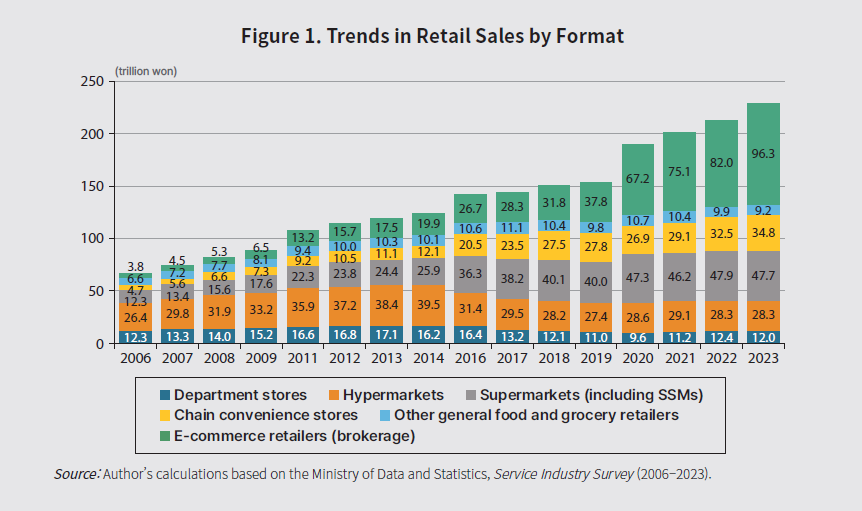
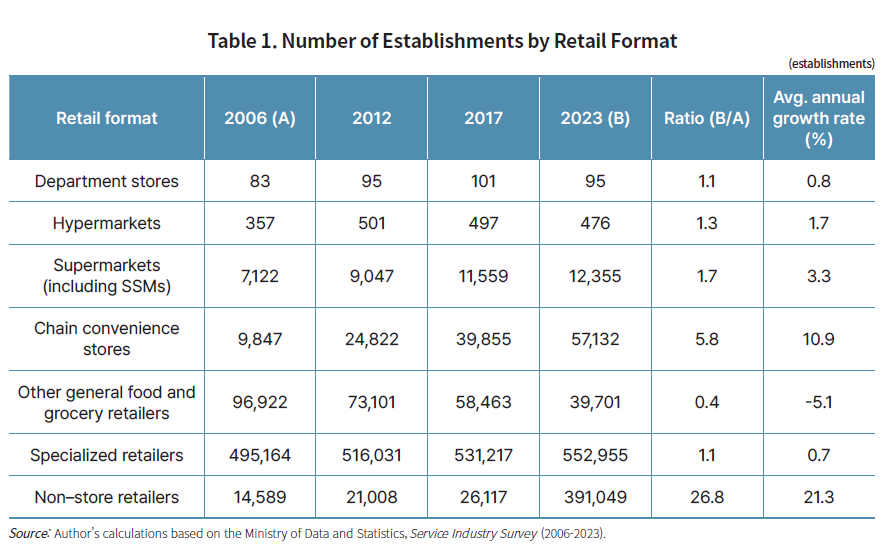
The neighborhood supermarket segment, including corporate supermarkets (SSMs), saw sales expand about 3.9 times despite the limited growth in store count. Conventional supermarkets still hold a large share, but as SSMs continue to expand, the segment appears to be gradually shifting toward larger, more efficient corporate-run formats. Since 2020, however, its sales growth has also shown signs of slowing.
Other general food and grocery retailers―a retail format consisting largely of independent stores operated by small business owners―have seen a long-running decline in their store count, with sales remaining stagnant or slightly contracting. This reflects concurrent trends of independent store closures and their conversion into convenience stores, driven by intensifying competition from corporate retail formats with superior logistics efficiency, economies of scale, and product differentiation.
Since the mid-2010s, hypermarket sales have shifted into decline, while convenience stores and SSMs have continued to expand.
The most consequential development has been the rise of non-store retail, which distributes goods and services through online platforms. The number of establishments rose from 14,589 in 2006 to 391,049 in 2023, a roughly 27-fold increase, driven by the expansion of platform-based e-commerce, such as NAVER Smart Store and Coupang, and the growing participation of small-scale sellers, including individual sellers.2) Sales grew from 3.8 trillion won to 96.3 trillion won over the same period, an about 25-fold increase, lifting the segment’s share of total retail sales from around 6% to more than 40%. E-commerce is no longer a supplementary retail channel. Now it occupies the center of Korea’s retail market.
The rapid growth of online retail is tilting Korea’s retail market away from offline stores and toward online platforms.
2. The Shift to Weekday Closures
As online shopping expanded and reshaped competition across retail channels, the operation of the mandatory closure policy itself began to evolve. Daegu Metropolitan City set an early precedent in February 2023, moving the mandatory closing days for all districts and counties under its jurisdiction to Mondays. Weekday closures subsequently gained momentum in Cheongju, Seoul, Busan, Gyeonggi-do, and other regions.
Since 2023, Daegu, Seoul, and Busan have been at the forefront of the weekday shift.
In step with these developments, the Korean government clarified in January 2024 that the Distribution Industry Development Act does not require mandatory closing days to fall on public holidays. Such days can also be designated on non-holidays through agreement among stakeholders. In April 2024, the government went further, announcing a plan to extend weekday closures to 76 municipalities nationwide and sharing the details with local governments.
The shift to weekday closures now covers 30 municipalities and over 300 stores.
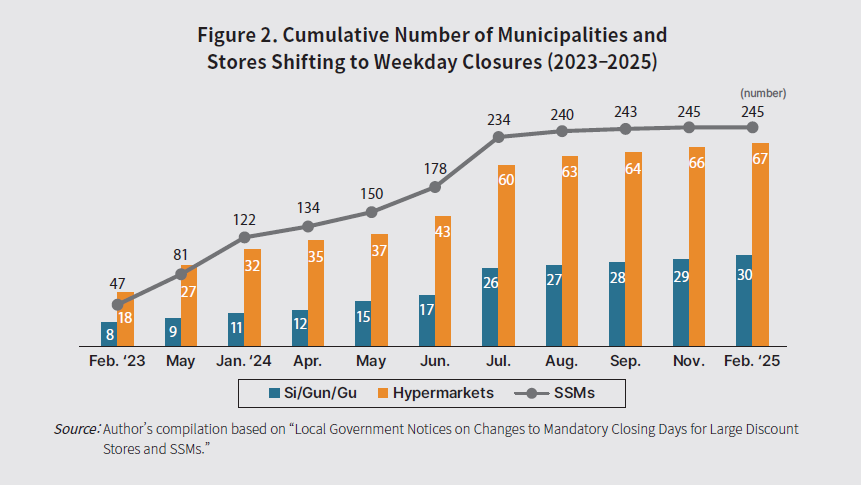
Figure 2 tracks the cumulative number of municipalities―cities (si ), counties (gun ), and districts (gu )―that moved mandatory closing days to weekdays after February 2023, along with the store counts in those areas. The number of participating municipalities grew from eight in mFebruary 2023 to 30 by February 2025, approximately 13% of the 226 municipalities nationwide.
The number of hypermarkets subject to weekday closures rose from 18 to 67,4) while the number of SSMs rose from 47 to 245. The expansion accelerated markedly after mid-2024, reflecting broader participation by local governments, including Busan, following the central government’s announcement of its policy direction.
Table 2 summarizes cases between 2023 and 2025 in which mandatory closing days were moved to weekdays or lifted entirely. It illustrates how these institutional changes spread gradually and unevenly, led primarily by local governments. The transition pattern includes cases implemented uniformly at the metropolitan level, as in Daegu, and cases introduced sequentially by individual municipalities, as in Busan and parts of Seoul. In Busan, in particular, the scope of implementation expanded progressively as individual districts adopted weekday closures one after another after April 2024.
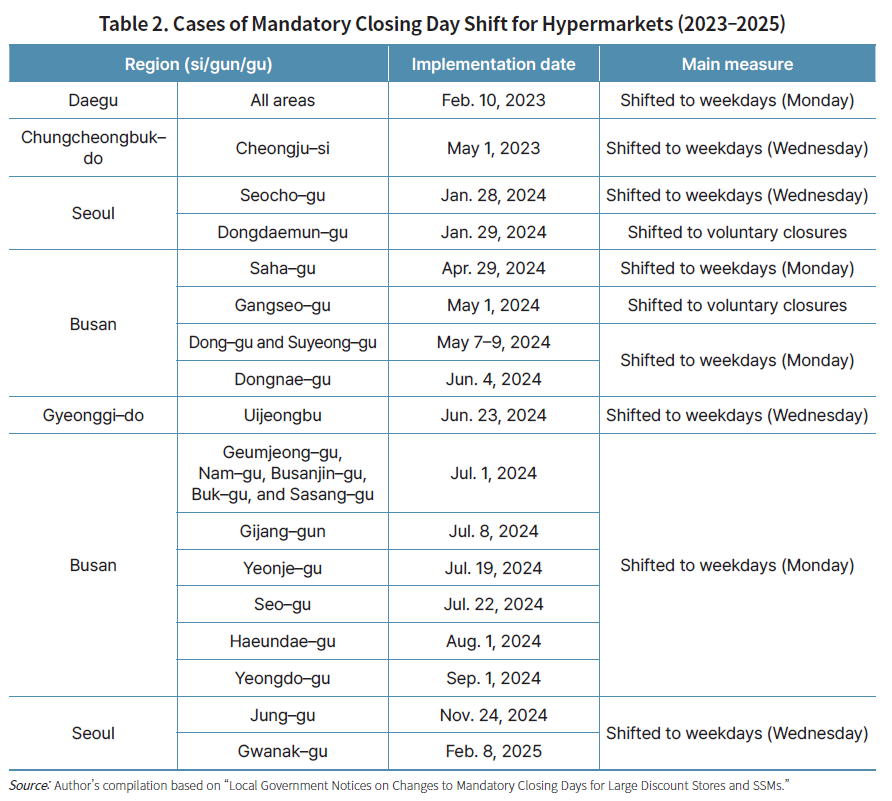
The policy changes also took different approaches: some municipalities shifted mandatory closure days to weekdays, while others replaced the mandate with voluntary closure arrangements. Designated days differed as well, with Mondays chosen in some areas and Wednesdays in others. Rather than converging toward a single model, its operation continues to diversify in response to local conditions and the policy judgments of individual local governments.
The shift to weekday closures varies across municipalities, reflecting local conditions and policy judgments.
III. Effects of Moving Mandatory Closing Days to Weekdays
1. Identifying Policy Effects Using Staggered Regional Rollouts
Because the mandatory closure policy was introduced almost simultaneously nationwide, cross-regional comparisons provided limited scope for identifying policy effects. The recent shift to weekday closures, by contrast, has occurred at varying times across municipalities: some adopted it in 2023, others followed in 2024, while a substantial number maintain the status quo.
This study identifies the policy effects by exploiting differences in the timing of weekday closure adoption across municipalities.
This study exploits the variation in adoption timing to identify policy effects. When estimating the impact of Daegu’s shift to weekday closures in February 2023, for instance, regions that had not yet made the change at that point serve as the control group―including both municipalities that never adopted the change and those that did so later. The analysis is designed to compare changes in treated regions before and after adoption with changes in other regions over the same period, while controlling for nationwide economic and consumption trends.
The analysis uses monthly Shinhan Card merchant-level transaction data from January 2015 through December 2024, linked to a complete record of changes to mandatory closing days compiled from local government notices.5) To account for region- and format-specific characteristics and minimize the biases associated with simple before-and-after comparisons, it applies a heterogeneous difference-in-differences (DID) panel model with interactions among treatment status, post-treatment period, and retail format.
2. Sales Effects across Retail Formats
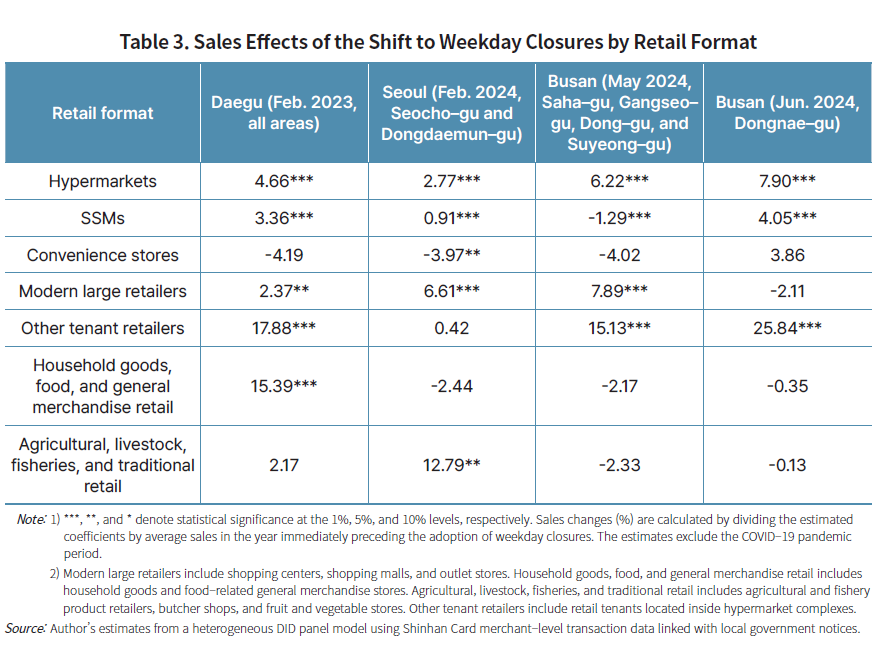
This section examines the specific effects of the shift to weekday closures on sales across retail formats (Table 3).
1) Hypermarkets and SSMs
As the direct target of the mandatory closure policy, hypermarkets posted consistent sales increases across the major regions examined. The estimated gains were 4.7% in Daegu, 2.8% in Seoul (Seocho-gu and Dongdaemun-gu), and 6.2-7.9% in Busan, pointing to some recovery in demand that had been constrained by weekend operating restrictions.
After the weekday shift, hypermarket sales rose consistently across major regions―up 4.7% in Daegu, 2.8% in Seoul, and 6.2-7.9% in Busan.
Hypermarkets are primarily one-stop destinations for groceries and household goods, closely tied to family shopping trips. For dual-earner households and families with children, work and caregiving demands limit available time on weekdays, pushing most of their shopping to weekends. Weekend closures may therefore have restricted shopping schedules and imposed additional travel and search costs on these households. Moving mandatory closing days to weekdays allowed consumers to shop at more convenient times, expanding choice and convenience―a shift that appears to be reflected in higher hypermarket sales.
By expanding consumer choice and convenience, the weekday shift appears to have led to higher hypermarket sales.
SSMs, which are also direct targets of the policy alongside hypermarkets, may likewise have benefited from the easing of operating constraints. Indeed, sales increased by about 3.4% in Daegu, 0.9% in Seoul (Seocho-gu and Dongdaemun-gu), and 4.1% in Dongnae-gu, Busan (Table 3).
SSM sales, however, declined by about 1.3% in parts of Busan (Saha-gu, Gangseo-gu, Dong-gu, and Suyeong-gu). This outcome is consistent with a substitution effect: as weekend access to hypermarkets was restored, some demand appears to have shifted back from SSMs to hypermarkets. In areas where hypermarkets are highly accessible, this effect may have been especially pronounced, likely contributing to the observed decline in SSM sales.
2) Convenience Stores
Convenience stores were the fastest-growing offline retail format in the 2010s. Beyond their structural growth drivers, such as the rise of proximity-based consumption, they may also have captured some demand displaced by mandatory weekend closures at hypermarkets. In this context, the roughly 4% decline in convenience store sales in Seocho-gu and Dongdaemun-gu, Seoul, suggests that some demand previously diverted to convenience stores returned to hypermarkets after the weekday shift.
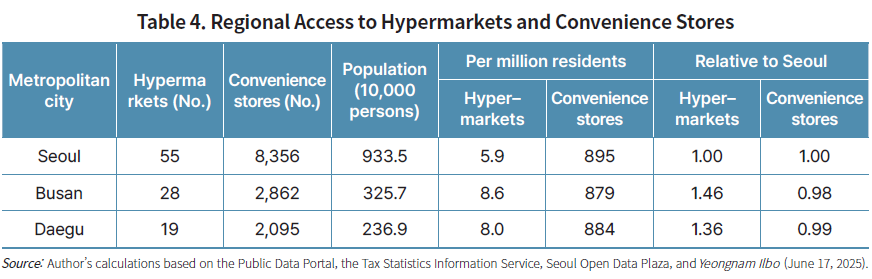
Regional differences in the distribution of retail formats and consumer environments may also be relevant. As shown in Table 4, the hypermarket-to-population ratio is considerably lower in Seoul (5.9) than in Busan (8.6) or Daegu (8.0), while the ratio for convenience stores is broadly similar across all three cities. Coupled with Seoul’s high population density and stronger orientation toward proximity-based consumption, these differences may have encouraged greater substitution toward convenience stores on mandatory closing days, a pattern that reversed once weekend accessibility to hypermarkets improved.
3) Modern Large-format Retailers and Other Tenant Retailers
Sales in modern large-format retail, including shopping centers, shopping malls, and outlet stores, rose across the regions examined: 6.6% in Seoul, 2.4% in Daegu, and 7.9% in Busan (Saha-gu, Gangseo-gu, Dong-gu, and Suyeong-gu). Other tenant retailers within hypermarket complexes recorded large gains: 17.9% in Daegu, 15.1% in the aforementioned Busan districts, and 25.8% in Dongnae-gu, Busan.
Sales gains at modern large-format retail and tenant retailers suggest that the foot-traffic effect of hypermarkets can extend to co-located stores and neighboring commercial districts.
These results indicate that lifting weekend closures at hypermarkets generated additional foot traffic that spread to co-located and adjacent commercial establishments. Modern large-format retail complexes often incorporate hypermarkets as anchor tenants on the same site, suggesting that higher hypermarket traffic may have generated spillover spending across a range of businesses within the complex. In addition, because tenant retailers in hypermarket buildings consist of various store types, the foot-traffic effect of this anchor function appears to have extended to small businesses, franchise stores, and corporate-owned stores.
4) Household Goods, Food, and General Merchandise Retail; Agricultural, Livestock, Fisheries and Traditional Retail
Finally, and notably, no consistent evidence of sales declines emerged in household goods, food, and general merchandise retail or in agricultural, livestock, fisheries, and traditional retail (a category covering agricultural and fishery product retailers, butcher shops, and fruit and vegetable stores) across most of the regions examined. This suggests that a limited regulatory relaxation of the kind examined here does not necessarily translate into lower sales at traditional markets or neighborhood commercial districts.
Following the shift to weekday closures, no clear evidence of sales declines emerged in household goods and grocery retail or in agricultural, livestock, fisheries, and traditional retail across most regions studied.
Today’s retail landscape is differentiated not only between online and offline channels but also within the offline sector itself, which has been subdivided into formats such as hypermarkets, SSMs, convenience stores, and traditional markets, each serving distinct functions and consumer needs. In this process, hypermarkets and SSMs show relatively high substitutability in product mix and shopping patterns, while convenience stores function as partial substitutes for immediate local shopping needs. Meanwhile, as a substantial share of demand for processed foods and daily necessities has shifted toward online channels and hypermarkets, traditional markets generally serve a distinctly different pattern of demand, characterized by frequent small-basket purchases of fresh food, face-to-face transactions, and locally rooted consumption.
Where hypermarkets and traditional markets serve different consumer needs, a rise in hypermarket sales following the weekday shift may not lead to a decline in traditional market sales.
Where traditional markets function as partially independent retail channels, competing with hypermarkets only in selected product categories rather than serving as close substitutes, higher hypermarket sales following the weekday shift do not automatically translate into lower traditional market sales. In some regions, sales in these categories actually increased. In Daegu, household goods, food, and general merchandise retail posted a statistically significant gain. In Seocho gu and Dongdaemungu, Seoul, agricultural, livestock, fisheries, and traditional retail also rose significantly. Dongdaemungu is notable for its concentration of traditional markets, including Gyeongdong Market, Seoul Yangnyeong Market, and Cheongnyangni General Market, which account for a large share of the local commercial base. In such areas, consumers may plan hypermarket visits around manufactured goods and processed foods, then make additional trips to traditional markets for fresh items, smallbasket purchases, or products where traditional vendors offer distinct quality or pricing.
That said, these findings should not be generalized to all regions. In areas where online shopping has not yet taken hold or where offline retail formats are close substitutes for one another, the possibility that higher hypermarket sales could lead to lower traditional market sales cannot be ruled out.
3. Changes in Online Shopping after the Weekday Shift
Rising hypermarket sales following the shift to weekday closures, combined with the absence of clear sales declines at other offline retail formats, suggest that this spending increase cannot be attributed simply to substitution within offline retail.
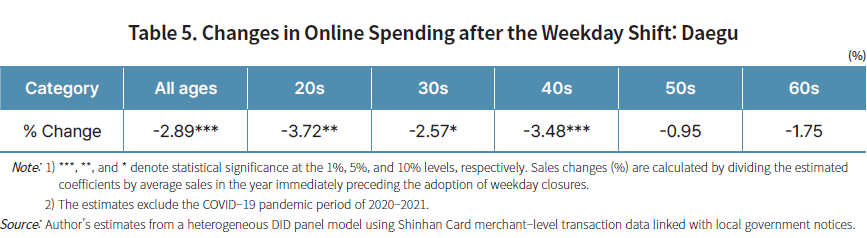
As an additional check to examine whether spending moved from online to offline channels, this study constructs a separate dataset of Shinhan Card online transactions and analyzes changes in online spending following the shift. Because online shopping rose structurally during the COVID-19 pandemic, the analysis excludes this period of 2020-2021.8) To secure a sufficient post-policy observation window, it focuses on Daegu, the first region to implement this shift.9) The results show that overall online spending fell by 2.9% following the weekday shift. By age group, statistically significant declines were concentrated among consumers in their 20s (3.7%), 30s (2.6%), and 40s (3.5%) (Table 5). Among consumers in their 50s and 60s, by contrast, the estimated declines were smaller and statistically insignificant.
Following the weekday shift, online spending fell by 2.6-3.7% among consumers in their 20s-40s.
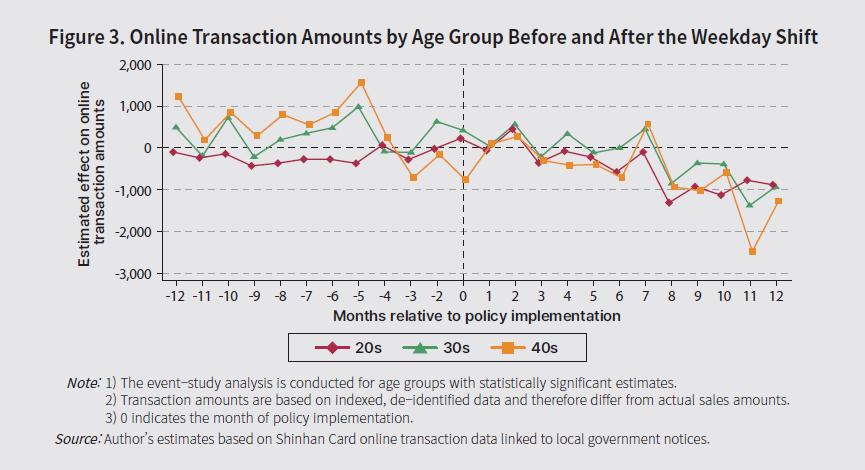
The event-study analysis in Figure 3 also shows no statistically significant differences in pre-policy trends. However, following implementation, online spending gradually declined among consumers in their 20s, 30s, and 40s. The decline was pronounced at certain intervals for consumers in their 40s, an age group with a high proportion of dual-earner households and families with school-age children. These patterns suggest that improved weekend accessibility to hypermarkets and other offline retailers drew some spending away from online channels.
Furthermore, this effect did not materialize immediately after the shiftFurthermore, this effect did not materialize immediately after the shift took effect but emerged with a lag of roughly six months and built gradually thereafter. This pattern likely reflects the time needed for consumers to become aware of the institutional change and adjust their shopping routines. As consumers accumulated experience comparing and learning the benefits of online and offline channels, their spending choices appear to have moved incrementally.
The decline in online spending was relatively pronounced among consumers in their 40s, an age group with a high share of dual-earner households and families with children.
Ⅳ. Overall Assessment and Policy Directions
Overall, shifting mandatory closing days to weekdays boosted hypermarket sales across Daegu, Seoul, and Busan. The gains appear to reflect a shift of some consumer spending from online to offline channels rather than substitution or reallocation among offline retailers. No consistent evidence emerged that the weekday shift reduced traditional market sales. Certain retail categories actually saw sales growth, likely reflecting foot-traffic spillovers from hypermarkets.
These findings suggest that hypermarkets and traditional markets do not compete directly for the same consumer demand. Their customer bases seem to be segmented in part by shopping purpose, convenience, accessibility, and age profile. In a retail environment where online channels account for a substantial share of consumer spending, the effects of mandatory closures and the weekday shift may operate less through competition within offline retail than through the reallocation of spending between online and offline channels. To better reflect these changes in the retail sector, the following section offers policy recommendations for greater flexibility in mandatory closures.
1. Prioritizing the Weekday Shift
Given changes in the retail environment, local governments should actively explore moving mandatory closing days to weekdays, fully considering local conditions and the characteristics of their commercial districts. This shift eases constraints on weekend grocery shopping and broadens consumer choice. It may also benefit other retail formats in the same commercial district through spillovers from hypermarket foot traffic. The weekday shift represents a practical policy option that preserves the original regulatory intent while better serving consumer convenience and market efficiency.
Given the changed retail environment, local governments should actively explore the shift to weekday closures.
In assessing whether to adopt weekday closures, local governments should treat the concentration of weekend spending and the share of online shopping as key criteria. Where grocery shopping is more heavily concentrated on weekends, the weekday shift is likely to deliver greater gains in consumer convenience and more pronounced sales recovery. Similarly, where online shopping accounts for a larger share of spending, regulatory relaxation is more likely to redirect consumer spending from online to offline channels. In light of the considerable variation in retail ecosystems across regions, differences in retail accessibility, demographic composition, and the reach of online delivery services should also inform these assessments.
When exploring the weekday shift, local governments should treat weekend spending concentration and the share of online shopping as key criteria.
Moreover, local governments should weigh the competitive and complementary dynamics among offline retail formats within local commercial districts. Where hypermarkets, traditional markets, and neighborhood commercial districts serve clearly differentiated consumer needs, the weekday shift is less likely to directly erode traditional market sales. Programs designed to channel hypermarket foot traffic toward traditional markets and neighborhood commercial districts―such as joint promotions, local product tie-in marketing, expanded shelf space for local specialties, and delivery partnerships―could help ensure that regulatory relaxation stimulates spending across the district rather than concentrating gains in a single format. The discussion of weekday closures should therefore move beyond simple deregulation to consider how local retail ecosystems can be structured for mutual benefit.
Discussion of the weekday shift should move beyond simple deregulation to consider how local retail ecosystems can generate mutual benefit.
In terms of policy acceptability, the weekday shift also offers a more gradual path to reform than abolishing the mandate altogether. By mitigating conflicts among stakeholders, it serves as a pragmatic alternative that can enhance public support for institutional change.
2. Incorporating Consumer Welfare into Retail Policy
As the discussion of weekday closures gains momentum in more and more regions, the criteria for evaluating retail policy need to be reoriented to give greater weight to consumer welfare. Articles 1and 3 of the Distribution Industry Development Act explicitly identify consumer protection and the advancement of consumer interests as its core objectives and guiding principles.
Policies such as mandatory closures may indirectly support consumer welfare by curbing excessive competition to promote market stability or by protecting traditional markets to sustain the diversity of retail channels. However, these effects tend to be stronger in an offline-centric retail environment where consumers can switch fluidly between formats. In today’s landscape, where a single click completes a purchase, restrictions on offline stores directly affect consumer choice and convenience and may push consumer spending toward online channels. While this mandate has long been employed as a tool for structural adjustment, despite some constraints on consumers, a substantial share of its intended effects now appears to accrue to online retailers rather than to the traditional markets it was designed to protect.
Future reviews of whether to maintain, modify, or lift the closure mandate should therefore include a consumer impact assessment. Such an assessment should go beyond simply measuring inconvenience to systematically evaluate accessibility, prices, consumer choice, time costs, substitution across retail channels, and effects on vulnerable consumer groups. In a retail environment where spending moves fluidly between online and offline, it is especially important to assess which channels and retail formats ultimately absorb the policy effects.
3. Conclusion
Retail thrives on consumption, and the performance of retail firms is shaped by where and how consumers decide to spend. In the roughly 15 years since the closure mandate was introduced, Korea’s retail market has undergone a broad structural transformation, marked by the rapid rise of e-commerce, the proliferation of convenience stores,a contraction in the number of hypermarkets, and the stagnation of traditional markets. These trends are, in part, the accumulated outcome of consumer decisions made under an evolving institutional framework. Retail policy now needs to be reassessed in light of these developments, with closer attention to how it affects consumers’ access to and experience of retail services, while maintaining a careful balance with industrial and labor considerations.
- CONTENTS
-
- I. Background
- II. Changes in the Retail Market and the Spread of Weekday Closures
- III. Effects of Moving Mandatory Closing Days to Weekdays
- IV. Overall Assessment and Policy Directions
- Key related materials
We reject unauthorized collection of email addresses posted on our website by using email address collecting programs or other technical devices. To access the email address, please type in the characters exactly as they appear in the box below.
Please enter the security code to prevent unauthorized information collection.