
News Policy Forum on “Key Strategies for Genuine Growth in the AI Era”
Policy Forum on “Key Strategies for Genuine Growth in the AI Era”
KDI–National Economic Advisory Council
Policy Forum on “Key Strategies for Genuine Growth in the AI Era”
-
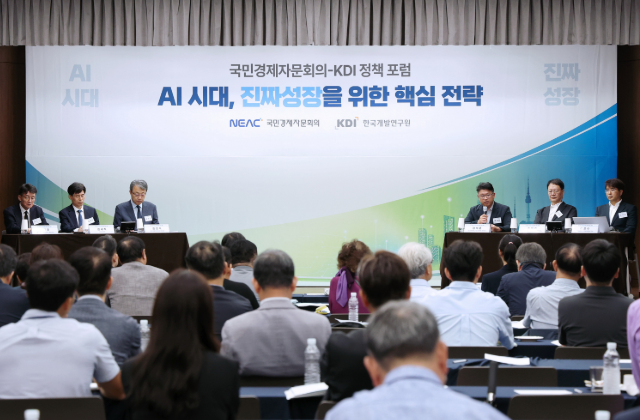
KDI and the National Economic Advisory Council (NEAC) jointly hosted a policy forum titled “Key Strategies for Genuine Growth in the AI Era” on August 31 in Seoul. The forum brought together experts to explore new engines of growth for the Korean economy in the AI era and discuss policy priorities and directions for laying the foundation for future growth through technological innovation and enhanced growth potential.
Keynote Presentations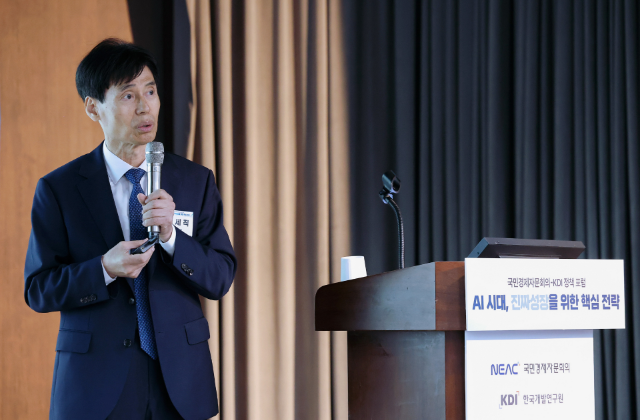
Dr. Se-Jik Kim, President of KDI, opened the keynote session by noting that the Korean economy is facing a continued decline in its long-term growth rate and the limits of an imitation-based growth model. President Kim called for a shift in the country’s growth engine from imitation-based to creativity-driven human capital and advocated an “HI (Human Idea)-led growth” model. He pointed out that although Korea has increased its R&D investment to nearly 5% of GDP over the past two to three decades, innovation has fallen short of expectations, attributing this gap to insufficient investment in and incentives for human ideas, a critical input for technological innovation. As a potential solution, President Kim proposed a nationwide idea registration system that would grant individuals ownership and property rights over their original ideas. Under the proposed system, the government would facilitate the sale or auction of registered ideas to businesses and return a portion of the proceeds to their creators. He also stressed the need to strengthen HI education to foster creativity and problem-solving skills, thereby generating new technologies and industries and ultimately reversing the decline in Korea’s long-term growth rate.
Professor Keun-kwan Ryu, Professor Emeritus at Seoul National University, noted in his keynote presentation that Korea needs to move beyond its traditional catch-up and input-driven growth model toward a productivity-centered system that organically connects talent, demand for AI, data, and regional economies. He emphasized the need to reshape the education system around the development of creative, interdisciplinary talent and an (s, S)-type lifelong learning model, while expanding the demand base for AI. Professor Ryu also highlighted the importance of building an evidence-based policy infrastructure by linking data on individuals, households, businesses, and regions around the statistical registers maintained by the Ministry of Data and Statistics.
Panel Discussion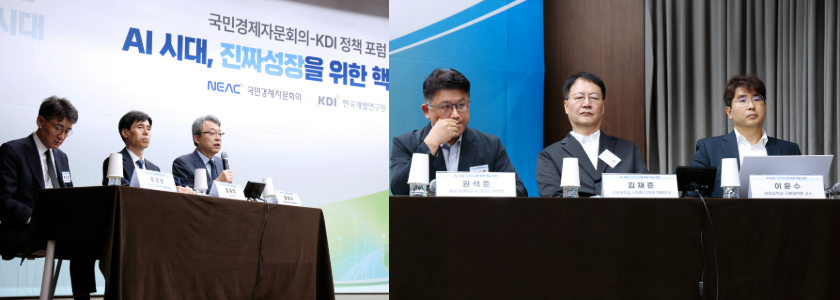
Following the keynote presentations, a panel discussion was moderated by Mr. Song-sik Kim, Vice Chairman of the National Economic Advisory Council, and featured the keynote speakers alongside Professor Seokjoon Kwon, Associate Dean of the College of Engineering at Sungkyunkwan University; Professor Jai-June Kim, Professor Emeritus at Kookmin University; and Professor Yunsu Lee, Professor at the Graduate School of International Studies at Seoul National University. The panel explored a range of strategies for achieving genuine growth in the AI era, including Korea’s “Manufacturing 2.0” strategy, ways to complement the three mega-projects, approaches to translating ideas and creativity into economic growth, and growth strategies for AI service startups.
Professor Seokjoon Kwon, Associate Dean of the College of Engineering at Sungkyunkwan University, proposed a “Manufacturing 2.0” strategy that would transform manufacturing from a sector focused primarily on producing goods into a platform for generating and accumulating intelligence. Professor Kwon also proposed a new indicator, “Gross Domestic Intelligence (GDI),” to measure the production and accumulation of intelligence as a fundamental resource in the AI era.
Professor Jai-June Kim, Professor Emeritus at Kookmin University, examined the implications for national growth of Korea’s lack of globally renowned artists and Nobel laureates in the sciences despite the global success of K-pop. He proposed introducing an AI-based system for evaluating creativity as well as a “Korea Creativity Index (KCI).”
Professor Yunsu Lee, Professor at Seoul National University, argued that the key to startup policy in the age of AI transformation (AX) is to create a market environment in which AI service companies can turn technologies into viable products and translate them into recurring revenue and scalable growth. He added that policy outcomes should likewise be assessed using market-oriented indicators such as purchase conversion rates.
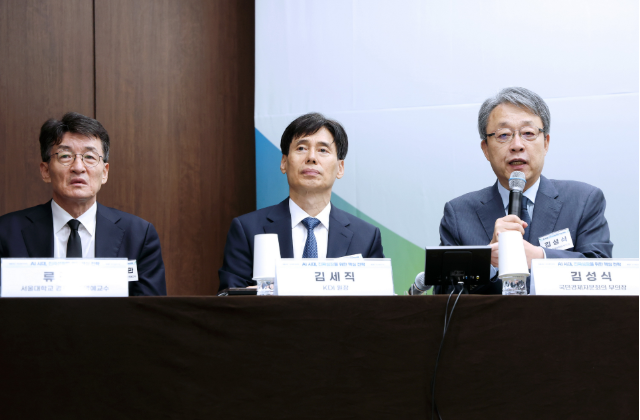
Mr. Song-sik Kim, Vice Chairman of the National Economic Advisory Council, emphasized the need for government reform, noting that accumulated bureaucratic regulations, single-year budgeting practices, and administrative silos are impeding R&D, AI transformation (AX), and startup growth. He stressed that the government should focus its efforts on shifting toward incentive systems that encourage innovation while strengthening social safety nets to foster greater societal acceptance of innovation. He further underscored the need to move beyond short-term stimulus measures or fragmented growth policies toward a more inclusive growth model centered on human capital.
The joint KDI–NEAC forum reaffirmed the need for a new growth strategy centered on human capital, creativity, and productivity-enhancing innovation to strengthen Korea’s growth potential as AI accelerates structural transformation across the economy and industry.
Written by: Wanhee Jeon, Research Associate, Division of External Affairs, KDI +82 44-550-4442, whjeon@kdi.re.kr
We reject unauthorized collection of email addresses posted on our website by using email address collecting programs or other technical devices. To access the email address, please type in the characters exactly as they appear in the box below.
Please enter the security code to prevent unauthorized information collection.