
Policy Study Government Forms and Economic Security February 28, 2026
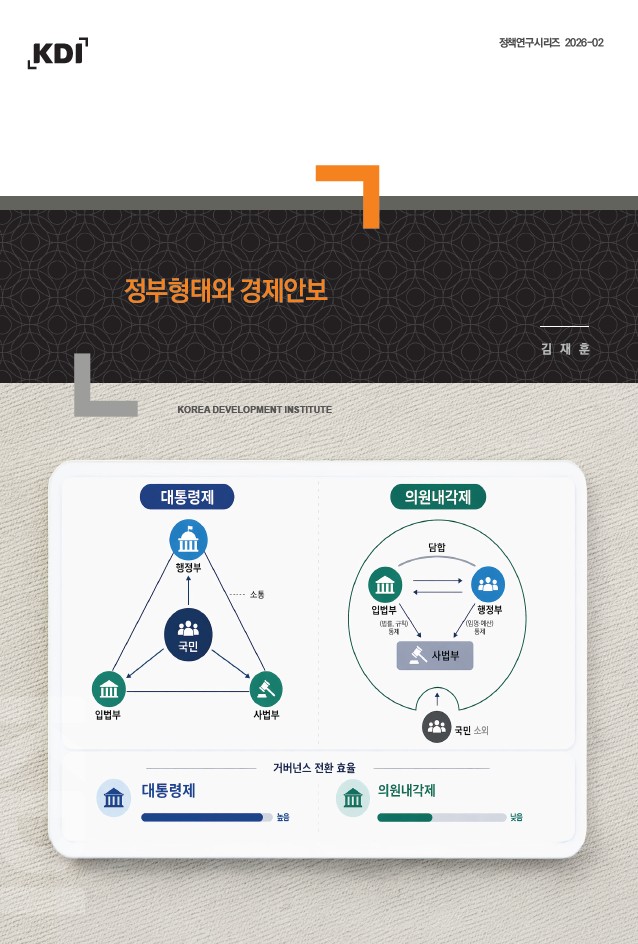
Series No. 2026-02
Policy Study
KOR
Government Forms and Economic Security
#Economic Growth
#Global Economy and Economic Crisis
#General(Other)
February 28, 2026
-
Jaehoon Kim
 프로필
프로필
- Summary
-
This report explores the relationship between government forms and economic security, analyzing how political systems in democratic countries influence economic development. Unlike previous studies that focus on dichotomous comparisons between democracy and authoritarianism, this research empirically identifies the conditional effects of micro-institutional combinations in OECD high-income democracies―such as government type, electoral rules, and power structures―on long-term economic levels through government capacity. It emphasizes that beyond the polar extremes of the Washington Consensus and the Beijing Consensus, the economic conversion efficiency of government capacity within democratic institutions is the key determinant.
The literature review examines contrasting views on the impact of democracy on economic growth. Some studies argue that democracy promotes growth by strengthening property rights and investment incentives, while others point out that it can hinder growth due to policy delays and populism. Presidential systems are praised for long-term stability and executive power, whereas parliamentary systems are noted for flexibility and consensus, though empirical results are mixed. Recent analyses, like Acemoglu et al. (2019), confirm positive effects of democracy when using income levels rather than growth rates as the dependent variable, as this captures long-term cumulative effects while controlling for short-term volatility.
For the analytical method, panel data from 38 OECD countries (1995-2023) is utilized with the Arellano-Bover/Blundell-Bond System GMM. The dependent variable is ln(GDP per capita) to measure economic development levels, with political system dummies (presidential, semi-presidential, parliamentary; single-member district, multi-member district; separation of powers, fusion of powers) and their interactions with government capacity indicators (government effectiveness, control of corruption, political stability, regulatory quality, rule of law) as key explanatory variables. Control variables include historical legacies (Spanish colony, former USSR, Scandinavian legal origin), economic structures (trade dependence, inflation, FDI, oil rents), and demographic factors (aging) to mitigate endogeneity.
Empirical results show that the combination of presidential system + single-member district + separation of powers yields the greatest increase in income levels from improvements in government capacity. A 1-unit improvement in government effectiveness leads to a 47.1% rise (real 60.2%) in presidential systems (ps), but is nearly insignificant in parliamentary systems (cm). Similar patterns hold for control of corruption and rule of law, with regulatory quality showing 4-7% uplift effects. Political stability is positive in presidential systems but has reverse effects in parliamentary ones. This is interpreted as the fixed terms and separate survival in presidential systems enhancing incentives for long-term reforms, while bottom-up nominations in single-member districts ensure political stability.
Policy implications suggest that for countries like Korea, with vulnerabilities in single-term presidencies and top-down nominations, reforms are needed. Introducing a four-year re-election system to secure long-term vision, midterm elections to turn divided governments into negotiation opportunities, and bottom-up nominations to strengthen legislative independence are recommended. Constitutional amendments should exclude incumbent politicians and emphasize citizen participation to block agency problems. This forms an "institutional trinity" to complete economic security within democracy, providing a roadmap for the post-Washington-Beijing world.
Research limitations include its restriction to OECD high-income democracies, making generalization to developing countries or authoritarian regimes difficult. The low institutional heterogeneity limits identification of regime effects themselves, and it fails to capture advantages of authoritarian models. However, it provides empirical evidence for optimizing efficiency through fine-tuning in high-institutional environments.
- Contents
-
Abstract (ENG)
Preface
Summary (KOR)
Chapter 1. Introduction
Chapter 2. Literature Review
Section 1. Forms of Government and Separation/Fusion of Powers
Section 2. Electoral Systems
Section 3. Political Regimes and Economic Growth
Chapter 3. Theoretical Discussion and Hypotheses
Section 1. Theoretical Discussion
ection 2. Hypothesis Formulation
Chapter 4. Methodology
Section 1. Analytical Model
Section 2. Variables, Data, and Descriptive Statistics
Chapter 5. Empirical Analysis
Section 1. Political Regimes and Long-term Economic Development Levels
Section 2. Political Institutions and Government Capacity
Section 3. Theoretical and Policy Implications
Chapter 6. Conclusion and Policy Implications
Section 1. Summary of Results
Section 2. Policy Implications and Principles of Institutional Design
Section 3. Limitations of the Study
References
Appendix
If you want to know more in detail?
related materials ( 9 )
- Key related materials
Security code
![captcha]()
We reject unauthorized collection of email addresses posted on our website by using email address collecting programs or other technical devices. To access the email address, please type in the characters exactly as they appear in the box below.
KDI Staff Information
Please enter the security code to prevent unauthorized information collection.
KDI Staff Information
KDI Staff Information