
News 2026 Knowledge Sharing Program (KSP) Global Innovation Conference Successfully Concludes
2026 Knowledge Sharing Program (KSP) Global Innovation Conference Successfully Concludes
2026 Knowledge Sharing Program (KSP)
Global Innovation Conference Successfully Concludes


Event Highlights
The 2026 Knowledge Sharing Program (KSP) Global Innovation Conference, hosted by the Ministry of Finance and Economy (MOFE) and organized by the Korea Development Institute (KDI), the Export-Import Bank of Korea (Korea Eximbank), the Korea Trade-Investment Promotion Agency (KOTRA), and the Korea Overseas Infrastructure & Urban Development Corporation (KIND), was held on September 7 at Vista Hall, Grand Walkerhill Seoul.
Under the theme “KSP: Driving AI and Digital Transformation for Inclusive Growth,” this year’s conference explored the roles of policy, institutions, and international cooperation in translating advances in artificial intelligence (AI) and digital technologies into sustainable and inclusive growth at a time when these technologies are rapidly transforming economies, industries, and societies worldwide.
The conference showcased digital innovation and policy cooperation cases from a diverse range of KSP partner countries, including Kenya, Uzbekistan, Liberia, the Dominican Republic, and Thailand, highlighting how KSP policy advisory projects have led to institutional reforms and concrete follow-up initiatives.
Policymakers, development cooperation practitioners, academics, and experts from Korea and abroad also discussed new directions for policy innovation and knowledge sharing in the AI and digital era. The conference was conducted in a hybrid format, with participants joining both in person and online.
Opening Ceremony
The conference opened with remarks by Moon Ji Sung, Deputy Minister for International Affairs at MOFE, followed by congratulatory remarks by Kevin Chika Urama, Vice President of the African Development Bank (AfDB), and a keynote address by Se Jik Kim, President of KDI.

Opening Remarks — Moon Ji Sung, Deputy Minister for International Affairs, MOFE
Deputy Minister Moon highlighted AI and digital transformation as key engines of growth that can enhance productivity and create new industries and jobs. At the same time, he cautioned that differences in countries’ levels of preparedness and capacity could create new forms of digital divide.
He emphasized that technological advances must be accompanied by innovation in the policies and institutions that support them, as well as stronger international cooperation, if the benefits of innovation are to translate into growth that reaches all members of society.
In particular, he outlined four priority areas for cooperation through KSP in pursuit of “AI for All”: building AI innovation ecosystems; promoting the adoption of AI across industries alongside the transition to green energy; developing specialized talent capable of applying AI in industrial and public-sector settings; and strengthening international cooperation.


Congratulatory Remarks — Kevin Chika Urama, Vice President, African Development Bank
Kevin Chika Urama, Vice President of the African Development Bank, emphasized that AI and digital technologies alone cannot deliver sustainable development. Effective institutions, human capacity, financing, sound policies, and implementation capabilities must develop alongside technological innovation.
He proposed that international cooperation should move beyond the traditional notion of one-way “knowledge sharing” toward “knowledge co-creation,” in which countries jointly define policy needs and develop solutions suited to their respective circumstances.
Urama called for a transition from knowledge sharing to co-creation, from ideas to implementation, and from cooperation to shared prosperity, underscoring the importance of a more collaborative approach to development.

Keynote Speech — Se Jik Kim, President, Korea Development Institute
KDI President Se Jik Kim emphasized that, in the AI era, KSP should evolve beyond simply transferring Korea’s past development experience or predetermined policy solutions. Instead, it should seek to understand the unique circumstances and challenges of each partner country and work together to develop new policy ideas and solutions.
He explained that while Korea achieved rapid growth in the past by absorbing and adapting technologies and knowledge developed by advanced economies, sustaining long-term growth requires the development of “creative human capital” capable of generating new ideas, technologies, and solutions.
President Kim stressed that the key challenge is not merely the adoption of AI itself, but rather the ability to translate new ideas into technology and innovation, innovation into productivity, and productivity into sustainable “Genuine Growth.”
He proposed that KSP strengthen its role in the AI era around three key principles: Co-creation, Implementation, and Inclusion.


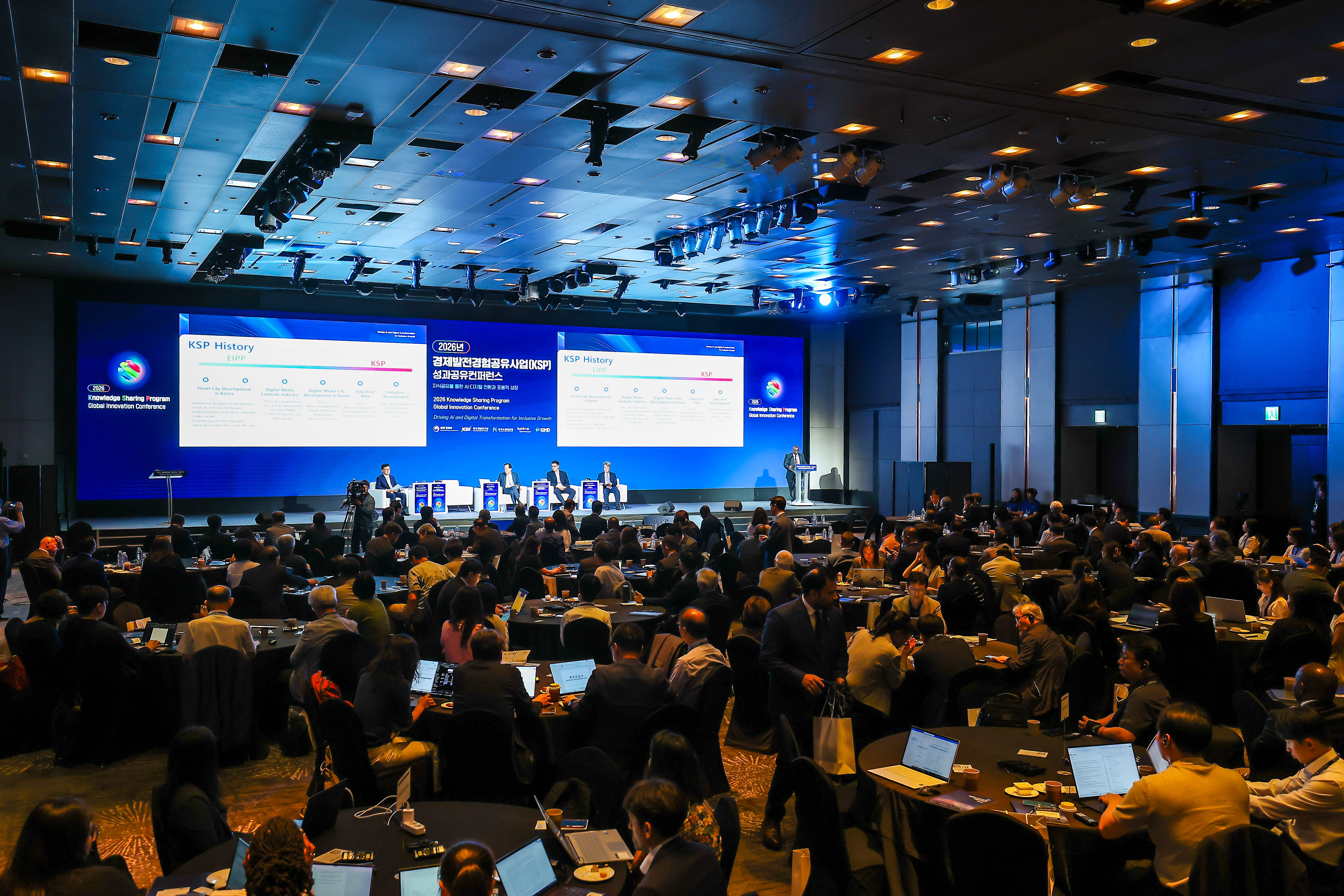
Session 1 | From Knowledge to Action: KSP Success Stories
Session 1, “From Knowledge to Action: KSP Success Stories,” highlighted representative cases in which KSP policy advisory support in the AI and digital sectors led to institutional improvements and concrete follow-up projects.
Chaired by Hoe Jeong Kim, KSP Senior Advisor and former Deputy Minister for International Affairs, the session focused on cases from Kenya and Uzbekistan and discussed the conditions needed for KSP policy recommendations to translate into implementation, as well as ways to scale up successful outcomes.
Anthony Kigen Sang, Chief Manager at the Konza Technopolis Development Authority in Kenya, and Hyeon Park, Professor at the University of Seoul, presented the case of Konza Technopolis.
They explained how KSP policy advisory support contributed to the development of a smart city master plan and an integrated control center through the Economic Innovation Partnership Program (EIPP), which subsequently led to follow-up initiatives supported by the Economic Development Cooperation Fund (EDCF).
Drawing on cooperation in areas such as industrial clusters, intelligent transport systems (ITS), digital media cities (DMC), and integrated control centers, the speakers illustrated how knowledge sharing can evolve into concrete development projects. They also emphasized the importance of strong partner-country ownership, a clearly defined project pipeline, and sustained stakeholder engagement.
Inogomkhoja Usmonov, Head of the Startup and Innovative Projects Ecosystem Coordination Department at the Ministry of Economy and Finance of Uzbekistan, and Min Chang Lee, Professor at Chosun University, then presented Uzbekistan’s experience with digital financial innovation and the institutionalization of a fintech regulatory sandbox through KSP Plus.
The presentation highlighted how Korea’s policy experience was adapted to Uzbekistan’s institutional and industrial context to develop the legal framework and governance arrangements for the regulatory sandbox and advance the initiative toward actual pilot implementation.
The speakers emphasized that sustainable implementation requires not only sound institutional design but also effective support for participating firms, inter-agency coordination, and robust data governance.


Session 2 | Exploring the Pathways to Impact: KSP in the AI and Digital Era
In the afternoon, Session 2 examined recent KSP cases from Liberia, the Dominican Republic, and Thailand, focusing on how policy advisory outcomes can be sustained and translated into follow-up cooperation.
The session was chaired by Wook Sohn, Professor at the KDI School of Public Policy and Management.
Participants approached digital transformation not simply as the introduction of new technologies and systems, but as a comprehensive process that requires coordinated improvements in institutions, organizational structures, human capacity, and follow-up financing.
They also discussed practical pathways through which KSP policy recommendations can be translated into concrete development projects.
Solomon G. Mahn, Technical Focal Point at Liberia’s Ministry of Finance and Development Planning, presented Liberia’s efforts to build ICT infrastructure for the digitalization of tax administration.
He highlighted the need for an integrated approach that connects key administrative systems to address fragmented government information and limited visibility over the tax base.
Pau Puig Gabarro, Senior Specialist at the Inter-American Development Bank (IDB), presented strategies for upgrading digital infrastructure to support public service innovation in the Dominican Republic.
His presentation outlined key areas for improvement, including policy and regulatory frameworks, digital governance, expanded connectivity, resilient infrastructure, and digital public services. He also emphasized an implementation-oriented approach that connects policy recommendations with financing and concrete investment projects.
Wannarat Channukul, Mayor of Nakhon Ratchasima City Municipality in Thailand, presented the city’s efforts to advance its smart city initiative.
Drawing on Korea’s experience with digital governance and integrated control centers, he stressed that the success of digital transformation depends less on technology itself than on institutional and operational capacity to overcome fragmented organizational structures and data systems and establish integrated management frameworks.
He also presented a city-level digital transformation roadmap and shared potential directions for expanding Korea–Thailand smart city cooperation through future follow-up projects.
The subsequent panel discussion featured Jong Won Kim, Director at Moon Engineering, and Byoung Shik Lee, CEO of Ennoble Partners, who shared perspectives on digital transformation in public administration and urban management, respectively.
The discussants emphasized that digital transformation should be understood not simply as the adoption of new technologies, but as a broader transformation involving laws and institutions, organizational arrangements, and inter-agency collaboration.
They also underscored the importance of developing “institutional infrastructure” capable of continuously operating, coordinating, and adapting digital systems alongside investment in physical digital infrastructure.


Closing Ceremony
In his closing remarks, Jungwook Kim, Executive Director of the Center for International Development at KDI, noted that the discussions throughout the day reaffirmed three important lessons: technological innovation must go hand in hand with institutional innovation; knowledge becomes meaningful when it is translated into action; and development outcomes can be sustained only when all participating stakeholders engage with a strong sense of ownership.
He also outlined KSP’s future direction based on the three-year KSP Medium-Term Operational Plan established in June.
KSP will pursue more strategically designed projects in four priority areas — AI and digital transformation, supply chains, green transition, and culture — taking into account both the development strategies of partner countries and Korea’s comparative strengths.
KSP will also strengthen linkages between policy advisory support and concrete follow-up initiatives, including EDCF financing, multilateral development bank (MDB) projects, and private-sector investment.
Overall Assessment
The wide range of KSP cases presented at this year’s conference demonstrated that the success of AI and digital transformation depends not only on technology itself, but also on the policy and institutional environment needed to adopt, utilize, and sustain technological innovation.
Although appropriate solutions differ depending on each country’s stage of development and policy environment, participants shared a common understanding that successful and sustainable technological transformation requires strong ownership by partner countries, effective coordination among relevant institutions, and sufficient implementation capacity.
The discussions also underscored that in rapidly evolving fields such as AI and digital transformation, effective knowledge cooperation should avoid one-size-fits-all solutions and instead closely reflect each country’s specific challenges, needs, and policy environment.
Going forward, an important task for international development cooperation will be to explore stronger linkages among policy advisory services, development finance, international organizations, and the private sector, while working jointly with partner countries to develop concrete policy solutions tailored to their needs.
By moving from the unilateral transfer of knowledge toward collaborative problem-solving and co-creation, knowledge-based development cooperation can play an even greater role in supporting inclusive and sustainable development in the AI and digital era.
Written by: Chiyeong An, Senior Research Associate, Policy Consultation Team 3
Center for International Development, Korea Development Institute (KDI)
Tel. +82-44-550-4453
Email: chiyeong@kdi.re.kr
We reject unauthorized collection of email addresses posted on our website by using email address collecting programs or other technical devices. To access the email address, please type in the characters exactly as they appear in the box below.
Please enter the security code to prevent unauthorized information collection.