
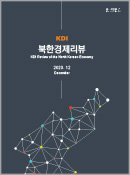
[북한경제전문가 <대화>] 북한의 산업과 기업: 사실, 개념 그리고 추세 [북한경제연구협의회] 미중갈등의 전개와 한국의 대응 [동향과 분석] 북한 식량 수급 분석을 위한 통계 현황과 시사점 등 수록
- 영문요약
-
KDI Review of the North Korean Economy for December delivers an expert interview in
, discussion summary of the North Korean Economic Research Forum, and one trend analysis article.
introduces expert’s insights into “North Korea’s Industry and Enterprises: Facts, Concept, and Trends.” These are the basis of economic fundamentals of a nation, but we know very little as to how they work in North Korea. It is widely believed that current industrial and business systems are completely different from what they had in the period of socialist economy. In North Korea today, capitalistic factors such as markets and profits seem to play a more significant role as de facto standards than authority-run plans. Signals of economic transformations and reforms are being seen across industrial and business activities, and their trends need to be looked thorough to get a better and more comprehensive understanding of the present and the future of the North Korean economy. With that recognition, the KDI Office of the North Korean Economics Studies interviewed an experienced researcher at Korea Institute for Industrial Economics and Trade (KIET), who have long studied North Korea's industrial and business activities
The topic for the North Korean Economic Research Forum was “US-China Conflicts and South Korea's Response.” As a year-end wrap up, the Forum was initially planned as a comprehensive seminar, but to avoid indoor crowds during the pandemic, participants contributed 11 articles instead that analyze the situation of the US-China conflicts and suggest South Korea’s responses.
features “Current Statistics and Implications for the Analysis of Food Supply and Demand in North Korea” which examined the status of basic statistics needed to closely analyze the food supply and demand situation in North Korea and discussed pending issues inherent in the process of statistics production. To get the data on food production, author presented statistics from the UN’s Food and Agriculture Organization (FAO) and Statistics Korea and compared their characteristics and data. Based on world trade statistics, author applied mirror statistics and extracted the amount of food exported to North Korea. Regarding food demand, this article focused on the method to estimate the demand by usage categories (such as people’s meal, livestock feed and crop seeds) and the assumptions used for the estimation.
- 목차
-
북한경제전문가 <대화>
북한의 산업과 기업: 사실, 개념 그리고 추세 | 이석기
북한경제연구협의회
미중갈등의 전개와 한국의 대응
동향과 분석
북한 식량 수급 분석을 위한 통계 현황과 시사점 | 최용호

한국개발연구원의 본 저작물은 “공공누리 제1유형 : 출처표시” 조건에 따라 이용할 수 있습니다. 저작권정책 참조
보안문자 확인
무단등록 및 수집 방지를 위해 아래 보안문자를 입력해 주세요.
KDI 직원 정보 확인
KDI 직원 정보 확인
담당자 정보를 확인해 주세요. 044-550-5454
등록완료
소중한 의견 감사드립니다.
등록실패
잠시 후 다시 시도해주세요.