
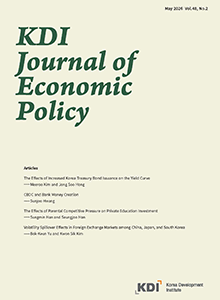
- 목차
-
Invoicing Currency and Exchange Rate Transmission in Korea’s Export / JUNHYONG KIM
I. Introduction
II. Data Description
III. Background
IV. Differential Effects of Exchange Rates by Invoicing Currency
V. Conclusion
REFERENCES
Effects of the Basic Pension Reform on Consumption and Labor Supply of the Elderly / MINSOO CHO AND HYELIM SON
I. Introduction
II. Background
III. Data
IV. Empirical Strategy
V. Analysis and Discussion
VI. Conclusion
APPENDIX
REFERENCES
우리나라 실효지급준비율 수준의 적정성 분석 / 손종칠, 허준영
I. 서 론
II. 기존 논의
III. 이용 자료 및 시계열 추이
IV. 실증분석
V. 결 론
APPENDIX
참고문헌
The Impact of Financial Stability Policies on Korea Treasury Bond Yields / JONG SOO HONG AND MEEROO KIM
I. Introduction
II. Literature Review
III. Background
IV. Methodology
V. Analysis and Discussion
VI. Conclusion
APPENDIX
REFERENCES
- 영문요약
-
Invoicing Currency and Exchange Rate Transmission in Korea’s Export / JUNHYONG KIM
Using highly disaggregated Korean micro-level trade data, this paper examines the determinants of invoicing currencies and their implications. We find that the determinants of exchange-rate passthrough intermediated imported inputs, market share, and foreign currency liability play an important role in shaping currency invoicing decisions. Invoicing choices also exhibit strong persistence over time and strategic complementarity. Demand elasticity further amplifies strategic complementarity. Moreover, exchange-rate passthrough differs markedly across invoicing currencies, with important implications for real economic allocations. The findings here are highly relevant for policymakers in small open economies that do not issue vehicle currencies yet face pervasive dominant-currency pricing.
Effects of the Basic Pension Reform on Consumption and Labor Supply of the Elderly / MINSOO CHO AND HYELIM SON
This study examines the effects of South Korea’s Basic Pension reform on the consumption and labor supply of the elderly. Using data from the Korea Welfare Panel Study (KoWePS) spanning the years 2009 to 2018, and by applying the difference-in-differences methodology, we find that the increase in pension benefits has had a small positive effect on household consumption but no significant impact on overall employment. However, we observe a decline in full-time employment and total work hours among the elderly. Additionally, a triple-difference analysis shows that the labor supply reduction is concentrated among low-educated elderly women, highlighting important heterogeneity in policy responses to the pension reform.
An Analysis on Adequacy of Effective Reserve Requirement Ratio in Korea / JONG CHIL SON AND JOONYOUNG HUR
This study examines the adequacy of Korea’s effective reserve requirement ratio (defined as the ratio of banks’ Korean-won deposits held at the liability accounts of the Bank of Korea to their Korean-won deposits) and its potential use as a macroprudential policy tool, employing cointegration regression analysis and a Bayesian VAR conditional forecasting framework. The main findings are as follows. First, the effective reserve requirement ratio in Korea is found to exhibit a generally positive long-run equilibrium relationship with economic growth and the financial stress index. Second, projections of the ratio through 2045 based on the estimated cointegration coefficients indicate a gradual decline under the baseline scenario. Third, conditional forecasts for the next ten years using a Bayesian VAR show that maintaining the current level of 4.2% minimizes the sum of squared forecast errors, compared with scenarios in which the ratio increases or decreases by 1.5 percentage points. Fourth, Korea’s reserve requirement system appears to have contributed to macroprudential stability by functioning as an automatic stabilizer that mitigates short-term liquidity fluctuations in the money market. In conclusion, the current level of the effective reserve requirement ratio does not deviate significantly from its equilibrium path and is expected to decline gradually in response to changing macro-financial conditions, including a slowdown in economic growth.
The Impact of Financial Stability Policies on Korea Treasury Bond Yields / JONG SOO HONG AND MEEROO KIM
This paper examines the effects of macroprudential regulations implemented in the Republic of Korea on Korea Treasury bond (KTB) yields. While macroprudential regulations primarily aim to enhance financial stability by mitigating systemic risks, they can also indirectly affect bond market dynamics by altering the demand for safe assets. Specifically, this study analyzes the impacts of two significant financial stability measures introduced in the Republic of Korea following the Global Financial Crisis: restrictions on securities firms' call borrowing and the phased implementation of the liquidity coverage ratio (LCR) for banks. Empirical findings indicate that restricting securities firms' call borrowing to within 25% of their equity capital and subsequently excluding them from the call market substantially increased their demand for KTBs, cumulatively reducing KTB yields by approximately 10.8 to 12.5 basis points. Furthermore, the phased implementation of the LCR regulation increased banks’ demand for KTBs, resulting in an additional cumulative decrease in KTB yields of approximately 6.1 to 7.3 basis points. These findings underscore the necessity for policymakers to carefully consider the potential implications for bond markets and broader financial market spillover when introducing or adjusting macroprudential measures.

한국개발연구원의 본 저작물은 “공공누리 제3유형 : 출처표시 + 변경금지” 조건에 따라 이용할 수 있습니다. 저작권정책 참조
보안문자 확인
무단등록 및 수집 방지를 위해 아래 보안문자를 입력해 주세요.
KDI 직원 정보 확인
KDI 직원 정보 확인
담당자 정보를 확인해 주세요. 044-550-5454
등록완료
소중한 의견 감사드립니다.
등록실패
잠시 후 다시 시도해주세요.