
Economic Outlook KDI ECONOMIC OUTLOOK | UPDATE 2025.08 August 12, 2025
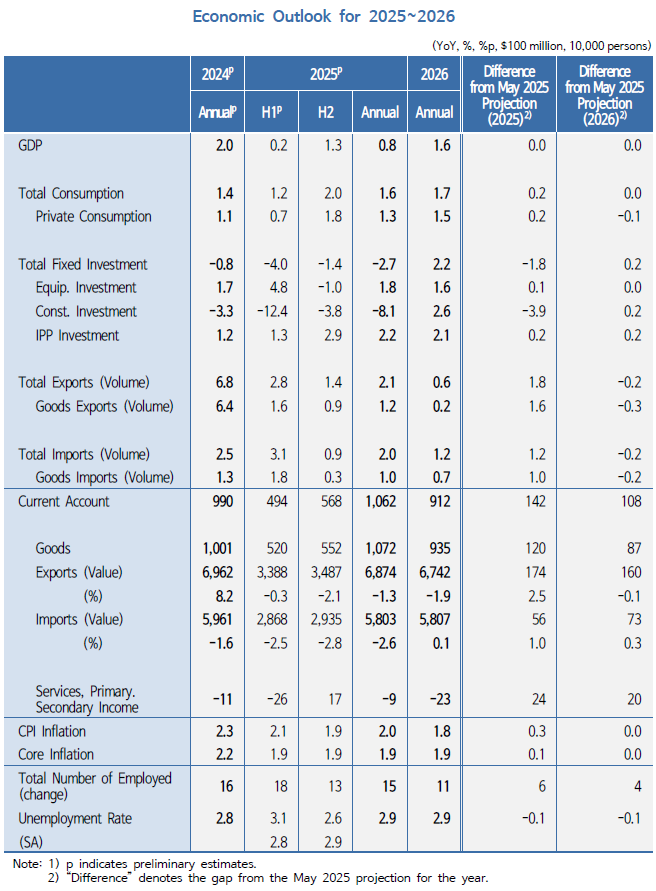
The Korean economy is projected to expand by 0.8% in 2025, constrained mainly by persistent weakness in construction investment, before rising to 1.6% in 2026 as domestic demand recovers moderately despite sluggish exports.
- Private consumption is expected to strengthen as the downturn moderates from the second half of 2025, supported by lower interest rates and policy stimulus, expanding by 1.3% in 2025 and 1.5% in 2026.
- Equipment investment is projected to grow moderately by 1.8% in 2025 and 1.6% in 2026, as lower interest rates and favorable semiconductor market conditions persist despite external uncertainty.
- Construction investment is expected to decline sharply by 8.1% in 2025, following a 3.3% decline in 2024, reflecting the impact of weak orders received during the high-interest-rate period. As orders received recover gradually, construction investment is projected to grow by 2.6% in 2026.
- Exports are forecast to increase by 2.1% in 2025 and 0.6% in 2026, slowing sharply from 6.8% in 2024, due to higher U.S. tariffs.
- The current account surplus is projected to remain substantial at $106 billion in 2025 and $91 billion in 2026, driven by the semiconductor upturn and improved terms of trade, following $99 billion in 2024.
- Consumer price inflation is projected to slow from 2.3% in 2024 to 2.0% in 2025 and 1.8% in 2026, in line with subdued growth.
- The growth in the number of employed persons is projected to slow from 160,000 in 2024 to 150,000 in 2025 and 110,000 in 2026, reflecting demographic shifts and modest economic growth.
Ⅰ. Current Economic Conditions
- □ The Korean economy has recently emerged from the slowdown that began last year, but growth remains subdued.
- · Domestic demand stayed sluggish, but consumption conditions improved with stimulus measures and a rebound in consumer sentiment.
- · Despite weaker trade conditions stemming from U.S. tariff policy, exports strengthened on the back of a robust semiconductor market, emerging as a key driver of Korea’s recent growth.
- ·Inflation remained stable, while the number of employed persons rose modestly, mainly in the services sector, which is heavily influenced by government job programs.
- □ Externally, Although the U.S. and major economies recently concluded trade agreements, tariff rates and uncertainty stayed elevated compared with previous years.
- · The U.S. effective tariff rate remained high at levels seen in the 1930s, and trade policy uncertainty though partly eased was still about 15 times higher than the average over the past decade.
- · As the effects of tariff increases spread, U.S. inflation has risen and employment has slowed. Meanwhile, international oil prices have edged up on supply concerns linked to geopolitical risks.
- □ Given these domestic and external conditions, the economy is projected to experience a moderate easing of weakness from the second half of the year, led by private consumption.
- · As the front-loaded export gains in anticipation of tariff increases fade, their negative impact is projected to intensify in the latter part of the year, while weakness in the construction sector is proving prolonged.
- · Even so, declining market interest rates and policy measures to bolster consumption are expected to gradually reduce the weakness in private consumption.
Ⅱ. Domestic Economic Outlook for 2025
1. Major External Assumptions
- □ The global economy is assumed to maintain a low growth rate in 2025–26, affected by higher US tariffs.
- · The IMF projects global growth of 3.0% in 2025 and 3.1% in 2026, below the pre-pandemic (2011–19) average of 3.5%.
- · The WSTS projects global memory semiconductor sales growth of 17.1% in 2025, up from the 13.4% assumed in KDI’s first-half 2025 outlook.
- · U.S. tariff rates are assumed to remain at current levels, with the average tariff on Korean goods at 14.5%, similar to the earlier assumption of 14.1%.
- □ The import price of crude oil (Dubai) is assumed to decline from $80 per barrel in 2024 to $71 in 2025 and $67 in 2026, driven mainly by weak demand.
- · However, assumptions were revised slightly up from $69 and $66 in the previous projection, reflecting higher oil prices from heightened geopolitical risks.
- □ The Korean won, in terms of the real effective exchange rate, is assumed to remain broadly stable at recent levels.
2. Domestic Outlook
- □ The Korean economy is projected to grow by 0.8% in 2025, mainly due to weakness in construction investment, before rising to 1.6% in 2026 as domestic demand recovers moderately despite sluggish exports.
- · Although the growth forecasts for consumption and exports have been revised upward for 2025, a downward revision to construction investment keeps the overall annual growth rate close to that in KDI’s first-half outlook.
- · Private consumption is expected to strengthen as the downturn moderates from the second half of 2025, supported by lower interest rates and policy stimulus, expanding by 1.3% in 2025 and 1.5% in 2026.
- · Equipment investment is projected to grow moderately by 1.8% in 2025 and 1.6% in 2026, as lower interest rates and favorable semiconductor market conditions persist despite external uncertainty.
- · Construction investment is expected to decline sharply by 8.1% in 2025, following a 3.3% decline in 2024, reflecting the impact of weak orders received during the high-interest-rate period. As orders received recover gradually, construction investment is projected to grow by 2.6% in 2026.
- ·Exports are forecast to increase by 2.1% in 2025 and 0.6% in 2026, slowing sharply from 6.8% in 2024, due to higher U.S. tariffs.
- ·The current account surplus is projected to remain substantial at $106 billion in 2025 and $91 billion in 2026, driven by the semiconductor upturn and improved terms of trade, following $99 billion in 2024.
- □ Consumer price inflation is projected to slow from 2.3% in 2024 to 2.0% in 2025 and 1.8% in 2026, in line with subdued growth.
- · Core inflation is expected at 1.9% in both 2025 and 2026, down from 2.2% in 2024.
- · Oil price assumptions and private consumption forecasts, both revised up from the previous projection, have prompted upward revisions of 0.3%p for headline inflation and 0.1%p for core inflation in 2025.
- □ The growth in the number of employed persons is projected to slow from 160,000 in 2024 to 150,000 in 2025 and 110,000 in 2026, reflecting demographic shifts and modest economic growth.
- ·Upward revisions to government job programs and to private consumption forecasts, closely linked to employment, have prompted a 60,000 upward revision to the projected increase in the number of employed persons for 2025.
3. Risks to the Outlook
- □ On the external front, escalating trade conflicts between the U.S, and major economies could further deteriorate export conditions.
- · Higher tensions with China, Brazil, and India, already subject to relatively high U.S. tariffs, could significantly slow global growth.
- · A substantial increase in semiconductor tariffs could pose a considerable downside risk to Korea’s exports.
- □ Domestically, delays in normalizing the real estate project finance market could impede the recovery in construction investment.
- · Persistent weakness in construction investment could undermine the financial soundness of construction firms, potentially leading to disruptions in project execution.

We reject unauthorized collection of email addresses posted on our website by using email address collecting programs or other technical devices. To access the email address, please type in the characters exactly as they appear in the box below.
Please enter the security code to prevent unauthorized information collection.