
KDI FOCUS Middle-aged and Older Workers in the Korean Labor Market: Current Status and Reform Measures Based on Task Analysis June 13, 2024
Middle-aged and Older Workers in the Korean Labor Market: Current Status and Reform Measures Based on Task Analysis
June 13, 2024-
Jiyeon Kim
 프로필
프로필


The task analysis by age in this report demonstrates that workers engage primarily in professional tasks, such as data analysis and organizational management, during their younger years. However, through middle age, their core job functions shift to simpler physical labor. This transition likely stems from task discontinuity that middle-aged and older workers experience during the reemployment process after leaving their lifetime main jobs. Given the anticipated decline in South Korea’s labor supply, efficiently leveraging its older workforce requires addressing structural issues within the labor market to secure task continuity.
Ⅰ. Changing Population Structure and the Labor Market
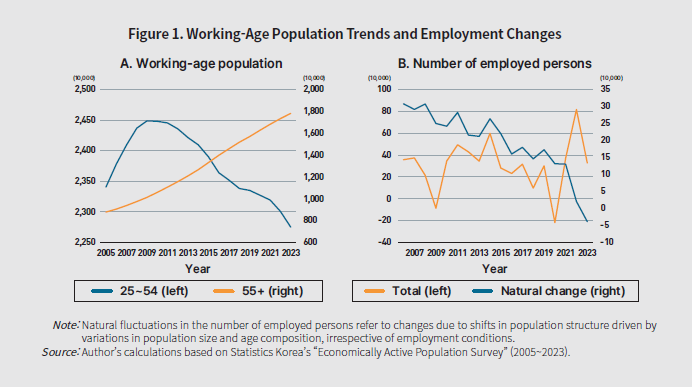
South Korea’s demographic structure is rapidly transforming, fundamentally reshaping its labor market. The cumulated effects of sustained low birth rates have led to a streak of sharp yearly declines in the young working-age population. As shown in Figure 1 (A), while the working-age population aged 25~54, the economically most active segment, peaked in 2009 and has since been declining, the population aged 55 and older has been increasing fast, demonstrating a marked contrast. The recent decline in birth rates suggests that the young working-age population will continue to shrink, and this demographic shift has begun to affect the number of employed persons. In the past, the number of employed persons naturally increased proportionate to the growth of the working-age population, but by the end of 2022, this figure transitioned to a natural decline (Figure 1 (B)). As the diminishing labor supply due to demographic changes becomes more pronounced, the need to better utilize the middle-aged and older workforce, gaining a larger share of the labor market, assumes greater importance.
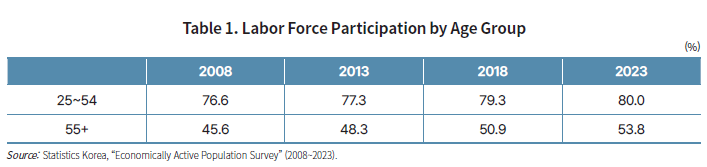
The economic participation of middle-aged and older individuals is experiencing swift expansion. In addition to the growing share of highly educated older workers, this increase is also due to the extended working years required to secure retirement funds, driven by longer life expectancy resulting from improved overall health. Over the past five years (2018~2023), the labor force participation rate of persons aged 25~54 increased by about 0.7%p, from 79.3% to 80%. In contrast, the rate for those aged 55 and older rose by about 2.9%p, from 50.9% to 53.8%, a much sharper ascent compared to their younger counterparts (Table 1). Despite the downward pressure on employment numbers from recent population structural changes, employment has remained robust. This sustained growth is not unrelated to the increased participation of the middle-aged and older segment in the labor market
As the younger workingage population in South Korea rapidly declines and the negative impacts of this shift become increasingly evident, there is a growing need for better utilization of the expanding middle-aged and older workforce in the labor market.
Ⅱ. The Necessity of Task Analysis
Assessing the effective integration of the middle-aged and older workforce, which has been surging in numbers, into the labor market requires analyzing their specific tasks and responsibilities. Although it is challenging to obtain specific data on the job functions of individual workers, occupational information can provide some insights into their work content. Occupations can be viewed as combinations of different tasks, and the composition and importance of each task differ by occupation.
Autor, Levy, and Murnane (2003) classified occupational tasks into three categories: abstract, routine, and manual. Using data from the US Occupational Information Network (O*NET), they measured and quantified how intensively each task type is used across different jobs. Building on this foundation, Deming (2017) subdivided these tasks into 10 categories and conducted a similar analysis. This study restructures these classification systems into five categories: analytical, social, service, routine, and manual. Furthermore, by linking the occupational classification systems of the US and South Korea, this study assigns task intensity scores established in previous studies to 135 occupations corresponding to the subcategories under the Korean Standard Classification of Occupations. To show the relative position of jobs in each task type, task intensity scores are converted into percentiles.
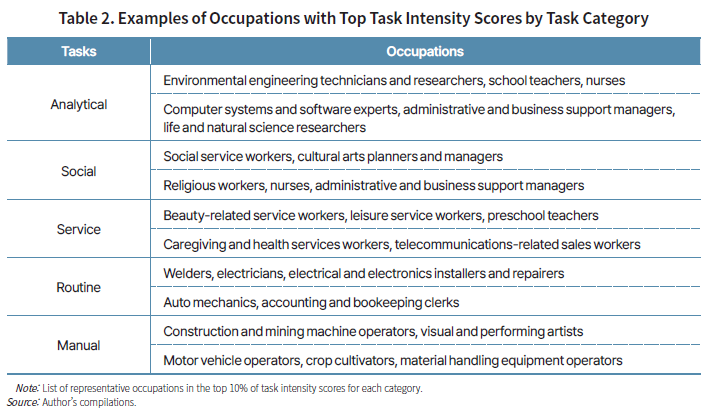
Table 2 lists occupations with high-intensity scores for each task category. Analytical tasks include mathematical analysis, deductive and inductive reasoning, and information processing. Professions such as researchers, managers, and school teachers score high in this category. Social tasks involve negotiation, persuasion, and team organization. Jobs like social welfare workers, cultural and artistic planners, and religious workers excel in this area. Social tasks are highly correlated with analytical tasks, and jobs with high analytical task intensity also tend to have high social task intensity (e.g., nurses, administrative and business support managers). Service tasks are primarily found in customer service roles. Leisure service workers, kindergarten teachers, and caregiving and healthcare service workers score high within this domain. Routine tasks encompass mechanical and repetitive activities. Occupations such as electrical and electronic equipment installers and repairers, auto mechanics, and accounting and bookkeeping clerks excel in this segment. Manual tasks heavily rely on physical abilities, and motor vehicle operators, crop cultivators, and performing artists fall into this category.
In this study, a task analysis evaluates whether the rapidly growing middle-aged and older workforce is effectively utilized in the labor market.
Ⅲ. Task Composition by Employee Age Group
This study conducts a regression analysis of task composition by employee age using data from the 1998~2021 Korean Labor Panel to examine how the task profile changes with age. To isolate the effects of age on task composition, other influencing factors such as birth year, education level, and industry sector are set as control variables. Additionally, a fixed-effect model is employed to capture individual characteristics that are not directly observed in the data.
For male workers aged 20~75, the regression analysis shows statistically significant age effects across nearly all tasks. Calculated based on the regression analysis, Figure 2 illustrates the average task intensity scores for different age groups, using the average for the 20s as a reference. This comparison reveals substantial variations in task intensity as they age. As men grow older, the intensity of analytical, social, and service tasks tends to decrease, while the intensity of routine and manual tasks increases. Analytical task intensity peaks in their 30s, indicating a higher proportion of employees in this age group are engaged in analytical tasks than others. Beyond their 30s, the intensity of analytical tasks declines, with an accelerated decline after their 50s. Social and service tasks exhibit a downward trend similar to analytical tasks. In contrast, the intensity of routine and manual tasks is lowest in the 30s and subsequently increases, forming a symmetry pattern. In other words, younger men are more engaged in positions predominantly involving analytical and social tasks, whereas older men are increasingly in roles characterized by routine and manual tasks. Since jobs with a high degree of analytical and social tasks are typically high-skilled and high-wage, the diminishing intensity of analytical and social tasks among middle-aged and older workers implies that they are increasingly finding themselves in relatively low-skilled and low-wage positions as they age.
Female workers show some limitations in the evolution of task intensity with age. The regression analysis for female employees aged 20~75 reveals that the coefficients for age are not statistically significant for all tasks, except for routine tasks. Figure 2 (B) compares the average task intensity of women across age groups using their 20s average as a reference. This comparison indicates that, apart from analytical tasks, women display a more muted disparity in task intensity across ages than men, especially in social and service tasks. Moreover, whereas male employees peak in analytical task intensity in their 30s, women reach their peak in their 20s, followed by a continuous decline. This early peak and subsequent decline suggest that women encounter a decline in job quality earlier than men, likely due to career interruptions from childbirth and childcare. However, after middle age, women appear to experience less variation in task composition compared to men.
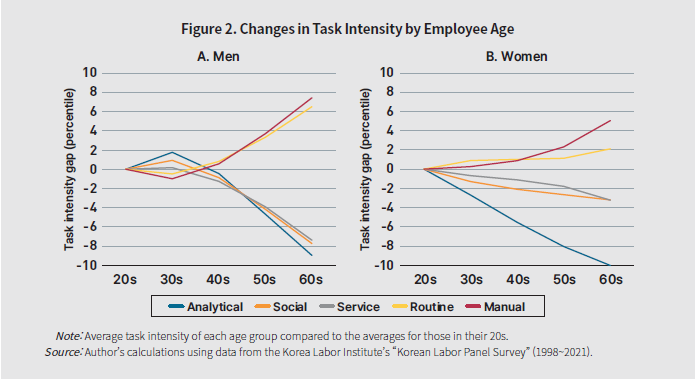
As workers advance in age, their intensity scores for analytical, social, and service tasks decline, while those for routine and manual tasks increase.
As workers progress through their lifecycle, they increasingly move towards jobs that involve routine and manual tasks, which are typically lower-skilled and lower-wage.
Ⅳ. Causes of Task Composition Differences by Age: Task Disruption among Middle-Aged and Older Workers
What are the causes of task composition differences by age? One of the causes is changes in task composition due to employment transitions as individuals face layoffs or retirements. Figure 3 illustrates the changes in task intensity scores by age group for male employees aged 20~75, who have undergone job transitions. Generally, following a job change, the intensity of analytical tasks tends to decrease while that of manual tasks increases. However, the degree of change in task intensity varies depending on the age at which the job change occurs. For those switching jobs before the age of 50, the analytical task intensity either remains nearly the same or even increases. For workers in transition in their 30s and 40s, the analytical task intensity slightly decreases after the transition, but the disparity is statistically insignificant. For those in their 20s, the analytical task intensity increases after the transition compared to before it. This finding suggests that younger individuals who switched jobs tend to secure reemployment in positions similar to their previous roles or even superior ones through investments in human capital.
The differences in task intensity across age groups are primarily driven by task discontinuity, which occurs when workers leave their jobs due to layoffs, retirements, or other reasons.
In contrast, for individuals changing jobs after 50, the analytical task intensity drops substantially. Those in their 50s experience a statistically significant decrease in analytical task intensity one year after leaving their jobs. Although the degree of decline slightly diminishes over time, the analytical task intensity remains lower than before the job change, even five years after leaving. For those who take on new positions in their 60s, the reduction in analytical task intensity is even more pronounced, and the decline further deepens over time. On the contrary, manual task intensity generally escalates following a role change for those over 50. In short, those who leave their former positions after 50 are likely to be rehired in functions with task compositions considerably different from earlier ones, typically involving fewer analytical tasks and more manual tasks. Social tasks follow a pattern similar to analytical tasks, but service and routine tasks do not show meaningful differences across age groups.
Female employees exhibit trends similar to their male counterparts. However, their decline in analytical task intensity begins earlier in their 30s and 40s compared to men, and women experience little change in task intensity after changing jobs after 50 (Figure 4). This disparity seems to reflect the impact of career breaks due to childbirth and childcare responsibilities. According to the “2022 Survey on the Economic Activities of Women with Career Interruptions” (Ministry of Gender Equality and Family, press release, May 30, 2023), 42.6% of women aged 25~54 experienced career interruptions. Following these breaks, the proportion of women in clerical workers and professionals decreased, while the proportion in sales and service positions, which typically have lower analytical task intensity, increased.
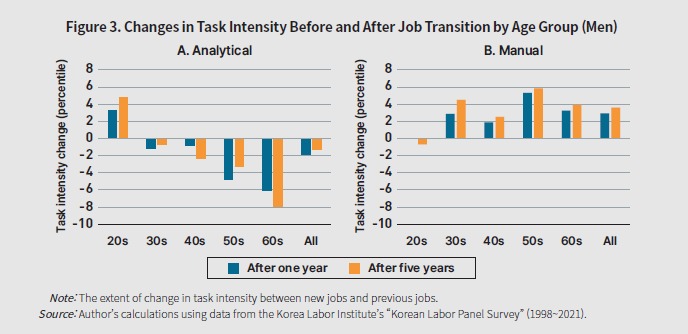
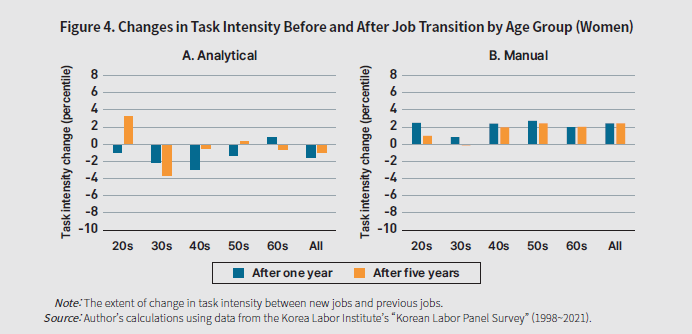
Younger individuals who change jobs typically find positions similar to their previous ones as to task composition, while those over 50 often end up in positions with significantly lower analytical and social task intensity.
Ⅴ. Employment Instability and Task Discontinuity among Middleaged and Older Workers
substantial differences in task compositions across employee age groups. Secondly, these differences are primarily attributable to the task discontinuity experienced by middle-aged and older workers as they leave their lifetime main jobs.
If the differences in task composition by age are simply a reflection of productivity differences across age groups, task discontinuity among the middle-aged and older workforce could be viewed as a natural phenomenon. Over time, the knowledge and skills required for analytical and social tasks may evolve, and employees who struggle to adapt to these changes may move to occupations with fewer such tasks, resulting in disparities in task intensity across different age groups. However, since the findings of this study are derived after controlling for variables that account for individual productivity, such as education level and individual fixed effects, it is difficult to attribute the differences in task intensity solely to productivity gaps. In other words, there exist middle-aged and older employees who possess the capabilities necessary for analytical and social tasks but are not employed in such positions, indicating an underutilization of their human capital in the current labor market.
Task discontinuity appears closely tied to employment instability and difficulties in finding new jobs for middle-aged and older workers. Figure 5 compares changes in continuous working years and analytical task intensity across age groups between Korea and the US, with analytical task intensity as the representative measure for task intensity. Unlike in the US, where employee age and continuous working years increase in tandem, Korea sees both metrics for male employees nosedive after age 50. On the other hand, the analytical task intensity of US men remains largely unchanged even after their 50s, meaning the share of workers engaged in analytical roles rarely decreases and stays relatively stable through middle age. Factoring in the continuous working years, it can be inferred that a higher proportion of Korean employees leave analytical job sectors after middle age than their US counterparts. For female workers, Korea experiences stagnation in both metrics after their mid-30s, whereas both continue to rise in the US beyond the 30s.
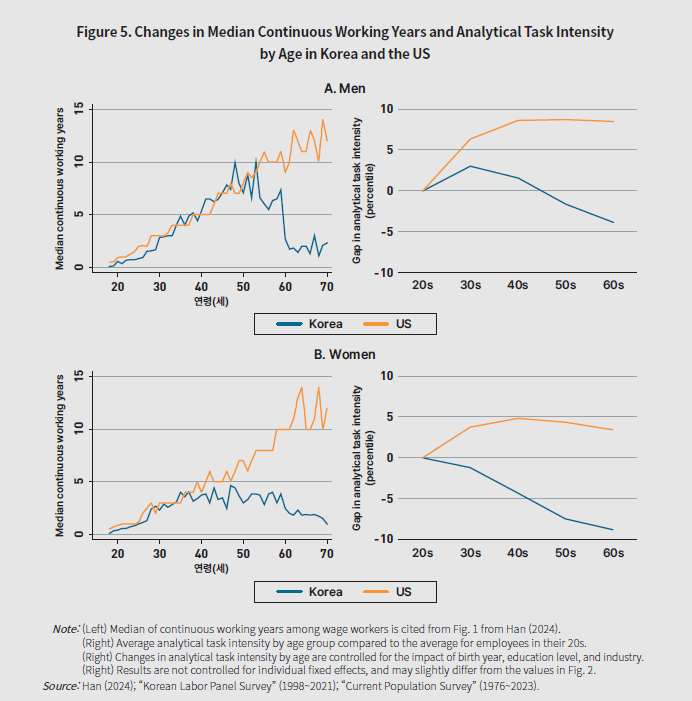
The comparison in Figure 5 shows that while US workers continue performing the same tasks within the same occupations even after middle age, Korean workers often leave their jobs and seek reemployment in entirely different capacities. The steady task intensity maintained by US workers after middle age suggests that changes in task intensity across age groups are not necessarily due to productivity decline. Instead, this finding points to structural factors within Korea’s labor market that may contribute to task discontinuity among middleaged and older adults.
Task discontinuity is closely related to employment instability and reemployment difficulties by middleaged and older workers.
Ⅵ. Conclusion and Implications
Weak labor demand for middle-aged and older workers is the common denominator affecting task discontinuity and employment instability for this age group in Korea. This limited demand sets hurdles to retaining existing jobs after middle age and getting reemployed at similar positions after retirement. Therefore, targeted interventions are necessary to address the factors contributing to their challenges.
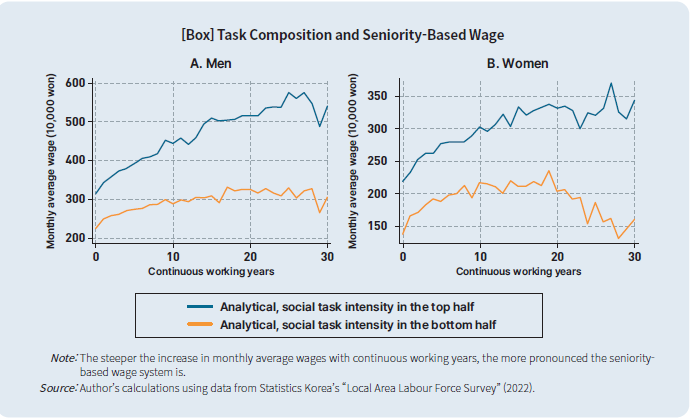
For instance, a wage system overly seniority-oriented can suppress the demand for middle-aged and older workers. As wages mechanically increase with tenure, the cost of hiring these workers becomes disproportionately high relative to their productivity, leading to early retirement and lower-quality jobs when reemployed (Han, 2024). The seniority effect on wages is more pronounced in job categories that require intensive analytical and social tasks (see Box), indicating that the seniority-based wage system contributes to task discontinuity for older workers. Therefore, ensuring task continuity through expanding a wage system based on task content and performance outcomes, rather than on continuous working years, would be more effective in leveraging their human capital.
Mandatory retirement is another pathway to task discontinuity. However, given the high share of workers leaving their lifetime main jobs early, before the statutory retirement age, extending the legal age is expected to fall short in effectiveness. For continued employment of older workers, better use of reemployment systems after mandatory retirement would be more sensible than simply extending the retirement age. Rehiring after mandatory retirement allows employers the opportunity to utilize the skills and experience of willing retirees, even with adjusted wages, while also providing a means to manage workforce composition through employment adjustments for lowperforming employees.
Furthermore, the task analysis in this study provides valuable insights into how another underutilized group, the female workforce, can be better engaged. Korea’s lower rate of female participation in the workforce compared to major economies represents an untapped reservoir for future growth in labor supply. However, this study finds substantial disparities in task requirements between male and female workers, which can weaken employment substitutability between the two. The gap in task composition appears to mainly arise from women’s transition to lower-productivity jobs during their 30s and 40s due to childbirth and childcare. Therefore, it is essential to support women to retain high-productivity jobs through work-family balance initiatives and by creating family-friendly work environments.
Efficiently leveraging the middle-aged and older workforce requires addressing structural issues in the labor market that overly constrain the demand for these workers to prevent task discontinuity in job transitions.
CONTENTS-
- Ⅰ. Changing Population Structure and the Labor Market
Ⅱ. The Necessity of Task Analysis
Ⅲ. Task Composition by Employee Age Group
Ⅳ. Causes of Task Composition Differences by Age: Task Disruption among Middle-Aged and Older Workers
Ⅴ. Employment Instability and Task Discontinuity among Middleaged and Older Workers
Ⅵ. Conclusion and Implications
- Ⅰ. Changing Population Structure and the Labor Market
- Key related materials
We reject unauthorized collection of email addresses posted on our website by using email address collecting programs or other technical devices. To access the email address, please type in the characters exactly as they appear in the box below.
Please enter the security code to prevent unauthorized information collection.