
Research Monograph Revisiting the DPRK Economy: Structural Evidence from Firms and Industries December 31, 2025
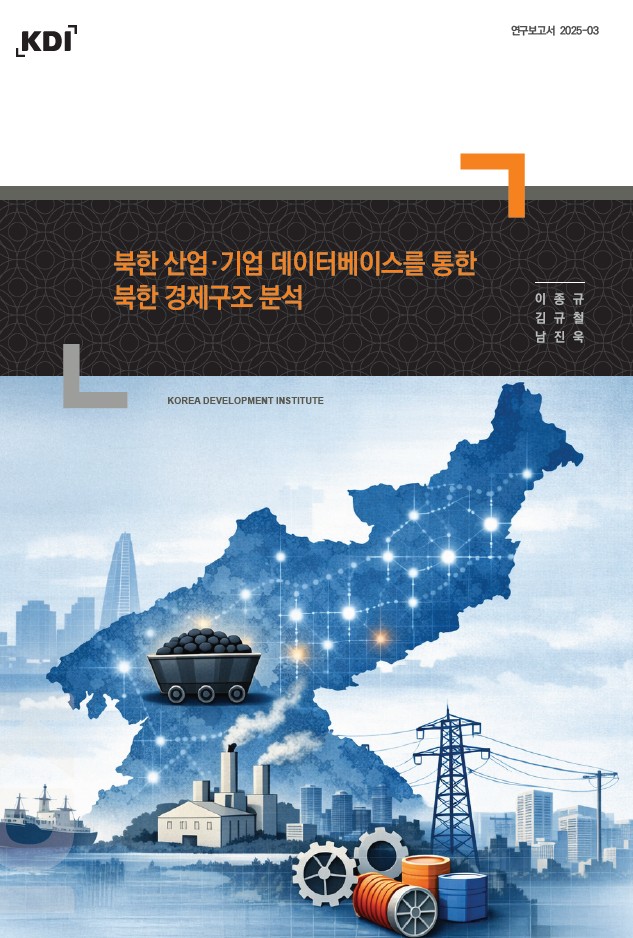
Series No. 2025-03
Research Monograph
KOR
Revisiting the DPRK Economy: Structural Evidence from Firms and Industries
#North-South Korean Economic Cooperation/Policy on North Korea/Unification Policy
#General(Other)
December 31, 2025
-
Jongkyu Lee
 프로필
프로필
-
KDIKyoochul Kim
-
Jinwook Nam
 프로필
프로필
- Summary
-
This study aims to analyze the structure of the North Korean economy by utilizing an industry-firm database constructed from North Korean media reports. By examining firms and industries at the micro level and cross-validating findings with satellite-based indicators, the study assesses whether media reports can provide meaningful insights into actual economic activities.
Chapter 2 reconstructs the original database obtained from the Korea Institute for Industrial Economics and Trade (KIET), covering the period from 2000 to 2024. Separate annual datasets were consolidated into a unified format, with duplicate entries removed and inconsistencies in firm names standardized. In cases where firm identifiers differed despite referring to the same entity, a single identifier was adopted, and additional information, such as industry codes and administrative regions, was supplemented when necessary. As a result of this reconstruction, the number of observed firms increased from 3,557 to 3,973, while the total number of media reports expanded from 86,116 to 153,047 compared to the original KIET database.
Chapter 3 analyzes the distribution and evolution of North Korean firms, demonstrating that media coverage carries economic implications beyond purely propagandistic purposes. At the industry level, the share of media coverage shows a strong correlation with the Bank of Korea’s estimates of industry-specific GDP shares. Investment-related reports are found to be significantly associated with increases in production-related reports one to two years later, with the impact of investment coverage exceeding that of political coverage. At the firm level, the analysis also identifies firms that gained prominence or declined during specific periods. Firms that expanded after Kim Jong Un’s accession to power include Chongchongang Cascade Hydropower Plant, Tanchon Power Plant, and Sunchon Chemical Complex; those that experienced decline include Sinchang Coal Mine, Komdok Mine, and Huichon Machine Tool Factory. Following the imposition of international sanctions, rising firms include Sunchon Phosphate Fertilizer Factory, Equipment Assembly Complex, and Kosong County People’s Power Plant; declining firms include Chosan Youth Power Plant, Sariwon Coal Mine, and Kumya Youth Coal Mine.
Chapter 4 conducts a multidimensional analysis of North Korean industries using the reconstructed database. Trends in industry-related and non-industry-related coverage vary over time, reflecting fluctuations in production and investment activities across sectors. The regional distribution of major industries also differs substantially, shaped by natural, geographic, and demographic factors. With respect to the “20×10 Policy for Regional Development,” the analysis finds that some regions were selected based on their importance as benchmarks for policy success, while others ― characterized by poor living conditions ― were prioritized in line with the policy’s stated objectives.
Chapter 5 combines the reconstructed database with satellite-based nighttime light data and applies panel regressions and event study methodologies to examine whether reported investment and production activities are linked to actual increases in operations and electricity usage. The results indicate that both investment and production reports are positively and significantly correlated with nighttime light intensity. In the event study, investment reports are treated as events, with the month preceding the report serving as the reference period. The average post-event effect over 0~12 months shows an approximately 7.1% increase in nighttime light intensity, statistically significant at the 5% level, with positive and significant effects concentrated in the 7~12 month window. This suggests a persistent increase in nighttime illumination around firms following reported investment activities. Furthermore, a weighted nighttime light index based on the frequency of investment and production reports exhibits high correlations with the Bank of Korea’s estimates of GDP by economic activity, particularly in the energy, light manufacturing, and heavy and chemical industries.
Overall, this study treats North Korean media reports not merely as propaganda but as a source of indirect evidence for understanding economic policy directions, sectoral priorities, and firm-level activities. While media reports do not directly capture macroeconomic fluctuations, the findings suggest that they can function as a useful tool for tracking micro-level industrial and firm dynamics. The analytical potential of this approach may be further enhanced through continued validation using alternative data sources such as satellite imagery.
- Contents
-
Abstract (ENG)
Preface
Summary (KOR)
Chapter 1. Introduction
Chapter 2. North Korean Industry and Enterprise Database: Overview and Reconstruction
Section 1. Introduction
Section 2. Industry and Enterprise Database Provided by the Korea Institute for Industrial Economics & Trade
Section 3. Reconstruction of the Industry and Enterprise Database
Section 4. Descriptive Statistics of the Reconstructed Database
Section 5. Conclusion
References
Chapter 3. An Analysis of the Dynamic Changes of North Korean Enterprises: Focusing on Official Reports
Section 1. Introduction
Section 2. Previous Studies on North Korean Enterprises
Section 3. Trends and Characteristics of Reports on North Korean Industry and Enterprises
Section 4. The Rise and Decline of North Korean Enterprises
Section 5. Conclusion
References
Chapter 4. An Analysis of North Korea’s Industries and Regions Using the North Korean Industry and Enterprise Database: Focusing on the Frequency of Rodong Sinmun Reports
Section 1. Introduction
Section 2. Overall Industry Analysis
Section 3. Conclusion and Implications
References
Chapter 5. An Analysis of North Korea’s Industries and Regions Using the North Korean Industry and Enterprise Database: Focusing on Satellite Indicators
Section 1. Introduction
Section 2. Characteristics of North Korean Regions, Industries, and Enterprises as Seen through Satellite Indicators
Section 3. Empirical Analysis of the North Korean Industry and Enterprise Database and Satellite Data
Section 4. Structural Changes in the North Korean Economy Examined through Satellite Indicators
Section 5. Conclusion
References
Appendix
Chapter 6. Concluding Remarks
If you want to know more in detail?
related materials ( 9 )
- Key related materials
Security code
![captcha]()
We reject unauthorized collection of email addresses posted on our website by using email address collecting programs or other technical devices. To access the email address, please type in the characters exactly as they appear in the box below.
KDI Staff Information
Please enter the security code to prevent unauthorized information collection.
KDI Staff Information
KDI Staff Information