
Policy Study Innovation-Led Regional Growth in Korea: R&D Structures and Policy Directions February 28, 2026
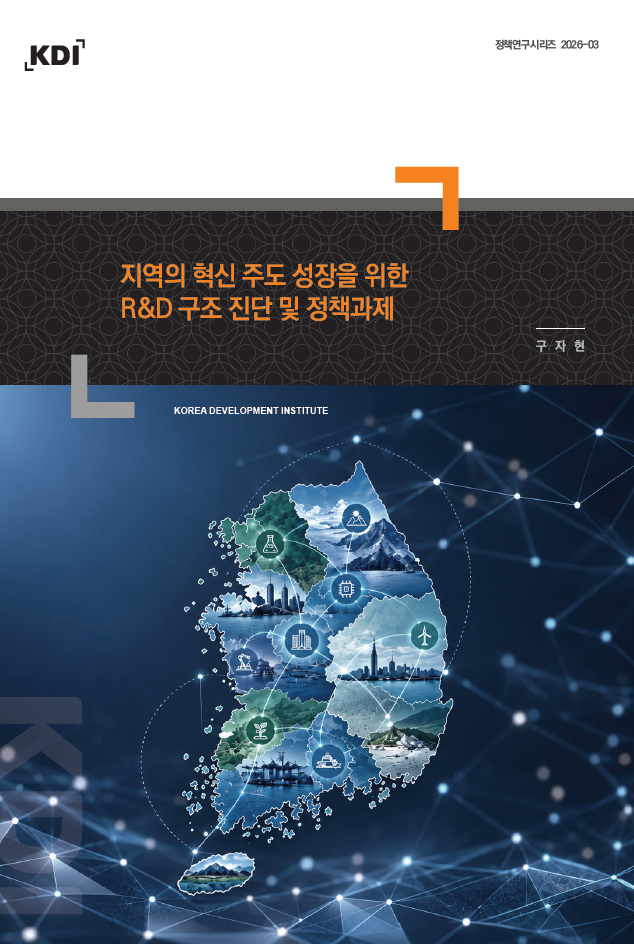
Series No. 2026-03
Policy Study
KOR
Innovation-Led Regional Growth in Korea: R&D Structures and Policy Directions
#Technology Innovation and Start-up
February 28, 2026
-
Jahyun Koo
 프로필
- Summary
-
Economic Sustainable regional growth increasingly depends on innovation capacity rooted in research and development (R&D). In Korea, however, R&D investment, human resources, patents, and innovation infrastructure remain concentrated in the Seoul Metropolitan Area and a limited number of regional hubs, contributing to persistent disparities in innovation capacity across regions. Addressing these disparities requires a regional innovation policy that goes beyond the geographical redistribution of resources and reflects regional industrial and technological strengths as well as patterns of collaboration among innovation actors.
This study examines the structure and limitations of regional R&D ecosystems in Korea, focusing on firms, universities, government-funded research institutes, technological fields, and inter-organizational collaboration. Using co-patent application data as an indicator of R&D collaboration, the study applies network analysis to identify the patterns of interregional and industry-academia-research linkages. It also reviews the roles of local governments and intermediary organizations and draws policy implications from selected international cases of regional innovation.
The analysis shows that R&D capabilities and collaborative networks are unevenly distributed across regions, with innovation resources and linkages concentrated in the Seoul Metropolitan Area and a small number of major innovation hubs. Regional differences are also observed in the composition of innovation actors and the degree of network connectivity, suggesting that uniform R&D support is unlikely to address the diverse needs and capacities of individual regions. The findings further highlight the importance of coordination mechanisms that connect innovation actors and facilitate the translation of R&D outcomes into commercialization and industrial development.
These results suggest that regional innovation policy should place greater emphasis on strategic investment tailored to regional technological and industrial capabilities, stronger industry-academia-research networks, and integrated support linking R&D, commercialization, and diffusion. While co-patent data provide useful information on collaborative structures, future research should incorporate technological proximity, patent citations, and other forms of collaboration to develop a more comprehensive understanding of regional innovation ecosystems.
- Contents
-
Abstract
Preface
Summary (Korean)
Chapter 1. Introduction
Chapter 2. Regional Innovation Systems and R&D Capabilities in Korea
Section 1. Concept of Regional Innovation Systems
Section 2. Policies to Enhance Regional Innovation and R&D Capabilities in Korea
Section 3. Key Indicators of Regional Innovation and R&D Capabilities in Korea
Chapter 3. Analysis of Regional R&D Characteristics in Korea
Section 1. Analysis of Patent Applications
Section 2. Patent Application Network Analysis
Section 3. Summary of Patent Application Network Analysis
Chapter 4. International Case Studies
Section 1. United Kingdom
Section 2. United States
Section 3. Germany
Section 4. Japan
Section 5. China
Section 6. Summary of Regional Innovation Policies in Major Countries and Implications for Korea
Chapter 5. Policy Recommendations for Innovation-Led Regional Growth
Section 1. Policy Recommendations Based on an Assessment of Regional R&D Structures and a Comparison of Growth Strategies
Section 2. Policy Recommendations for the Commercialization of Regional R&D Capabilities
References
If you want to know more in detail?
related materials ( 9 )
- Key related materials
Security code
![captcha]()
We reject unauthorized collection of email addresses posted on our website by using email address collecting programs or other technical devices. To access the email address, please type in the characters exactly as they appear in the box below.
KDI Staff Information
Please enter the security code to prevent unauthorized information collection.
KDI Staff Information
KDI Staff Information