
KDI FOCUS Drivers of the Growth of Marginal Part-Time Work and Policy Recommendations December 24, 2025
Drivers of the Growth of Marginal Part-Time Work and Policy Recommendations
December 24, 2025-
Su Hwan Chung
 프로필
프로필


Marginal part-time work has risen rapidly in South Korea’s labor market, driven by a policy structure in which labor costs increase sharply at 15 hours per week. Policy adjustments are needed to moderate the excessive cost differential at a specific working-hour threshold.
Ⅰ. Background: The Expansion of Marginal Part-Time Work
Since the 2010s, marginal part-time work has grown steadily in South Korea. Marginal part-time workers are generally defined as those whose contractual working hours average fewer than 15 hours per week over a four-week period. Because this study relies on monthly working-hour data, the analysis defines marginal part-time workers as those with fewer than 60 contractual hours per month. Data from the Survey on Labor Conditions by Employment Type show that the share of marginal part-time workers among wage workers rose from 3.7% (487,000 workers) in 2012 to 8.5% (1.538 million workers) in 2024—more than doubling over 12 years (Figure 1, left). The increase is particularly pronounced among newly hired workers with less than one year of tenure, for whom the share of marginal part-time workers has exceeded 20% since the early 2020s. Once regarded as an atypical employment arrangement (Hwang, 2004), marginal part-time work now constitutes a substantial segment of the labor market.
Among wage workers, the share of marginal part-time workers—defined as those working fewer than 60 hours per month—more than doubled, rising from 3.7% in 2012 to 8.5% in 2024.
Despite their growing prevalence, marginal part-time workers have low participation rates under the basic worker protection system, including social insurance, and there is little evidence of improvement over time. Examining the share of part-time workers covered by all three social insurance schemes—employment insurance, health insurance, and national pension—by working-hour range reveals a clear contrast: enrollment rates have increased markedly over the past 15 years for general part-time workers but have remained low for marginal parttime workers (Figure 1, right). In other words, marginal part-time work is a form of employment that falls within a blind spot in South Korea’s worker protection framework.
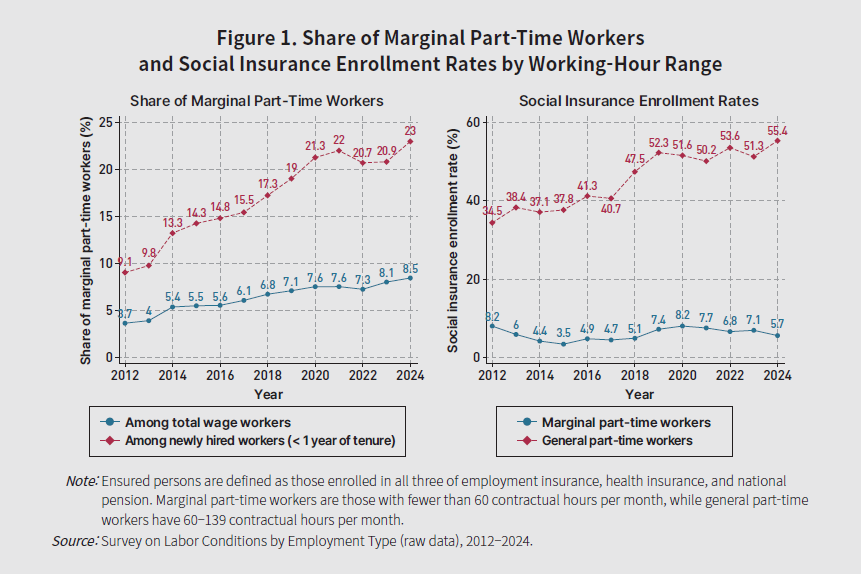
Social insurance coverage remains low for marginal part-time workers, with few signs of improvement.
The rapid expansion of marginal part-time work means that jobs outside the worker protection framework are increasing, calling for policy attention.
The rapid expansion of marginal part-time work means an increasing number of jobs falling outside the worker protection framework, calling for closer analytical and policy attention. The rise of part-time work, including marginal part-time work, has drawn mixed assessments. Proponents stress that increasingly diverse working-hour arrangements can broaden labor market participation among groups facing time constraints, including women and older persons. Critics point to poor job quality. Taken together, the growth of general part-time employment, where job quality has improved as reflected in broader social insurance coverage, does not in itself warrant a negative assessment. However, the growth of marginal part-time employment requires a policy response.
Ⅱ. Institutional Structure: Cost Differential at 60 Hours per Month (15 Hours per Week)
Marginal part-time work falls into a regulatory blind spot because most worker protection schemes apply only after contractual working hours reach 60 hours per month. As summarized in Table 1, as of 2025, workers employed below this threshold are excluded from the weekly holiday allowance, paid annual leave, national pension, health insurance, employment insurance, severance pay, and the prohibition on fixed-term contracts exceeding two years.
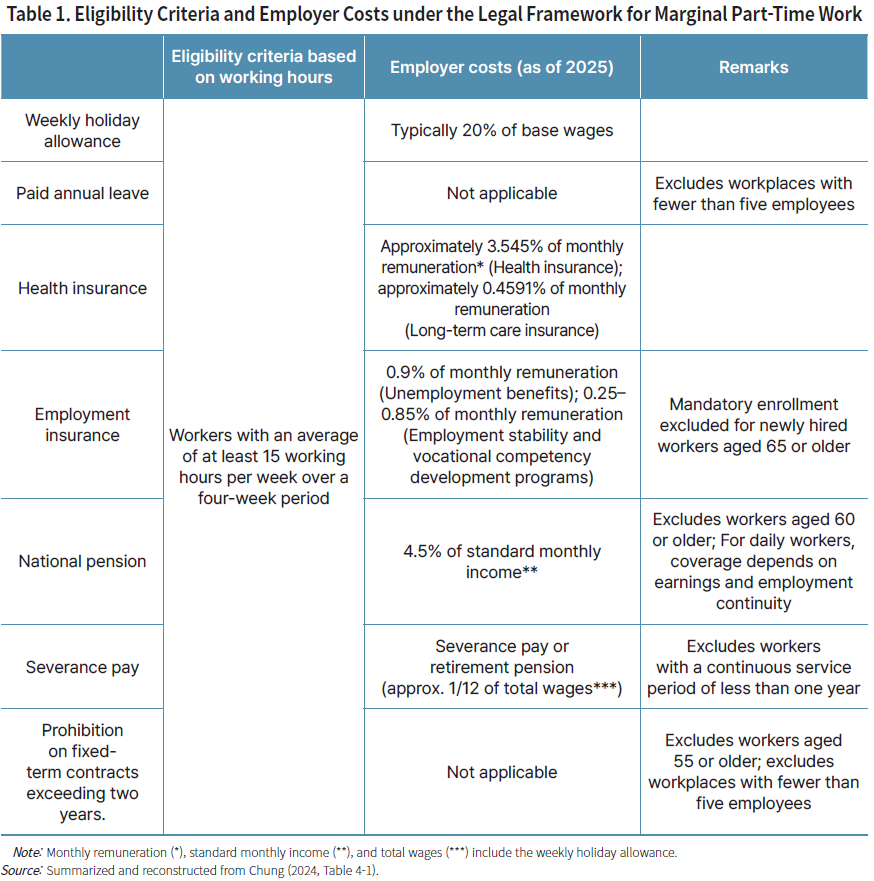
Because many worker protection schemes apply only to workers with contractual hours of 60 or more per month, marginal part-time work falls within a blind spot of the worker protection framework.
Reaching the 60-hour threshold triggers multiple worker protection schemes, substantially increasing employer costs. Although the scope of eligibility varies across some schemes, depending on worker age or establishment size, aggregating the employer cost components listed in Table 1 shows that, holding the hourly base wage constant, average hourly labor costs for workers employed 60 hours or more per month are approximately 25% to 40% higher than for those employed fewer than 60 hours per month. As illustrated in Figure 2, total labor costs exhibit an apparent discontinuity at the threshold, beyond which the labor cost curve steepens.
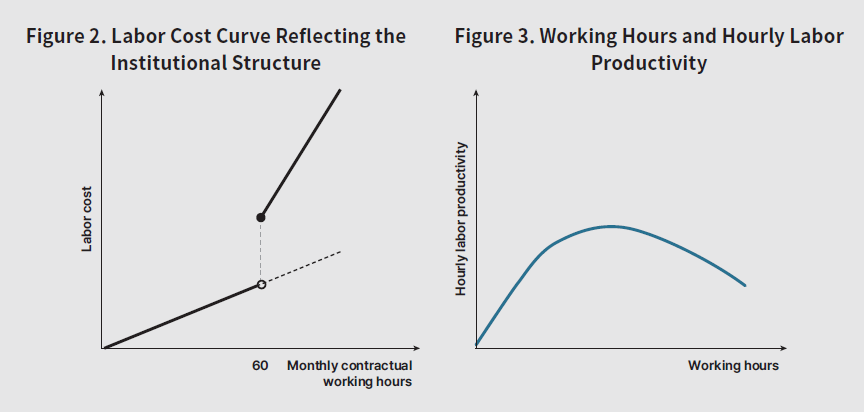
The cost discontinuity at 60 hours per month creates incentives for employers to hire marginal part-time workers.
The institutional design that changes costs and protection coverage at 60 hours per month has two outcomes. First, the sharp increase in labor costs at the threshold incentivizes employers to hire workers below it. Recent labor market reports note instances of contracts specifying 14 hours per week, 14 hours and 30 minutes, 14 hours and 50 minutes, and even 14 hours and 55 minutes. These arrangements are highly likely to be efforts to remain just below the threshold in order to avoid the associated cost increase. As a result, workers employed under such contracts fall outside the effective reach of worker protection.
Second, employers’ efforts to avoid higher labor costs may generate efficiency losses. As illustrated in Figure 3, hourly labor productivity tends to rise at relatively short working hours through learning by doing but declines beyond a certain point as work fatigue from long hours sets in (Barzel, 1973; Han et al., 2024). When working hours remain below 60 per month, additional hours may facilitate humancapital accumulation and improve efficiency. Hiring more workers to cover the same total operating hours also raises fixed costs and complicates human resource management. If employment is concentrated below the threshold to avoid higher labor costs, overall efficiency may suffer.
III. rivers of the Growth of Marginal Part-Time Work: Improved Compliance with Worker Protection Schemes for Workers above 60 Hours per Month
While the structure that sharply increases labor costs at 60 hours per month creates incentives for employers to hire marginal part-time workers, this feature alone cannot explain the recent surge in marginal part-time work shown in Figure 1. The weekly holiday allowance, the largest driver of the labor cost increase, has existed since the Labor Standards Act was first enacted in the 1950s. The 1997 revision introduced the exclusion for marginal part-time workers, which has remained unchanged to date. After eligibility thresholds for health insurance and national pension were lowered from 80 to 60 hours per month in 2010, the institutional structure that produces a sharp discontinuity in labor costs at the 60-hour cutoff remained largely intact. What, then, accounts for the rapid expansion of marginal parttime work since the 2010s?
This study focuses on the marked improvement in compliance with worker protection schemes for workers with at least 60 contractual hours per month since the 2010s. Low compliance limits the extent to which these schemes affect the labor market. Even into the early 2010s, many workers whose hours exceeded 60 hours per month—legally eligible for the protections in Table 1—remained outside the worker protection framework due to poor compliance in practice. Put differently, the cost differential associated with the 60-hour threshold was unlikely to have a meaningful impact on the labor market. Since the 2010s, however, protection for workers within the institutional framework has strengthened, a change that may have shifted labor demand toward marginal part-time workers outside it.
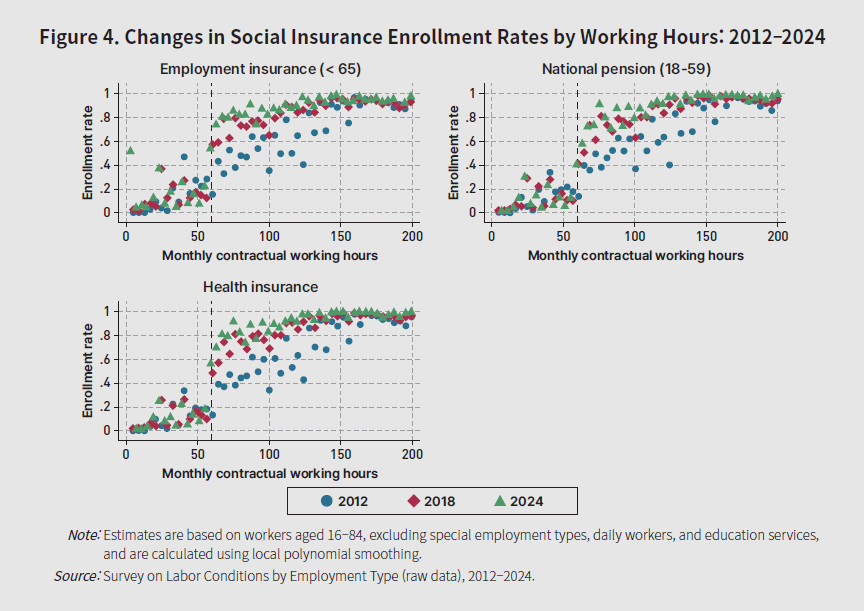
Since the 2010s, compliance with worker protection schemes for workers employed at least 60 hours per month has improved.
Changes in social insurance enrollment rates by contractual working hours provide a way to empirically show improvements in compliance. No single dataset captures compliance with all worker protection schemes listed in Table 1. Still, multiple sources show that, at the industry level, compliance rates with one worker protection scheme are positively correlated with those for others (Chung, 2024). Based on this finding, this study uses social insurance enrollment rates from the Survey on Labor Conditions by Employment Type—measured consistently over the sample period—as a proxy for overall compliance with worker protection schemes, including the weekly holiday allowance (Table 1). This approach rests on the premise that establishments complying with one scheme are more likely to comply with others.
Figure 4 shows a striking increase in social insurance enrollment rates among general part-time workers between 2012 and 2024. These workers put in at least 60 hours per month and are eligible for the relevant schemes.6) The figure excludes workers who may be ineligible for coverage for reasons other than working hours, including daily workers, special types of employment, workers in education services, and worker age. As a result, the sample primarily consists of workers whose monthly hours meet the 60-hour threshold and are thus eligible for social insurance coverage. However, in 2012, the percentage of workers employed for 60–100 hours per month who enrolled to social insurance was only about 40%. By 2024, that percentage had risen to roughly 80%. This gap in enrollment rates at the 60-hour threshold, barely discernible in 2012, had become pronounced by 2024. Improved compliance since the 2010s appears to have converted the institutional protection framework into an effective one, allowing the cost differential embedded in the institutional design to exert meaningful influence.
Improved compliance with worker protection schemes has stimulated the expansion of marginal part-time work.
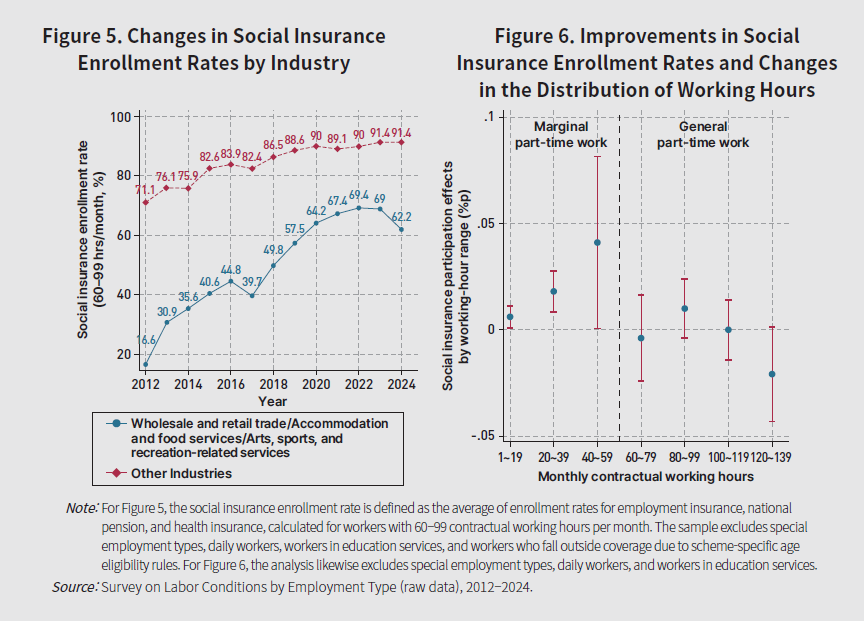
Compliance rates improved, especially in low-wage service industries where they had previously been low. In 2012, the average social insurance enrollment rate among workers employed for 60–99 hours per month stood at only 16.6% in wholesale and retail trade, accommodation and food services, and arts, sports, and recreation-related services (Figure 5), meaning roughly five out of six eligible workers in these industries lacked institutional protection. By 2022, the enrollment rate had risen to 69.4%, up more than 50%p. In short, worker protection schemes that were largely non-compliant in these sectors in 2012 had achieved substantial compliance by the 2020s.
A clear empirical correlation is observed between improved compliance and the growth of marginal part-time work. Figure 6 presents regression results at the industry-establishment size level, with the average social insurance enrollment rate among workers with 60–99 contractual working hours per month as the independent variable and the share of workers in each working-hour range as the dependent variable.
Improved compliance with worker protection schemes is empirically correlated with the expansion of marginal part-time work and explains a substantial share of that increase.
Industry-establishment size-level fixed effects and year fixed effects are included to control for time-invariant heterogeneity.7) In Figure 6, the blue dots represent the change in the share of workers in each monthly working-hour range (e.g., 1–19 hours and 20–39 hours) associated with a 1%p increase in the social insurance enrollment rate among workers employed for 60–99 hours per month, and the red bars denote 95% confidence intervals. The estimations indicate that a 1%p increase in the enrollment rate among workers with 60–99 working hours per month at the industry-establishment size level corresponds to a 0.065%p increase in the share of marginal part-time workers.8) Between 2012 and 2024, the enrollment rate for workers with 60-99 hours per month rose by approximately 40%p (Figure 3), implying an increase of about 2.6%p in the share of marginal part-time workers. Over the same period, the overall share of marginal part-time workers increased by 4.8%p. In a restricted sample excluding daily workers and education services—where the institutional structure applies differently—the share rose from 2.1% to 5.2%, an increase of 3.1%p. By and large, a substantial share of the observed increase in marginal part-time employment is correlated with improved compliance with worker protection schemes, measured by social insurance enrollment rates.
These findings suggest that the institutional design itself—characterized by a sharp cost change at the 60-hour threshold—is the primary driver of the rise in marginal part-time work during the 2010s. As compliance with worker protection schemes improved, the builtin incentive to shift labor demand toward working-hour arrangements outside the reach of the worker protection framework began to exert greater influence.
Improved compliance with worker protection schemes may reflect greater public awareness and understanding of these schemes
Identifying the causes of improved compliance is beyond the scope of this study, but increased public attention and associated growth in awareness likely played a role. Take the weekly holiday allowance as a representative case. Before 2010, fewer than ten newspaper articles per year mentioned this allowance across 25 newspapers (12 nationwide daily newspapers and 13 economic daily newspapers). From 2011 onward, media coverage expanded dramatically, reaching 108 articles in 2011 alone, reflecting a marked rise in public attention to the scheme (Chung, 2024, Figures 4-7). This increase in societal awareness and knowledge of the scheme appears to have driven improvements in compliance.
Ⅳ. Policy Directions: Reducing the Cost Discontinuity at the 60-Hour Threshold
The analysis presented so far offers a new perspective on the growth of marginal part-time work. Although worker protection schemes for general part-time workers who work at least 60 hours per month had long been in place, compliance with them improved significantly only after the 2010s, alongside growing societal awareness. This change is progress in terms of improved working conditions for general parttimeworkers. However, the resulting sharp increase in labor costs around the 60-hour threshold appears to have contributed to the growth of marginal part-time work. In essence, the improved labor conditions for general part-time workers and the growth of marginal part-time work can be understood as two sides of the same coin.
The labor market structure with a sharp cost discontinuity at 60 hours per month warrants adjustments.
With average labor costs increasing by more than 40% at a specific working-hour threshold, the current labor market structure warrants adjustments to moderate this cost differential. Eliminating all cost discontinuities across working hours is not necessarily desirable. A jump of this magnitude at a single cutoff, however, appears excessive.
Addressing the cost differential at 60 working hours per month requires reexamining the weekly holiday allowance, which accounts for the largest share of the cost increase. Introduced in the 1950s to guarantee a minimum income for low-wage workers by providing one paid rest day per week (Jeong, 2021), the allowance has remained in place even after the introduction of the minimum wage system, which has a similar policy rationale. Internationally, it is uncommon to provide paid weekly rest days.10) However, workers employed for fewer than 60 hours per month are not eligible for this paid rest, stimulating demand for marginal part-time work. For monthly-paid workers, it lowers the hourly ordinary wage, which serves as the basis for overtime pay (Jeong, 2021),11) stimulating demand for longer working hours. Accordingly, switching the weekly holiday allowance to unpaid rest would narrow the cost differential and weaken incentives for marginal part-time work, with additional positive effects of moderating demand for long working hours by raising the hourly ordinary wage used for overtime compensation. It is noteworthy that such an adjustment could entail income losses for low-wage workers, which calls for a gradual approach, supported by complementary measures such as minimum wage increases to offset these losses.
While revisiting the weekly holiday allowance is necessary to mitigate the cost differential that encourages both marginal part-time work and long working hours, adjustments should be framed as a longer-term objective and pursued cautiously.
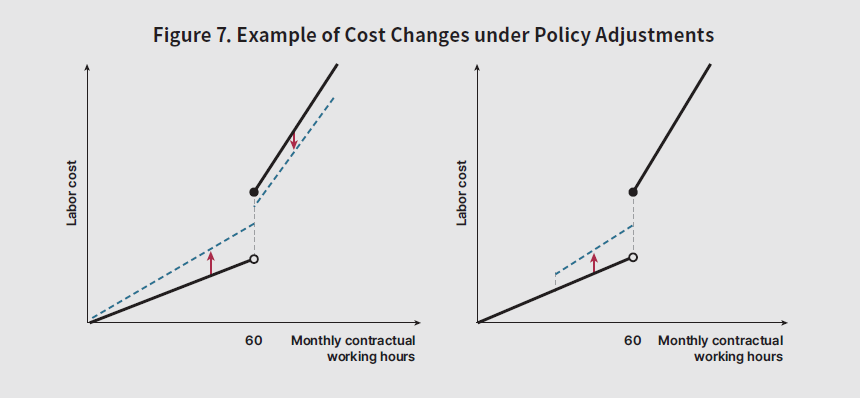
If the minimum wage increase is smaller than the weekly holiday allowance, labor costs at or above 60 hours per month would decline slightly, and those below would increase slightly (Figure 7, left), together substantially narrowing the cost gap. Switching to unpaid rest while raising the minimum wage would preserve the allowance’s original policy objective of guaranteeing a minimum income and simplify the institutional framework. Because the weekly holiday allowance applies to monthly paid workers, adjustments may have system-wide implications for the labor market. Given limited data and research on these potential effects, this option should be regarded as a medium- to long-run policy objective and pursued cautiously, informed by further study.
If short-run feasibility is the priority, the application of other labor protection schemes can be expanded in stages, with further policy adjustments considered in light of observed labor market responses. A sensible way forward would be first to expand schemes that offer substantive protection to workers and impose modest additional costs on employers. In this process, careful consideration of how to set reasonable eligibility standards for individual schemes is also essential. One option is to broaden eligibility for social insurance by relaxing the working-hour threshold,13) while mitigating increases in employer costs through existing support mechanisms, such as the Durunuri social insurance subsidy program or comparable measures.
As shown in the right panel of Figure 7, this approach partially narrows the cost gap at the 60-hour threshold, although the discontinuity persists. As long as the weekly holiday allowance, which accounts for the largest share of the cost gap, remains unchanged, the overall effect is likely to be limited.
Other policy combinations could also be explored, but the following principles should guide the formulation of a policy mix. First, eligibility criteria for individual schemes should be set or adjusted in line with their policy efficiency, alongside considerations for the overall cost structure. Second, abrupt changes to the current system―under which labor costs can differ by as much as 40% at the threshold of 60 hours per month―risk significant labor market disruption. A gradual rollout would be appropriate with complementary support and mitigating measures incorporated into the mix. Third, policy adjustments should avoid placing the costs of changes disproportionately on any single group. For example, extending all schemes currently tied to the threshold of 60 or more hours per month to workers below that threshold could excessively raise employer costs, requiring supplementary measures such as scaling back or eliminating the application of some schemes or introducing subsidies. Lastly, implementation should be accompanied by sufficient social dialogue and policy review, regardless of the policy mix pursued. Given the layering of multiple labor protection schemes, unanticipated side effects may arise during the adjustment process, highlighting the need for a comprehensive assessment of labor market impacts and extensive deliberation.
The following principles should guide the formulation of a policy mix: ① set eligibility criteria in light of the overall cost structure; ② proceed gradually and combine policy measures to mitigate adverse effects; ③ avoid placing disproportionate adjustment costs on specific groups; and ④ conduct sufficient social dialogue and institutional review.
- CONTENTS
-
- I. Background: The Expansion of Marginal Part-Time Work
- II. Institutional Structure: Cost Differential at 60 Hours per Month (15 Hours per Week)
- III. rivers of the Growth of Marginal Part-Time Work: Improved Compliance with Worker Protection Schemes for Workers above 60 Hours per Month
- IV. Policy Directions: Reducing the Cost Discontinuity at the 60-Hour Threshold
- Key related materials
We reject unauthorized collection of email addresses posted on our website by using email address collecting programs or other technical devices. To access the email address, please type in the characters exactly as they appear in the box below.
Please enter the security code to prevent unauthorized information collection.