
Research Monograph Korean Systems for Achieving Resource Adequacy in Electric Power Industry December 31, 2013
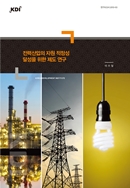
Series No. 2013-03
Research Monograph
KOR
Korean Systems for Achieving Resource Adequacy in Electric Power Industry
#Market Structure
#Regulatory Studies: Network Industries
#Environment and Energy
DOIhttps://doi.org/10.22740/kdi.rm.2013.03
P-ISBN978-89-8063-806-2
December 31, 2013
- Summary
-
This study assesses Korean systems for achieving resource adequacy in the electric power industry from the aspects of stability and efficiency in achieving resource adequacy and of system strength and predictability, and then agendas for system improvement are drawn from perspectives of power supply stability, energy security and climate change response.
Chapter 2 shows that resource adequacy problem in the electric power industry is derived from the lack of demand response and the nature of operating reserve as public goods, added by detailed descriptions of basic logics behind the two main approaches- energy-only market approach and capacity mechanism approach in pursuing resource adequacy in the electric power industry- and the system design of those in reality. These accounts are followed by the assessment of relative merits and demerits of those approaches in the aspects of stability and efficiency in achieving resource adequacy, which can be recapped as follows: when it comes to securing optimal generation capacity, the approach of capacity mechanism, particularly the method of reserve requirement, works relatively better, while when it comes to providing incentives for operating generation facility efficiently and to reviving demand response, the approach of energy-only market works better. Lastly, recent attempts to integrate relative merits of the two approaches are introduced.
Chapter 3 looks into the establishment of the Basic Plan on Electricity Demand and Supply-which Korea has been operating in order to achieve resource adequacy in the electric power industry, the energy market based on the cost-based pool (CBP), capacity payment, the market for ancillary service, and the demand-side management system and pricing in terms of its current state, problem, nature and function. It also assesses each system from the aspects of stability and efficiency in achieving resource adequacy and of system strength and predictability.
Above all, the Basic Plan brings negative impacts on stable achievement of resource adequacy and efficient investment in new facility due to the lack of compulsory means for investment, limited decision-makers on the subject of uncertainty, the shortage of linkage between generation and transmission plans and the lack of ability to coordinate the timing of investment. The CBP-based energy market contributes to efficient investment in new facility by deterring the possibility of market power at play and containing market risks, but on the other hand it disturbs efficient operation of generation facility and further invigoration of demand response by repressing market price volatility. The correction factor system in particular significantly undermines the incentives for power producers to operate power generation facility in more efficient manner. The capacity payment system is run on inefficient reference capacity price and indiscriminative capacity payment, bringing negative impacts on a stable achievement of resource adequacy and efficient investment in new equipments. Meanwhile, it is analyzed that the capacity payment applying regional differences affects positively the generation site designation to be more efficient, while that applying seasonal and hourly differences affects positively the operation of generation facility to be more efficient. As for the market for ancillary service, excessively low operating reserve requirement and below-cost pricing undermine stable achievement of resource adequacy and efficient operation of generation facility. The retail price structure and electricity sales monopoly, in which the volatility of energy market price is completely removed or only a part of it is delivered to consumers, hinder the invigoration of demand response. Lastly, the Basic Plan on Electricity Demand and Supply, the energy market based on the CBP and capacity payment are all analyzed to be not stable and even weak in the aspect of system predictability.
Chapter 4 demonstrates that the shortfall of power transmission facility today is derived from Korea’s current structure of investment planning and implementation for power transmission network. It also accounts for the need to take differentiated approaches towards policy resources such as nuclear and new renewable energy and market resources such as coal and LNG power generation from the perspectives of energy security and climate change response. In Section 2, based on assessment results and discussions above, improvement agendas to achieve resource adequacy in Korea are suggested in eight categories as follows: ① rationalizing energy price and taxation; ② strengthening the transmission network investment plan in terms of its leading role, acceptance and accountability; ③ improving the Basic Plan on Electricity Demand and Supply; ④ adopting the method of reserve requirement; ⑤ improving the way of operating the energy market; ⑥ rationalizing ancillary service requirements and its unit price; ⑦ developing policy measures regarding the adoption of sales competition; and ⑧ planning and announcing a roadmap for system implementation. Above all, for improving the Basic Plan on Electricity Demand and Supply, active disclosure of information would be effective in order to properly forecast future demand for power, and for achieving energy security and better climate change response, entry barriers need to be lowered as to market resources such as coal and LNG power generation. In addition, in order to make the Basic Plan work more effectively, it is necessary to come up with a master plan that comprehensively covers all energy-related plans. Taking into account the forecast for Korea’s future electricity power demand, political burden weighted by the goal of achieving resource adequacy, consumers’ confidence in the market and public awareness of regulatory risks resulting from government intervention, it would be better for Korea to achieve resource adequacy in a stable manner, not efficient. So, it can be said that the approach of capacity mechanism is more suitable to the reality than that of energy-only market is; within the capacity mechanism, the method of reserve requirement works better than the current capacity payment method does. This study presents concrete measures to transform the current capacity payment method into the reserve requirement system.
- Contents
-
발간사
요 약
제1장 서론 및 문제제기
제2장 전력산업의 자원 적정성과 이의 달성을 위한 제도 설계
제1절 전력산업의 자원 적정성 문제
1. 수요반응의 부재와 자원 적정성 문제
2. 예비력의 공공재적 성격과 자원 적정성 문제
3. 논의의 정리
제2절 자원 적정성 달성을 위한 제도
1. 에너지단일시장 접근방식
2. 용량메커니즘 접근방식
제3절 자원 적정성 달성을 위한 제도의 평가 및 제도의 수렴
1. 제도의 평가
2. 제도의 수렴
제3장 우리나라 전력산업의 자원 적정성 달성을 위한 제도의 평가
제1절 최근의 전력수급 현황
제2절 자원 적정성 달성을 위한 제도
1. 전력수급기본계획
2. 전력시장제도
3. 수요관리
제3절 자원 적정성 달성을 위한 제도의 평가
1. 자원 적정성의 안정적 달성
2. 자원 적정성의 효율적 달성
3. 제도의 안정성과 예측 가능성
4. 평가의 요약
제4장 우리나라 전력산업의 자원 적정성 달성을 위한 제도개선 과 90
제1절 추가 고려사항
1. 안정적 송전
2. 에너지안보와 기후변화대응
제2절 자원 적정성 달성을 위한 제도개선 과제
1. 에너지 가격⋅세제의 합리화
2. 송전망투자계획의 선도성⋅수용성⋅책임성 강화
3. 전력수급기본계획의 개선
4. 용량확보의무제도의 도입
5. 에너지시장의 운영방식 개선
6. 보조서비스 확보기준 및 정산단가의 현실화
7. 판매경쟁 도입에 대한 정책방안의 조속한 확정
8. 제도 이행의 구체적인 로드맵 작성⋅공표
제5장 논의의 종합 및 결론
참고문헌
부 록
ABSTRACT
If you want to know more in detail?
related materials ( 10 )
- Key related materials
Security code
![captcha]()
We reject unauthorized collection of email addresses posted on our website by using email address collecting programs or other technical devices. To access the email address, please type in the characters exactly as they appear in the box below.
KDI Staff Information
Please enter the security code to prevent unauthorized information collection.
KDI Staff Information
KDI Staff Information