
Research Monograph Monetary Policy Transmission to the Korean Bond Market December 31, 2023
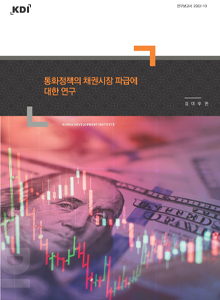
Series No. 2023-10
Research Monograph
KOR
Monetary Policy Transmission to the Korean Bond Market
#Inflation, Interest Rates, and Monetary Policy
#Asset Pricing
#International Finance
December 31, 2023
-
Meeroo Kim
 프로필
프로필
- Summary
-
This study quantitatively examines the transmission channels through which domestic and external monetary policy shocks affect the yields of Korean Treasury Bonds (KTBs). To this end, it proposes a new methodology that decomposes long-term KTB yields into expected policy rate paths and term premia and analyzes the interaction between monetary policy and the government bond market through this decomposition. Specifically, the study develops and estimates a four-factor linear term structure model that incorporates gradual structural changes in the level of the KTB yield curve. A comparison with the conventional three-factor model shows that the proposed four-factor model is statistically superior.
The estimation results indicate that, when yields are decomposed into trend and cyclical components, cyclical fluctuations account for a larger share of yield variation at shorter maturities, whereas trend components dominate at longer maturities. The expected policy rate path is extracted from the estimated term premia, suggesting that policy rates are expected to remain broadly stable in the near term and decline gradually thereafter. Analysis of the interaction between monetary policy and the bond market shows that policy rate shocks significantly raise expected policy rates, while shocks to expected policy rates also lead to increases in the actual policy rate. This implies a high degree of mutual credibility between the central bank and the government bond market.
Using this decomposition, the study examines the effects of domestic and U.S. monetary policy shocks on KTB yields. Domestic monetary policy shocks generate significant spillovers across the entire yield curve, from short- to long-term maturities. Short-term yields respond mainly through changes in the expected policy rate path, whereas long-term yields respond more strongly through adjustments in term premia. In contrast, U.S. federal funds rate shocks do not exert statistically significant effects on KTB yields. However, U.S. forward guidance and quantitative easing shocks exert meaningful impacts. Quantitative easing shocks produce larger short-term effects, while forward guidance shocks exhibit greater persistence. Nevertheless, these spillovers are considerably shorter-lived than those from domestic monetary policy shocks, highlighting the relative independence of Korea’s monetary policy.
The study also analyzes the Korean corporate bond market in the context of domestic and external monetary policy. Although the corporate bond market has expanded steadily in terms of outstanding issuance, secondary market liquidity remains limited, with turnover ratios substantially lower than those in the government bond market and trading concentrated in financial bonds. U.S. monetary tightening is found to reduce corporate bond trading volumes and widen credit spreads, with a 25 bp increase in the U.S. policy rate leading to an immediate spread widening of 11―13 bp. Over a horizon of one to three months, corporate bond spreads increase by 28―56 bp. Domestic monetary policy shocks also have significant effects on corporate bond yields, with particularly pronounced responses in lower-rated (BBB-) bonds. By contrast, firm-level financial conditions do not appear to systematically influence the sensitivity of corporate bond yields to U.S. monetary policy shocks, likely reflecting a flight-to-quality behavior during tightening episodes.
- Contents
-
ABSTRACT
Preface
Summary
Chapter 1. Introduction
References
Chapter 2. A Study on the Transmission Effects of Monetary Policy through the Estimation of KTB Term Premia
Section 1. Introduction
Section 2. Estimation of KTB Term Premia Incorporating Long-Term Trends
Section 3. Spillover Effects of Domestic and External Monetary Policy Shocks on the KTB Market
Section 4. Concluding Remarks
References
Appendix
Chapter 3. Effects of Domestic and External Monetary Policy Factors on Korea’s Corporate Bond Market
Section 1. Introduction
Section 2. Literature Review
Section 3. Outstanding Issuance of Corporate Bonds in Korea
Section 4. Trading Conditions in Korea’s Corporate Bond Market
Section 5. U.S. Monetary Policy and Korea’s Corporate Bond Market: A Focus on Trading Volume
Section 6. U.S. Monetary Policy and Korea’s Corporate Bond Market: A Focus on Interest Rates
Section 7. Spillover Effects of Monetary Policy Shocks on the Domestic Corporate Bond Market
Section 8. Concluding Remarks
References
Appendix
Chapter 4. Conclusions and Policy Implications
References
Abstract
If you want to know more in detail?
related materials ( 9 )
- Key related materials
Security code
![captcha]()
We reject unauthorized collection of email addresses posted on our website by using email address collecting programs or other technical devices. To access the email address, please type in the characters exactly as they appear in the box below.
KDI Staff Information
Please enter the security code to prevent unauthorized information collection.
KDI Staff Information
KDI Staff Information