
Policy Study A Study on Competition in the Mobile Ecosystem: Focusing on the Market Dominance of App Stores December 31, 2025
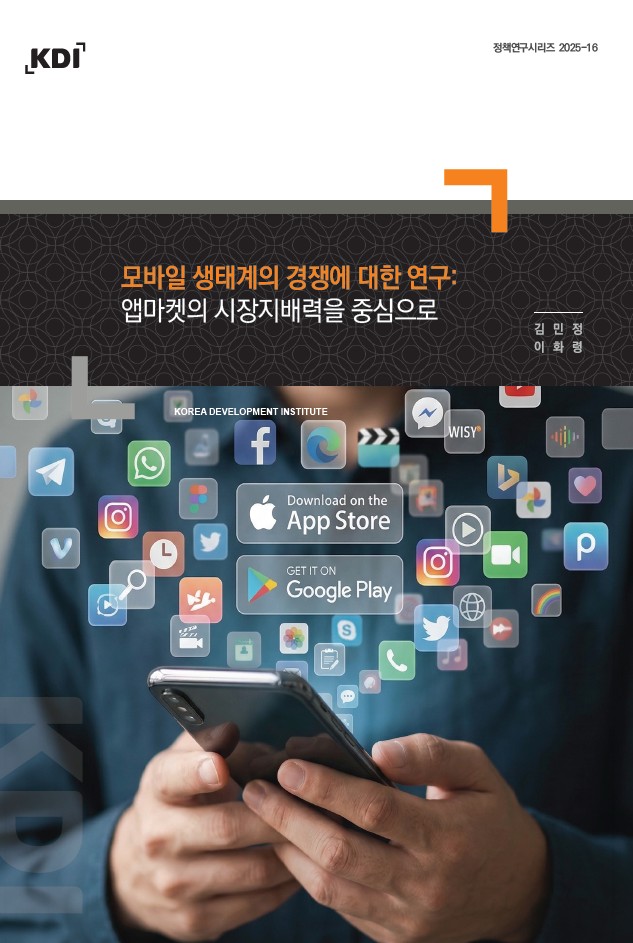
Series No. 2025-16
Policy Study
KOR
A Study on Competition in the Mobile Ecosystem: Focusing on the Market Dominance of App Stores
#Competition Policy
#Market Structure
December 31, 2025
-
Min Jung Kim
 프로필
프로필
-
KDIHwa Ryung Lee
- Summary
-
Using detailed market data, this study provides an in-depth analysis of competition in app store related markets and derives implications for the market dominance of app store platforms. It examines the state of competition both between the app stores of Google and Apple, and among leading apps within them from various perspectives, while also examining where the Korean market diverges from other major markets.
Chapter 2 analyzes the market sizes of Google Play and Apple’s App Store across multiple dimensions, including free versus paid apps, non-game versus game apps, and category-level breakdowns. The relative dominance of each app store varies considerably across countries. In Korea, Google Play accounted for over 70% of both downloads and revenue as of 2023. Across all major countries, the share of free apps has risen steadily in both measures, recently surpassing 98%―a pattern consistent with revenue models anchored in in-app purchases rather than paid app sales. Comparing non-game and game apps, game apps account for 93% of Google Play revenue and 71% of App Store revenue, making them the primary driver of overall revenue growth. Korea stands out in this regard. Not only is the revenue share of game apps disproportionately high relative to major countries, but concentration in a narrow set of top-performing categories is also markedly more pronounced.
Chapter 3 uses app-level performance data for the top 1,000 apps to analyze within-store concentration. The degree of concentration is substantial: these apps account for nearly 100% of revenue and roughly 60% of downloads. When a Pareto distribution is fitted to app performance, the estimated shape parameters fall below 1 in many categories―especially for free downloads―indicating an extreme bias toward top-ranked apps. Revenue distributions are more uneven still for game apps than for non-game apps.
Chapter 4 examines the volatility of app performance rankings, focusing on top-ranked apps. Monthly transition matrices constructed across ranking groups, reveal a tendency for apps to remain within the same ranking group from one month to the next, with persistence more pronounced among higher-ranked groups. Revenue rankings exhibit considerably less volatility than download rankings.
These findings suggest that the app store market is close to a competitive bottleneck, situation in which platforms can exercise strong market dominance over app developers. The heterogeneous user bases of Google Play and the App Store further suggest that inter-store competition for single-homing consumers may be limited. Korea’s market situation heightens these concerns. Compared to other major countries, game apps account for a dominant portion of revenue in Korea, and spending is heavily concentrated in popular categories―particularly games with high in-app purchase volumes. For app stores, this concentration raises the stakes of attracting top game apps; for app developers, it elevates the importance of marketing tools such as chart rankings and featured placements. This environment can amplify both the incentives for and the effects of practices already under scrutiny―mandatory in-app payment requirements, the use of featured placements to exclude rival app stores, and self-preferencing―suggesting a need for close monitoring by competition authorities.
- Contents
-
Abstract (ENG)
Preface
Summary (KOR)
Chapter 1 Introduction
Section 1 Research Background and Overview
Section 2 Structure of the Mobile Ecosystem and the Role of App Markets
Section 3 Data Overview
Chapter 2 Comparative Analysis of Market Size Across App Markets
Section 1 Overall Market Size
Section 2 Comparison between General Apps and Game Apps
Section 3 Comparison by Category
Chapter 3 Analysis of Market Concentration within App Markets
Section 1 Trends in Concentration of Top App Performance
Section 2 Comparison by Category
Chapter 4 Analysis of the Stability of App Market Rankings
Section 1 Comparison across App Markets
Section 2 Comparison by Ranking Criteria
Section 3 Comparison between General Apps and Game Apps
Chapter 5 Conclusion
References
Appendix
If you want to know more in detail?
related materials ( 9 )
- Key related materials
Security code
![captcha]()
We reject unauthorized collection of email addresses posted on our website by using email address collecting programs or other technical devices. To access the email address, please type in the characters exactly as they appear in the box below.
KDI Staff Information
Please enter the security code to prevent unauthorized information collection.
KDI Staff Information
KDI Staff Information